What happens to your home when the power goes out and the HVAC stops?
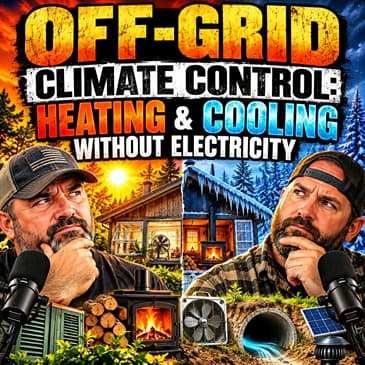
In this episode of The Survival and Basic Badass Podcast, Chuck and Kevin take on off-grid climate control—how to keep your home cooler in the summer and warmer in the winter when electricity isn’t available.
Long before central air and heat pumps, people designed homes around the climate. We look at some of those old-school solutions and how they can be combined with modern preparedness to build a home that’s much harder to disrupt.
We get into passive cooling, high ceilings and transom windows, whole-house and solar-powered fans, night flushing, awnings and shutters, insulation, thermal mass, adobe and earth-sheltered construction, summer kitchens, earth tubes, wood stoves, firewood planning, and concentrating heat where you actually need it.
We also talk about something that gets overlooked in preparedness: adaptation. Sometimes resilience isn’t about producing enough electricity to run everything exactly as you do today. It’s about designing your home, changing your habits, and reducing how much energy you need in the first place.
Because when the grid goes down during a 100-degree summer day—or in the middle of a freezing winter night—your generator isn't the only thing standing between you and trouble.
Build a Life That’s Hard to Disrupt.
🎙️ Listen to the Podcast: https://open.spotify.com/show/4YdMrZ4oWTPKv4YrcZgExg
📲 Follow Us:
🔹 https://survivalandbasicbadasspodcast.com/
🔹 Facebook: https://www.facebook.com/share/g/15wU8rw6hS/Don't let uncertainty overwhelm you. We deliver practical tips to help you and your family navigate what is coming. Join the email list and check out the shop @ survivalandbasicbadasspodcast.comThe Survival and Basic Badass Podcast is available on Apple, Spotify, Podurama, and wherever you find great content.As always, this show is for entertainment. We are not to be considered doctors, financial advisors, or lawyers, and it's not legal, financial, or health advice.
Preparedness | Self-Reliance | Homesteading | Off-Grid Living | Grid-Down Survival
Learn more about your ad choices. Visit megaphone.fm/adchoices
[00:00:00] Academy Sports and Outdoors. Fun can't lose. Shop now. All right, welcome back to the Survival and Basic Badass Podcast, Kevin and Chuck. Now, today we're going to talk about climate control for your house, but we're going to go deep.
[00:00:27] It's not going to just be, hey, get a wood stove, open the window, you're good. But we're going to try and go a little deeper than that. But it's funny because we were just talking before we started recording and basically everything we want to say is like, yeah, I basically have to give Kevin an hour-long pep talk on things you're not allowed to say. Can't say nothing anymore.
[00:00:53] Nothing. And Kevin's like, why? What are we worried about? Getting banned from the White House? Well, you know, I want to be invited in the White House because people are throwing temper tantrums because they reported news. I'm banned from China. I want to be like Sean Hannity or Kid Rock where I can go play piano in the White House or go eat. Go eat. Willie Nelson smoked a joint on top of the White House, at least according to him.
[00:01:22] There you go. And what if those opportunities get closed out for me because of your behavior? Would you feel any shame, Kevin? Any shame? No. Okay. I had to think about it, but no. No. I wouldn't hurt my feelings. Okay. So anyway, so now we're going to move in. Just because the government's treating the bill rights like a 12-year-old girl. It's fucking gross, bro. Every politician.
[00:01:48] It is. It's politicians are dirty. It's just, ugh. It's ugly, Kevin. It's a swamp. A swamp. If only somebody would be like, hey, I'm going to go clean up the swamp. Somebody did do that and then became a swamp monster. There are always swamp monsters out there. That's the thing. I keep noticing that we have
[00:02:12] our own opinions on stuff. And it's like, I don't know. Anything we say, one, people don't get the New York sarcasm that we both bring to the table. I find it's also a Navy veteran sarcasm. Like military in general, but the Navy has its own unique brand of ugliness that we bring to the table.
[00:02:40] So with that, just be a little gentle is what I say, Kevin. Because it's funny because people who agree with us, like exactly my point, they'll be like, I hate you. Why are you against me? And I'm like, wait, I think you missed what I was saying. You missed. Yeah. Yeah. It was a joke, but it turns out me and Kevin have different opinions and, and it's okay for people to have
[00:03:06] different opinions and still talk to each other. It's okay. It's okay. Like it's, it's the world we could live in. So I'm just saying, you know, buckle up. It's going to be tough. You know, I had to make the like little three minute disclaimer, not, not a disclaimer for, oh, we should get sued. It's we want to protect your feelings. And if you know that Kevin is coming from
[00:03:30] a good place, then your feelings would be okay. A little bit. Yeah. You're a unique snowflake and I care about you. And you, I love you. Exactly. That's the world we need. Kevin, just keep a lot of that like happiness and rainbows. That's what a lot of the guys. And it's funny. Cause every time I'm like, that's it. Kevin's gone too far. We can't. And the thing is you guys don't
[00:03:55] even know because I have to edit out half of what you don't even know what's on the table. Then I get, you know, I only listened to the show because of Kevin's rants and I'm like, damn it. You know, like I can't, I can only do so much. So anyway, let's talk about how to make a house that can survive temperature things at, you know, temperature swings and things like that, live in an environment.
[00:04:23] And right. Because you know what? Yeah. I got my electric bill the other day and every time I get, I get it and I look at it, I, you know, have like a small heart attack and heart palpitations and stuff. It's, it's, it's through the roof and it's only going up, you know, and it's, it's the heating and the cooling are two of the biggest 40 to 50% of your electric bill is heating and cooling.
[00:04:48] Yeah. That's a lot. It's a lot. 40 and 50% is about $300. And it turns out my bill. Exactly. So if you, if you look like over time now, again, I don't know. Cause right. I didn't grow up necessarily living in the South. I lived in, in Florida as a kid for a little bit and I lived in Atlanta and a little bit, but it was the majority of my childhood was New York and people didn't
[00:05:17] have central air, right. Or even forced air heating and nice things like that. You didn't, and that wasn't normal, right? You might have an air conditioner for a room. Yeah. Right. The window unit, but that's yeah. Now maybe you'll tell me like air conditioners everywhere in the South. I don't know. I doubt it. Cause I know the income level of, you know, people around me, but I do know everybody around
[00:05:42] me has central cooling now, like here, not in New York. When I left New York, that was not the norm. No, I still don't have it in my house. You live in the great state of North Carolina. You can look at like a $60,000 house and they're like central air. And I'm like, yeah, you don't want to be there. You'll die. But that's, that's the thing, right? Is we need to kind of go back to how we used to live a little bit.
[00:06:11] If we're terrified of these electric bills and they're kicking our ass. Now, if you got money and you're a baller and you're making it like that, then don't worry about it. Like, cool. You know, central air paid the electric bill, man. And it's all good. I have no doubt. Yeah. Yeah. Cause cause I hate money. I try and get rid of it as fast as I can. Kevin money is dirty and it just represents a corrupt system. So let's just get rid of it.
[00:06:39] Let's just give it away. You know, and speaking of, if you want to support us on Patreon.com, send us money. That would be a great place. If you're trying to get rid of your evil money as fast as you can, I've got suggestions. Maybe, maybe go to a survival and basic bad-ass podcast.com and just buy some of the cool t-shirts, some of the cool sweatshirts like Kevin's got, or maybe a fancy mug to make your morning a little
[00:07:07] better. Right. A little something like that. That's there you go. They need the prepping bad-ass mug. You know, they don't give them a fucking inch. That's where you need to be. Right. I'm not afraid of profanity. It's just faith YouTube and everybody gets butthurt about everything else. So anyway, now that we got the, this, the show, whatever notes, whatever out of the
[00:07:35] housekeeping, we're seven minutes into this thing and we can finally get to the topic. I know that upsets people sometimes, but you know, Hey, it's all about our feelings. That's really what you guys need to respect is feelings. Cause that's where me and Kevin, you know, we bring it in. So anyway, basically over time, right. People have gotten more and more for convenience because believe it or not,
[00:08:01] electricity used to be kind of cheap. Like it really was for the value of what you got. It wasn't bad. And you were like, Oh, let's just, you know, keep, you know, cooling and heating our houses that way. But I think first let's go back to like those Victorian houses, right? You ever watch these like HGTV or whatever shows and you know, whatever, all the fancy home remodels and people get
[00:08:28] excited. Cause they have the vents over the doors, right? You have the big transom over the door and you have 12 foot ceilings or even 10 foot ceilings. Right. Why do you think they did that? Kevin? What was going on? He rises, right? Everybody, everybody has known that forever. So those transoms, you just crack those things open during the summer and the heat, the hottest part of the house would be emptying out. Right. And it used to be a standard thing. And then they started using
[00:08:57] AC and then to seal those things up. So if you go into old houses now, they still have those things there, but they're like nailed shut, you know, they're painted. Yep. Yeah. Painted clothes. Yeah. And so starting to bring that back turns out like, I mean, I know I'm never going to live in a world where it's not between 68 and 72 in my house. And that's depending on my feelings, not the electric
[00:09:22] bill, but right. I'll just say, but it turns out it could be like 78 in your house and it can be okay. Old people do it all the time and they're not even doing it. Like they do it in the winter. They're keeping it 78. So I don't even know. I don't know what's happening. And people were talking a lot of trash about, um, what's, what's his name? The New York city mayor, Mondami, I don't know. Yeah. He
[00:09:48] said some nonsense about like, everybody should, you know, raise your AC up, you know? So it's 74 degrees during the summer. Cause it's, it's, that's not even so much energy department energy. Once he even hired that people lost their minds. Like this was like some sort of a front. He just asked you to do it. So the thing is you just say, okay, I will do that. And then don't do it. Thanks. That's the
[00:10:13] way Americans have been doing things forever. You just say, yeah, I'm recycling, you know, like I, and they said you can only, you should only buy medium sodas. Right. I was like, Oh, okay. And then they were like, Nope, it's the law. You can only buy medium sodas in New York city. And I was like, but a medium soda is like a, in a medium soda is like 64 ounces. It's like a,
[00:10:36] you know, I'm really thirsty. Kevin, I've developed a taste for high fructose corn syrup. Yeah. To be, to be honest, I'm actually not that's, that's as much you like, you look at my beer belly and whatever. It's not from soda. There's none of that. It's beer. There's, I drink like a gallon of water a day. Easy. Like I literally bring like the big, you know, I think the big
[00:11:05] bottle, gotta stay hydrated, man. And that is a key to staying cool. Oh, I like it. Now, humidity is a big thing. I think the ventilation helps with that, but there's not, you know, so much you can do. So, all right, let's talk more about air conditioning. So I know we're talking like off grid and like homestead and things like that, right? That's a big thing. So even though
[00:11:31] things have electricity, they might still use electricity, but we could use a little bit, right? And then that was solar and things become an option. So one of the big things in New York, they always did was having a big house fan. And what they would do is, is you would have a fan. And that's what I know my parents all going through the eighties and nineties, you'd turn that thing on and it was noisy as hell and be like, Oh, right. In the, in the roof,
[00:12:00] right. In the ceiling, it would, it would be like in the hallway, you know, a central place in the house and it would suck the hot air and blow it outside. Now you're like, Oh, well it blows, you know, then you got to draw in air from somewhere. And, and I don't know the whole thing of where it's, you know, how it's right. What will you do it in the evening when the air starts cooling off outside and still hot inside and you're still hot and it, you got to move that air, you make that change.
[00:12:26] Right. But I know it made a big difference. So having an exhaust fan, one that could either blow into the attic or just having an exhaust fan blowing out of your attic all the time. Now my wife has like greenhouses. I just spent like 120 bucks on Amazon and bought a fan that is going to blow the air out. Yeah. It's air out of the greenhouse to keep it from getting too hot. And just so that way she can
[00:12:54] choose when, you know, once it hits a certain point, she can pull it back down and you could do that in your attic to just, when your attic gets too hot, it could blow that air out. And you could throw a little solar panel that came with mine. Mine was like 120 bucks came with a solar panel. That thing will run all day long. No problem. Now, again, there's $30 options, but it's not going to move air
[00:13:20] like $120 option. Right. So you just pick and choose. So that that's an option. Another option would be ceiling fans. Turns out you don't need full on AC. Well, we don't like full on AC. I'm not going to live in a fantasy world where I tell you, Hey, having your AC set to 68 versus running a ceiling fan and it be an 80 in the room. It's not going to feel exactly the same. That's right.
[00:13:48] You're, you're not going to be like, uh, yeah, I can't even tell, but it turns out you can get used to it and it's okay. Um, you really do adapt to your environment. It turns out like you'll look at me and Kevin right now. If you you're watching this on YouTube, we're both wearing sweatshirts and we're inside our house. Do you know that's an option for people like you can dress for the
[00:14:14] weather. Right. I understand some girls are like, Oh, it's cute. I'm wearing a sweatshirt and it's summer and I'm wearing shorts and it's fun. And you're like, but you're inside, right? You just not put the air conditioner down so much. Now I understand you have multiple people in a house and we have to accommodate for everybody. So maybe Kevin's delicate needs to wear a sweatshirt and, um, you know, wearing a t-shirt and sweating through the pits or something, you know, whatever,
[00:14:44] right. You can do whatever, but maybe it's the other way. Maybe it's Kevin who sweats a lot. I don't know. I haven't really sniffed his armpits or anything. I don't know if he sweats. Actually, it was funny because at prepper camp, I had a, these like light Hawaiian shirts and it was dude, it was like a hundred degrees the whole frigging time. And everybody's like dying and they're dripping and whatever. And I just look all relaxed and happy. I had like eight
[00:15:10] people come up to me and be like, I hate you. Why are you not in shirt? Yeah, exactly. And I'm like, I know how to dress dude. Cause I knew if I wore like the t-shirt and whatever, I'd be all clingy in big pits. Dude, it was a hundred degrees. I mean, everybody was clingy in big pits and right now. And I'm like, cause that's appropriate. Yeah. So, all right. So let's talk about some other options, um, for, for things to keep your house cool. Whitewashing used to be,
[00:15:39] these used to be a standard thing. Right. And, and now we talk, think about white paint and white paint's just as expensive as any other paint, but whitewashing was, was water and, and lime basically. And, and it was super cheap and it's still super cheap. You can make this yourself. Um, but keeping the siding of your house from absorbing heat, especially if you live in a hot, hot climate. Um, you know, maybe if you live up North, you want to have a darker,
[00:16:08] you know, darker house to, to kind of absorb some of the heat. What's the majority that you're dealing with? Right. So when I picked the black roof in North Carolina, was that maybe a mistake? Maybe a mistake. Um, let's see. Do you remember in, in old movies, they used to have all the canvas awnings over windows. I still see them on old buildings around here. They have like a little aluminum awning. When you want to update an old
[00:16:35] house back to like HGTV or whatever, you see the old house and it's got those ugly aluminum ones that come out like three foot and they're like painted white and they have, you know, some moss and crap growing on them and they look like horrible. And you're like, rip those eyesores off. Yeah. Well, let's, let's slow down a little bit. Yeah. Because, because you can close your curtains, you can do stuff to keep the heat from coming in, but you're the, the sun's still going through the
[00:17:02] glass, creating that greenhouse effect. But with that awning, the sun's not even hitting your window. And especially not during the hottest times of the day, you know, maybe in the afternoons or early mornings, you get some sun, but it's blocking the sun during the hardest part of the day from even hitting your windows. So that's a, that's a big one that, that is basically all but abandoned at this point. Yeah, it really is. Cause you know, Kevin, it doesn't look that good.
[00:17:29] It looks terrible. It doesn't look good. To be honest, it doesn't look good. Um, another thing people have been doing. So the Southwest, um, you know, uh, the, the Pueblo, you know, people, that kind of thing, right? Adobe houses, you know, having foot thick walls, basically making your house like a solar
[00:17:53] battery where it kind of, you know, basically it absorbs the cool at night and you kind of maintains through the day. And then as it warms up in the day, you go in to go to sleep and it slowly, you know, it slowly dissipates. Right. And that's, that's another thing that's super overlooked. And it's weird because they don't pay attention to it too much in the South. And I don't really
[00:18:20] understand it, but I remember doing new constructions in, in New York and up in the Northeast. And they would be like, you have to have six inch thick walls, you know, two by six is instead of two by fours on the outside of your house. And it was to one, carry the snow load, but two, because you could fit more insulation in there. Right. And that's a big deal. They were up in the
[00:18:45] R values of insulation. And I remember at the time it was like a small house and they were like, you need $10,000 worth of insulation underneath the concrete slab. And I'm like, but that's ridiculous. And I got to say, dude, I went from living in a similar size house where I was filming
[00:19:09] a 275 gallon oil tank every month for the hard months of winter, like four months. And then to using one tank for the entire year in the house that was well insulated, you know, so you're paying upfront. Yeah. It was 20 grand more to do it that way, maybe 30 grand more, but then all of a sudden
[00:19:33] every year you're paying three to $5,000 less in your, and that's both heating and cooling, right? Cause that insulation is going to help you maintain on both ends of it. And like Kevin said, you know, just opening all the windows at night, you know, you mentioned it with the exhaust fan, but opening the windows at night and letting in the cool and then, you know, shutting it back
[00:20:00] in the, in the mornings as it starts to warm up, usually you can get away with like till like 10 in the morning or something. And then you start closing it all down. You know, it depends when the sun hits, I guess if you're here in the great state of North Carolina, it might be a little bit, you know, sooner, like you might have to get up at five just to shut that window. Cause yeah, it gets warm. Um, but you know, that's how it goes sometimes. So just keep that in mind as options that you have.
[00:20:30] Yeah. Another one with windows is, is, uh, double hung windows. There's a lot of people that you're not using it. Right. You know, you open the top of the, the top of the window. It's designed to let the heat out. Um, high ceilings shutters to block the sun out. One that I, a lot of people miss out on is it used to be normal was, uh, the summer kitchen, right? You'd be cooking,
[00:20:56] doing the, doing the cooking outdoors during the summer. And I still, you know, still, I, I, my wife will, uh, you know, I'll come home from work and she'll be like, get the grill going. Cause I'm not turning this stove on. It's 90 degrees out. I'm not heat this house up any more than necessary. Right. And that's, I mean, that's completely reasonable behavior, you know, Kevin, what about the planet? Are you heating up the planet when you're growing outside? It is, I'm, I'm creating climate change,
[00:21:25] just like your AC is. Yeah. You know, it turns out when you make, when you use a traditional air conditioner and you're putting the cold inside, you're making heat on the outside. Yeah. And they're using cold to make that electricity. So that means like a double whammy there. Oh, it's yeah. That, that's a thing. Yeah. Have you ever seen these, they have these videos where they, they fill the,
[00:21:50] uh, copper with, uh, ammonia or something. And they, uh, they put a candle on one side and it makes it cold on the other side where I think, uh, like Apple TV just redid that mosquito coast or whatever. If you watch the original movie, I didn't want to make it through the TV show. It was actually kind of brutal. Um, as far as violence and stuff, but, uh, the TV show, but the, uh,
[00:22:15] the original movie with Harrison Ford and maybe river Phoenix, it was like way back. And, uh, they, uh, people don't know who river Phoenix is, but he was kind of a rock star is, you know, but anyway, the, uh, anyway, they, uh, he made the big ice in the middle of the like Amazon or something. And he's making ice blocks and they're like, how it's magic. And even I was like,
[00:22:43] that can't be real. That's gotta be magic. You know, when I was a little kid and now I'm like, Oh, you really could do that. Like that's a thing. You just gotta be smart. Now mind you, it took some chemicals and things that they didn't just have in the, I don't know what he was supposedly used to fill it. I mean, it could have been propane would have worked actually. Uh, there's a lot of cool ways you can do things, but anyway, they were making big ice blocks in the
[00:23:08] Amazon. It's a thing you can do it. And they use heat to make gold. It's magic. Another cool thing that people don't think about is, uh, the porches with the ceiling fans, not a bad way to be hanging out on the porch. Kevin, you know what I like to choose as an option is to just sit and not move. That's a good one. That's, that's like my go-to like you crack a cold beer and you just,
[00:23:37] cause then I just got to keep the refrigerator cold. Right. And not the whole house. You have to, you have to be careful though, because like sometimes you'd be like, I'm going to sit on the porch. I'm going to bring a cold drink and then maybe I'll bring a book. And now, now you're doing stuff though. You know what I mean? Like you really have to, yeah, you don't want to overdo it. You know, one thing that's it. You know, those guys bring with you and that's it. You know who those guys who like, don't even move and they just kind of sit there on the porch with
[00:24:05] their eyes closed and lay back, kind of drool a little bit, whatever, you know, those guys, they're the ones that really care about the planet. That's right. So let's kind of flip this. Let's talk about how do we keep our house warm, Kevin? All right. Well, that's it. That's a big one. So there's, there's a lot of options here, right? Wood stove is the, is the big one, right?
[00:24:30] Without, without using electricity, but you're always going to need fuel. You know, there's always going to have to have something to create that heat. So whether it's your, your you know, forced air heater, your fuel tank that you're running off of for a furnace, your, you know, electricity, your, your wood stove, whatever it is, you're going to need, need fuel. So there's some things that are less expensive and some things that are more expensive. And if you live in the woods,
[00:24:59] lumber isn't, you know, burning firewood isn't, isn't expensive. And it's one of those things where you get warm twice, chopping the wood. If again, probably not the best solution for the planet. And I don't even know that it works anymore, but people used to sign up for all kinds of subscriptions and junk mail. So they would have
[00:25:24] stuff to burn. Right. And that's, you know, that's another way to go. But the, the thing with that, avoid, avoid those things. And I still have a full mailbox mailbox every day. It's kind of like the same thing with the, the no call list. I looked that up yesterday and I was like, I feel like I've signed up for the no call list, you know, a million times. And yet I get a
[00:25:49] million calls. So I go to, I go to the thing and I go to the website and I check it out. And it says, here's the phone number you can call to check. If you're active on the no call list, I call it. And I'm mind you, I've had my phone same number for like only like four years. Cause I finally, after I moved from New York, I switched to a North Carolina area code and that kind of thing.
[00:26:14] And, and they were like, you've been on the no call list since 2006. And I'm like, with, with this number, they were like, you're totally good. But it turns out, you know how you get the, the phone calls from like, it looks like a local area code. And then the guys in India, they were like, Oh, cause I said, how do I report this and have recourse? Right. I got nothing but time at work. They just pay me to, you know, whatever. I'm like, I'm going to report every one of these
[00:26:43] guys, you know, every phone number in my thing. And they were like, those are all spoof numbers and you, you can report them, but nothing will happen. Like it's not going to do anything. And they were like, but you should record and keep a log. And I'm like, and then they're like, Oh, you got to tell the people, Hey, I'm on the no call list. Cause they couldn't look it up their own damn self. Like, come on. Yeah. No, I finally had to set up my phone where it blocks all numbers,
[00:27:09] except for numbers that are in my, my phone, you know, that are saved. I like the way you think that's smart. So nobody can get ahold of me that unless I let, you know, unless I plan ahead for you to call me. Right. Yeah. All right. So we, we talked about wood stoves and another thing we talk about like solar battery, you know, how people have like a big stone, like hearth behind their wood stove or whatever. Now, a lot of that is obviously for fire protection, right? You want to make it. So
[00:27:39] it's going to be fireproof, but it also retains a lot of that heat having thermal mass. That's a big word that happens there. And it's the way you make it, it stores that heat and radiates it back. There's other things people do is they say, Hey, why don't you hang out in the room with the heat? And you don't know. Sometimes you can run that chimney up and have that chimney kind of exposed
[00:28:08] where it's going to radiate heat from floor to floor, things like that. You can have, they'd like this word also on HGTV. I don't know why I'm plugging that channel like left and right here, but they talk about having an open concept where, sorry, just open. And so if that fireplace or wood stove is in the middle of the room, you're able to, you know, spread that heat evenly throughout.
[00:28:36] So that's a good thing. Um, we've talked in the past about running like a radiator system where you could run hot water and actually pipe it in, in different places and let that dissipate. Um, you've seen like a radiator in a car where it's got those little fins all over it, the aluminum that helps dissipate the heat. You could rig up something like that. They used to have the, uh,
[00:28:59] the radiant, the baseboard heaters would be one copper pipe. It'd be like an inch or three quarter inch. I didn't measure it. I was a little kid. I don't remember, but you'd see it a lot where it would have like little ribbon kind of metal ribbon all along it. And that would help dissipate the heat more evenly and, you know, just spread it out through the room. So you don't have loss.
[00:29:24] So that's another thing, you know, ways that you could do it. Now, another thing you're like, well, Chuck, how do I keep it in that one room? A lot of times you have a big archway or something. You could put a blanket or curtains to close it off. Um, when I was poor, it turns out like we used to be like really innovative back in the day. Now everything is like a, uh, well, we'll throw
[00:29:49] money at the problem. Like I'll just turn the thermostat up or whatever. But I just take like one of the kids comforters off the bed and I would hang it over the windows and that would be my like hardcore curtains, you know? Right. And I would hang that all winter long or whatever. So it would stay nice and warm in there. And I wouldn't be, cause I dude, I had this house that it was in a Virginia
[00:30:13] beach and it had like two by four walls. And I don't even know if there was insulation in between there, but if there was termites ate through it or whatever happened, there wasn't much going on. You know, you'd feel the wind blow and same thing. The windows were like super thin, you know, glass that they made out of toilet paper or something. And yeah, you needed to, to really work
[00:30:38] on it. So putting up blankets over the windows. Now, obviously we can buy fancy drapes. Maybe your wife can sew some cool curtains. We can obviously buy expensive insulated windows that are, you know, double thermal pain and filled with nitrogen or whatever it is they have in them and might make cool effects. If you're shooting at it, I don't know. I don't know what options are there,
[00:31:03] but like there's options out there, right? It's all budget. Right. And I'm talking about how to do it. Maybe Kevin covers his windows in the summer with aluminum foil to reflect that cold from running the AC, keep it cold. All right. Maybe that, maybe I'm thinking of the crackhead up the street from Kevin, but it might've been Kevin. Somebody put out foil in the windows. That's all I know. That's for when you're growing pop plants inside.
[00:31:29] Oh, it's the pop plants. Okay. I didn't realize what you, okay. What you were doing. That's the goal there. That's why you got to reflect the light and the heat for the plants. The light and the heat. All right. I mean the tomato plants I grow indoors. Yeah. Tomato plants. Yeah. But actually you're in one of those free States where you can, uh, yeah, there's no rules about it here in New York. I can, I can grow. I think it was, uh,
[00:31:52] I think it was up to six plants or it's three plants for every adult in the house. So I feel like that's limiting your style though, Kevin. I mean, I feel limited by that. I can, I can have for my own personal use in New York state. I can have up to five pounds in my house, which that's a lot. That's a lot of weed. That's a lot of storage you can have going. Now,
[00:32:16] can you get that out of three plants per adult or whatever? Uh, yeah. Yeah. I mean, if you've got the, the miracle grow and, and got everything going in the miracle girl, yeah. Yeah. You really gotta, you really gotta water it every day. You really gotta be on top of it, but I don't, I don't, I don't know if you can get five pounds. I don't know if you can get a pound out of a plant, but yeah, that's close. I've only seen it in movies. I've actually heard
[00:32:44] that they're realizing that there may be some cognitive long-term effects. Cause none of us saw that coming. Right. Right. We were all shocked to hear that there may be cognitive effects to smoking marijuana all the time. Yeah. Yeah. If you've ever had a stoner friend, you can kind of see that right off. You know, pretty quick. You recognize that, Hey, like we always
[00:33:08] think, Oh, well that guy was always kinda, but maybe he wasn't, maybe he was like Einstein and now he's like, yeah, man. Now it's like Cheech and Chong, you know, one of those. All right. So another thing you could do would be shutters, shutters on the outside. Now this is more, I mean, one wood is a reasonable insulator. Um, I have wood, you know, little bit behind me and, uh,
[00:33:37] that's, that's an option, but, uh, you gotta go pretty thick for wood to insulate, but you could do decent shutters. Um, and shutters, I mean, shutters will keep the sun from, from beating on the window too. Yeah. You know, um, again, you paint them the appropriate color for what you want. Do you want it? That's right. And shutters used to be a real thing. Now it's just like plastic, shit that's stapled on the wall on that. It doesn't, they don't even work. That's not a real
[00:34:03] thing. Yeah. If they don't close over the window, then it's not going to help you like you think it will. Yeah. And you know, but I mean, shutters are, are benefiting a lot of different situations, even when it comes to like big storms and things like that, protecting your, your windows from getting smacked. You got, you got asshole kids with BB guns in the neighborhood. Maybe you want to keep those shutters closed, you know? Maybe you don't like looking at your neighbors, shutters. Keep those shutters closed. Another dude across the street is so ugly. Put on some
[00:34:33] clothes, dude. You know, Kevin, I'm glad you said it. Cause yeah, but no, that's, that's another option. So then we keep the whole room warm, but then you're like, but Chuck, but what happens when I go to bed? Well, that's where you find a good woman is what I would say. Yes. It's this got to get them big, healthy women with the cold feet. But now, so there are other options. Like,
[00:35:01] have you guys heard of, remember back in the day, they used to have like a canopy bed, right? Where they, and I'm not talking about, you know, the four post, I am talking about the four posts, but I'm saying four posts with, with the top and a top and you bang, you're closed in right now. Now that may look a little weird, but if you're sleeping in Michigan and you're trying to live off grid, now it's sounding pretty freaking smart, right? You don't think about that. Now there was
[00:35:29] another trick they used to do, and this is pretty cool now that you can get like the soda bottles and stuff, but heat up water on the wood stove that they're using in the family room that they're hanging out. Right. Then they would take that water and they would put it in bottles and they would go set it in the bed and warm up the bed before they get in. And the thing is really just has to be warm
[00:35:54] until you fall asleep and then it's okay. And then you wake up with the cold and it gets you ready to go and start today. It's moving. Now they used to do a, um, I forget what they're called, but it was, was basically a, uh, a metal pot with a lid on it and you'd put the coals in there and you would slide it under the blanket and warm everything up before you got it. But also people used to burn, burn to death a lot. So I mean, there's that thing, things like that in mind, right?
[00:36:24] Think Todd Chauvin with that pot kind of thing, like, like that kind of style. Um, yeah, there are options. So, you know, there, there are things you can do and, you know, a lot of these ideas, I mean, they sound obvious, but I feel like people have really let these ideas go. They're not, you know, people are like, Oh, well they survived just fine without electricity in the
[00:36:49] 1800s, but we don't have the same knowledge that we did in the 1800s. And these are the kinds of things that actually make a big difference. Yeah. Right. And these are all things that have just been forgot. Like Chuck and I aren't like coming up with brand new ideas. These are things that everybody used to do. Yeah. Well, even in the eighties, poor people used to do this. I was that guy, right? I was that guy, you know, I did a lot of these things and that's something, you know,
[00:37:18] but the big thing is like, take advantage, right? When it cools down at night, bring the cool in, you know, in the summertime when it's hot in the day, try and trap the heat in, in the winter, when that's what you're looking for, you know? And, but the ways to do it preemptively, right? To prepare is to have great insulation. Uh, think of like earth houses too, like things that are buried, you know, that regulate from the earth. You guys know, I get excited about, uh, earth tubes,
[00:37:48] right. And, and taking the earth, you know, the temperature from the earth and bringing it in with a fan, that kind of thing. We're going to do maybe an episode on that. That's why I didn't really touch on it much, you know, for this episode, but you know, these are the cool things that you could be doing. So there's a lot of ideas out there. Um, like I said, porches, pergolas, any kind of shade you can bring yourself is really cool. And then it's really just about confined small spaces and closing things
[00:38:17] in, in the winter, trying to keep, you know, warm by, you know, staying together, hang out. Turns out everybody doesn't have to be in their own room doing their little, you know, thing. You could all like hang out together. Like you like each other or something. I've heard of people doing it like that's how they do it in movies. Well, the Brady bunch or like, you know, way back, right? Way back when we'll say old movies, you know? Um, so that's something to think about, but anyway,
[00:38:47] I appreciate it. Appreciate you guys sticking around. Kevin, any last thoughts? That's all I got for today. All right. That's what we got. So with that, I'd say stay safe and we will talk to you guys next week.