An electromagnetic pulse is one of those threats that sounds like science fiction—until you start looking at how dependent modern life has become on electricity.
An EMP has the potential to disrupt or damage electronics and critical infrastructure over a large area. Severe space weather, including a powerful coronal mass ejection, presents a different but related threat to the electrical grid.
But here's the important part:
You don't need to know exactly what caused the power to disappear to prepare for what happens next.
Whether the cause is an EMP, solar storm, cyberattack or massive grid failure, the real preparedness problem begins when electricity doesn't come back.
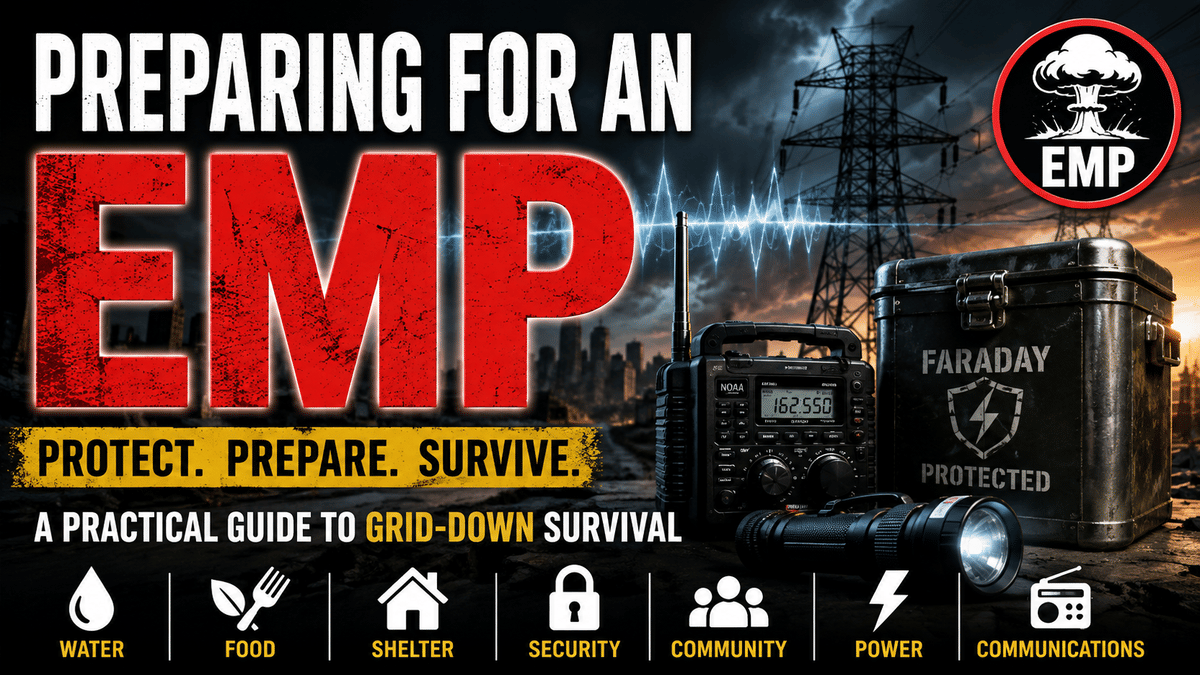
This guide covers the basic strategy from my Prepping for an EMP presentation: understanding the threat, preparing for a long-term grid-down situation, protecting critical electronics and—most importantly—building systems that allow your family to keep functioning when normal infrastructure doesn't.
What Is an EMP?
EMP stands for electromagnetic pulse.
A nuclear EMP consists of three distinct components commonly referred to as E1, E2 and E3. Each behaves differently.
The E1 component is extremely fast and is associated with gamma rays interacting with the atmosphere. E2 follows it, while E3 is a much slower component associated with disturbances in Earth's magnetic field. Long conductors—including portions of the electrical grid—are particularly important when considering the slower effects.
For the average person preparing at home, however, understanding every detail of the physics isn't nearly as important as understanding the potential consequences.
Our electrical grid connects almost every other system we depend upon.
EMP vs. Solar Storm: What's the Difference?
EMP preparedness often gets mixed together with preparation for severe solar storms.
They aren't the same thing.
A nuclear EMP originates from a nuclear detonation, while a coronal mass ejection (CME) is a massive release of plasma and magnetic field from the Sun.
One of the best-known examples of extreme space weather is the Carrington Event of 1859, which is included in the presentation as an example of the historical solar threat.
From a preparedness perspective, however, there is significant overlap.
Both lead us back to the same question:
What happens if the electrical grid goes down for an extended period?
That's the scenario worth preparing for.
What Happens After an EMP?
This is where EMP preparedness becomes much more interesting.
Forget your television.
Forget your cellphone.
Forget your refrigerator.
Those are inconveniences compared with what happens when the infrastructure supporting millions of people begins failing.
My presentation identifies several systems that could become unavailable during a major prolonged electrical outage:
Emergency services
Cellular and other communications
Gas pumps
Grocery and pharmacy deliveries
Hospitals
GPS and traffic systems
Municipal water and sewer
Natural gas infrastructure
And these failures don't occur independently.
They cascade.
Electricity powers pumps.
Pumps move water and fuel.
Fuel moves trucks.
Trucks deliver food, medicine and supplies.
Communications coordinate emergency services.
Transportation moves workers.
Electronic payment systems allow people to buy things.
Take electricity out of that equation long enough and seemingly unrelated systems begin failing together.
That's why preparing for an EMP isn't really about protecting electronics.
It's about preparing to live without infrastructure.
The Four Priorities of EMP Preparedness
My EMP preparedness plan starts with four basic priorities:
Security. Food. Water. Shelter.
They're not glamorous.
They don't require some magical EMP-proof gadget.
They're simply the things humans need to continue functioning.
Once those fundamentals are addressed, we can start adding additional layers of preparedness.
1. Have a Family EMP Plan
The first step doesn't cost anything.
Make a plan.
Think about where everyone in your household normally spends their day.
What happens if you're at work?
What happens if your spouse is somewhere else?
What if your children or other family members are miles away?
If cellular communications aren't available, how will everyone know what to do?
Establish meeting locations and alternate routes home. Keep paper maps available. Decide beforehand who might need help and who is responsible for helping them.
A plan created during normal times eliminates decisions that would otherwise have to be made during an emergency.
2. Prepare to Get Home
One of the most overlooked preparedness problems is incredibly simple:
What happens if the emergency starts while you're away from home?
Your supplies don't do you much good when they're sitting in your house and you're 30 miles away.
That's why a get-home bag is part of my EMP preparation.
My presentation includes items such as water filtration/storage, flashlights, a small cooking kit, fire-starting equipment, warm clothing or a blanket, navigation equipment, paracord and basic sanitation supplies.
The important thing isn't copying someone else's bag.
Build yours around the distance and conditions between where you normally are and where you need to get.
3. Secure a Reliable Water Source
Water should be one of your highest priorities.
A case of bottled water is useful.
It isn't a long-term water plan.
If the electrical grid remains down, municipal water systems and private wells may eventually become unavailable because both commonly depend on electrically powered pumps.
That means your plan needs two layers:
Stored water gets you through the beginning. A renewable water source keeps you alive afterward.
Depending on where you live, that could mean rainwater collection, filtration, a hand pump, stored water, surface water or a protected backup well pump.
Ask yourself a simple question:
If the power disappeared today, where would my family get drinking water 30 days from now?
If you don't have an answer, that's one of the first preparedness problems I'd solve.
4. Build a Long-Term Food Plan
The same philosophy applies to food.
Food storage is important because it buys time.
But there's a difference between having six months of food and having a system capable of producing food indefinitely.
Start by building a reserve of foods your household already eats. Then begin developing the ability to supplement and eventually replace those supplies.
Gardening, livestock, hunting, fishing, canning, dehydrating and smoking food can all become parts of a resilient food system.
This is one of the places where EMP preparedness and Build a Life That's Hard to Disrupt become the same strategy.
The goal isn't having the biggest pile of survival food.
The goal is needing the supply chain less every year.
5. Think About Security Before You Need It
A prolonged infrastructure failure creates another problem.
People.
Most people around you probably aren't storing months of food and water. They expect grocery stores to have food, gas stations to have fuel and faucets to produce water.
If those expectations suddenly disappear, desperation can follow.
Security therefore needs to be considered before an emergency.
But good security is about much more than weapons.
Physical barriers, doors, locks, lighting, knowing your neighbors, controlling access, maintaining situational awareness and avoiding unnecessary attention can all contribute to a layered security plan.
The objective should always be avoiding trouble whenever possible.
6. Build a Community
One item from my original EMP presentation deserves far more attention than it usually receives:
Build a community.
You cannot realistically do everything yourself.
Eventually you're going to need someone who knows something you don't.
Maybe that's medical care.
Maybe it's mechanical repair.
Maybe it's farming, electrical work, security, communications, construction or simply another set of hands.
Preparedness isn't necessarily about isolating yourself from society.
In many ways, it's about rebuilding the kind of local relationships that people depended upon before modern infrastructure made those relationships seem unnecessary.
7. Create an Alternative Source of Power
Having backup electricity after a grid-down event could provide an enormous advantage.
But don't start by asking:
"How can I power my entire house?"
Start with:
"What absolutely needs electricity?"
The list may be surprisingly short.
Water pumping might be critical.
Communications might be critical.
Refrigeration could be useful.
Lighting is helpful.
Charging batteries and operating certain tools may be important.
Instead of attempting to recreate normal grid-powered life, build a system capable of maintaining your critical loads.
Solar panels, batteries, generators and other systems can become layers of that strategy.
And whenever possible, create a non-electric backup for anything your survival absolutely depends upon.
8. Protect Critical Electronics From an EMP
Now we finally get to the part everyone associates with EMP preparedness:
The Faraday cage.
A Faraday enclosure is intended to shield the equipment inside from electromagnetic energy.
But here's where I think many preppers get the priorities backward.
You don't necessarily need to protect every electronic gadget you own.
Protect the electronics that give you an important capability.
In my presentation, examples of equipment considered for protected storage include:
NOAA radio
Communications radios
Solar charge controller
Solar battery chargers
Backup solar well pump
Flashlights
Thermal optics/night-vision equipment
Tablet
Lighting
Replacement circuit boards
Think about that list differently.
The radio gives you information.
Communications equipment gives you communication.
The well pump gives you water.
Charge controllers and chargers give you energy.
Replacement electronics can restore a critical system.
That's the real purpose.
Don't just protect electronics. Protect capabilities.
What Should You Put in a Faraday Cage?
There's no universal list because everyone's situation is different.
Instead, walk around your property and ask:
"What electronic component could stop an important system from working?"
That's where things get interesting.
Maybe you have a solar-powered well but the entire system depends on one electronic controller.
Having a spare pump but no spare controller doesn't provide much redundancy.
Maybe you depend on solar power. A replacement charge controller or inverter component might be far more valuable after an EMP than an old laptop.
Maybe communications are important. Protecting spare radios and charging equipment could maintain that capability.
The objective isn't to preserve modern conveniences.
It's to preserve your ability to solve problems.
A Faraday Cage Doesn't Make You EMP Prepared
This may be the most important point in this entire article.
You can have the world's greatest Faraday cage and still be completely unprepared for an EMP.
Because eventually you have to open it.
Then what?
A protected radio doesn't provide water.
A protected flashlight doesn't feed your family.
A protected solar controller doesn't provide security.
Electronics are tools.
The actual EMP preparedness plan from the presentation is much broader: have a plan, secure your family and property, establish a safe water source, develop short- and long-term food plans, build community, prepare a get-home bag, establish alternative power and protect essential electronics.
That's EMP preparedness.
Stop Preparing for One Disaster
There's a bigger lesson here.
If you build a reliable backup water system because you're worried about an EMP, it also works during a hurricane.
If you install alternative power because you're worried about the electrical grid, it also works during an ordinary blackout.
If you grow food because you're worried about supply-chain failure, you're also less affected by shortages and rising food prices.
If you develop relationships with neighbors because you're concerned about a major disaster, those relationships are valuable during smaller emergencies too.
If you have a get-home bag because you're worried about an EMP, it's still sitting there when a winter storm, hurricane, vehicle breakdown or evacuation leaves you stranded.
Good preparedness shouldn't depend upon correctly predicting the next disaster.
It should make you more resilient regardless of what happens.
Prepare for the Effect, Not the Event
Nobody knows exactly what the next major disruption will look like.
An EMP is possible.
A major solar storm is possible.
A cyberattack against infrastructure is possible.
So are hurricanes, ice storms, economic disruptions and ordinary equipment failures.
Trying to predict exactly what will happen can become an endless exercise.
There's a better approach.
Look at the systems your life depends upon:
Water. Food. Electricity. Shelter. Security. Transportation. Communications. Community.
Then start asking:
What happens if this system disappears?
What's my backup?
And what's my backup to the backup?
Solve those problems one at a time and something interesting happens.
You're no longer simply prepping for an EMP.
You're beginning to...
Build a Life That's Hard to Disrupt.
For more info on E.M.Ps Check our other videos