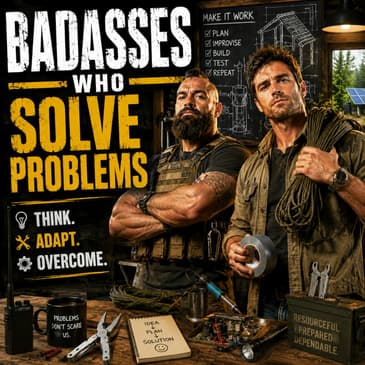
Some people panic when everything falls apart.
Others get to work.
What makes them different?
In this episode of The Survival and Basic Badass Podcast, we’re talking about the men and women who refuse to accept “it can’t be done.” The innovators, survivors, engineers, explorers, soldiers, and everyday people who looked at impossible situations and found solutions that changed history.
Being a badass isn’t about being the strongest person in the room.
It’s about keeping your head when everyone else loses theirs.
It’s about adapting when the plan falls apart.
It’s about refusing to quit.
From survival disasters and engineering miracles to legendary expeditions and real-world emergencies, we explore what these extraordinary problem-solvers all have in common—and, more importantly, what we can learn from them.
Whether you’re preparing for a disaster, building a resilient homestead, leading a family, running a business, or simply trying to become more capable, the mindset behind these stories applies to everyday life.
• What separates problem-solvers from everyone else
• Why mindset beats equipment
• The power of staying calm under extreme pressure
• Creative thinking when resources are limited
• Leadership during crisis
• Why adaptability is one of the greatest survival skills
• Lessons from history’s greatest “fixers”
• How ordinary people accomplish extraordinary things
Preparedness isn’t about having every answer.
It’s about becoming the kind of person who can find one.
If you enjoy survival, preparedness, self-reliance, off-grid living, engineering, bushcraft, leadership, resilience, and stories of incredible human ingenuity, subscribe for new episodes every week.
Listen to the Podcast:
https://open.spotify.com/show/4YdMrZ4oWTPKv4YrcZgExg
Visit Us:
https://survivalandbasicbadasspodcast.com/
Follow us on Facebook:
https://www.facebook.com/share/g/15wU8rw6hS/
At The Survival and Basic Badass Podcast, we believe preparedness is about building skills, confidence, and a life that’s hard to disrupt. Every week we explore survival, self-reliance, current events, homesteading, and the mindset needed to overcome whatever life throws your way.
The podcast is available on Apple Podcasts, Spotify, Podurama, and most major podcast platforms.
Disclaimer: This podcast is intended for entertainment and educational discussion. Nothing presented should be considered legal, financial, medical, or professional advice.
#BadassesWhoSolveProblems #ProblemSolving #Survival #Preparedness #Leadership #CriticalThinking #Resilience #SelfReliance #Homesteading #Bushcraft #Engineering #Innovation #EmergencyPreparedness #OffGrid #Podcast
Learn more about your ad choices. Visit megaphone.fm/adchoices
[00:00:13] You know, we're a survival and prepping channel and, you know, it's the Survival and Basic Badass Podcast. And every once in a while, we like to do a badass episode of, you know, people who really set the standard. And usually we deep dive into one and then sometimes there are stories where we don't even have enough details to, you know, go deep into them.
[00:00:38] So like to go too crazy, but I thought we'd put like a compilation of some great badasses together. People who really define shit, but also people who like kind of MacGyvered their way. Some of you aren't old enough, but basically, you know, empty their pocket and are like, hmm, I could build a tank with this. Kind of like the A-Team, Kevin. Right. The A-Team. B-A-Barack. A-Team.
[00:01:05] The A-Team episode, you know, where you kind of make anything out of anything. And that's the trick, man. So maybe it's not MacGyvering. Maybe it's like B-A-Barack-a-sing. I guess it was just too hard to say that people couldn't. That's why I didn't catch on. But all right. So who do you got? Who's number one, Kevin? Well, I've got this guy, Tengiz Shravgalit. All right.
[00:01:35] I'm going to ask him to put you on his spot. Oh, it's Ukrainian. That's it. I was going to say, what's his nationality? Yeah. So he was a Ukrainian. He was a Soviet. And he was a railway engineer when the Germans invaded. And he was captured, escaped from the prison camp, and became a guerrilla fighter in Belarus.
[00:02:01] So he used his railway knowledge, being an engineer. And basically, they didn't have enough explosives, the guerrilla fighters, to really blow up trains. That was the main thing. They wanted to stop the German supply lines. Right. So he came up with, basically, it's like a false rail. Okay.
[00:02:27] So if you blow up the engine on a tank, excuse me, on a train, it locks up the air brakes. And so you can stop the train, but you're not really destroying it. So he came up with this design that you could bolt onto the railroad tracks that would just drive the train off the tracks and destroy the whole thing. Right. So it came up.
[00:02:54] It was called the Shavgalid's Wedge. Right. And he designed that. And you could basically just make that in a forge, you know, in a random farm somewhere. So he started manufacturing a bunch of these. Then he started building explosives. Built hand grenades from, like, plumbing supplies and stuff. Like, kind of like the first pipe bombs. And he made homemade mortar launchers.
[00:03:22] Basically used old shells, empty shells, and primers from bullets to launch these bombs up and over in the enemy encampments and stuff. Okay. So he really was, like, you know, he was an engineer, and that's what he went to, you know. He used that for, you know, he's probably one of the most famous partisans in Soviet history.
[00:03:51] I mean, that's the thing. I mean, using ingenuity to totally, you know. I mean, these are the things that change the outcomes of war, you know. So they really, he also, he made like a, he kind of adapted a grenade launcher. I mean, this guy had a lot of, you know, a lot of creativity going on. You know, now in hindsight, we can look back and see things people have done in the past.
[00:04:19] But, and, you know, and then we're inspired to do new things. I had to say, I mean, there's a lot to listening to, like, creative. I find if I even listen to, like, creative music, you know, like more technical bands and stuff, I get, like, inspired. My mind gets, like, racing. You know, maybe it's why some people listen to classical music. I don't know. It just annoys me. But whatever. But you get the idea. Like, it just, something creative inspires you.
[00:04:48] And we see all these things and it's nice to kind of stretch the brain a little bit. That's one of the big things, like, we try and do with the podcast is if you're exposed to all these different ideas, it kind of opens the door to possibility, right? Right. And that's what makes it great. Yeah. No, I would say you definitely fit the whole badass criteria, right? Mm-hmm. All right. You know who were badasses?
[00:05:17] They even made a movie with Tom Hanks, Kevin. You know you made it when Tom Hanks is representing you. Yeah. I mean, you know, it's kind of like Castaway. You're like, oh, that's pretty good. I feel like if they made a movie of my life, it'd be Danny DeVito. Yeah, you know, same thing. Yeah, yeah. Maybe Guy Ritchie will make something for you. He'll rip something together for you. All right. Apollo 13.
[00:05:46] That's what I'm talking about. Now, these guys, like, they broke it down at the end, kind of, and they were like, look, these guys should have died eight different ways. It wasn't even, like, one thing. They had to, you know, the big thing that comes to mind is, like, there was a CO2 canister, and that kind of escalated everything into bad problems. Mm-hmm. But they solved a lot of problems.
[00:06:13] So, Jim Lovell, commander, astronaut, badass. And again, I have to give you a little framework, I think. We're talking April 11th, 1970. Right. Kevin, 1970. Have you seen these cars? They don't have Bluetooth. No. You know, you're lucky if you get power steering. Mm-hmm. You know, it was a different time. Although, I got to say, my 71 F100 is kind of the go-to.
[00:06:43] Still running in it. I do have Bluetooth in it. So, you know, that's... Yeah, but that's... You got to upgrade a couple of things. I just rigged up something under the seat, you know? Mm-hmm. You got to, you know, open it up. Yeah. Yeah, exactly. I started out, like, duct-taping it to the floor under the seat. Apparently, the exhaust gets too hot and cooks the Bluetooth. Not the way to go. So now it's actually stuck to the bottom of the seat. All right.
[00:07:11] So that's the secret of the pros right there. But you guys might know it as that, Houston, we have a problem. And that's when, like, shit all just falls apart, you know? They actually, they called back, and the exact quote is, Houston, we had a problem. Mm-hmm. All right. You know, it's all right. They're 200,000 miles from Earth. Yeah, that's a long ways. That's a long ways.
[00:07:41] Mission control is, like, can you stir the oxygen tanks? And they're like, yeah, we'll give that a shot. And they try it, and then it explodes. Mm-hmm. And they're like, oh, that's not good. So one oxygen tank exploded, and it blew off the entire, like, side panel. So it was, like, inside a cover, blew the cover off, destroyed oxygen tank number two,
[00:08:08] and then because of the explosion, it damaged the other oxygen tank, number one. All right? Right. Right. And it knocked out two of the three fuel cells. So now we don't have oxygen, and, well, I mean, we have half the oxygen, and we have a third of the fuel. So all of a sudden, you're starting out with, like, that's one of those, like, oh, shit. You know? You kind of know.
[00:08:34] And a lot of people, like, immediately get defeated and are like, we're going to die, you know? And they don't, instead of just moving forward, you know? Mm-hmm. And that's one of the big things. People don't just, like, persevere and push. So that's one of the, you know, defining badass, you know? It's like, oh, we got a problem. Let's do this, you know?
[00:08:56] I do wonder how much of the calmness is because they know America is listening or watching, you know? Right. Like, we got to act cool. We're astronauts. You can't let them hear us cry. Right. We can't cry on TV. So basically, the command module depends on, right, oxygen, electricity, and water.
[00:09:20] The fuel cells combine hydrogen and oxygen to produce electricity and water, right? That's how those two things are made. And so no oxygen, no electricity, well, limited oxygen, limited electricity, which means no communications, no heat. Heat is a big thing when you're out in space. Yeah, it's not real warm out there. Right. No life support.
[00:09:50] The moon landing, they said, scrap that. This would actually have been the third time they were going to land on the moon. Okay. Turns out we could do it, like, on the regular back in the day. We can't do it now, but yeah. Now it's, like, way too far. In the 70s. 70s, we were like, yeah. We worked out power- People were more expendable then, you know what I mean? Well, that's definitely true. True. And they were like, this year we're going to get power steering and landing on the moon. We'll nail those two down. Uh-huh. And then, you know.
[00:10:18] So anyway, I know power steering came a couple years earlier, but you know what I mean. You get the idea, right? So the problem is they basically needed to escape the vessel they're in, so they go into the lunar module, which is a problem because it's designed for two people, 45 hours. And they have three people, and they need 90 hours. That's a little different.
[00:10:45] But mind you, where they're staying is, like, exploding and falling apart. Not, like, rapidly, immediately, but it's exploding and falling apart. Yeah. So they shut everything down. Cabin temperature drops to 38 degrees. And I don't know if you know this. And you're not, like, prepared for a winter outing, right, when you're a space shuttle guy, right? Right. But the big thing is it's hard to do things when you're cold. It's hard to think.
[00:11:15] It's hard to, you know, your teeth are chattering. Even moving your fingers. Yeah. Then when the temperature drops, everything starts condensating. So now you're wet and you're cold. The crew lost weight. Fred Hayes develops a urinary tract infection because they're drinking six ounces of water a day. That's the rationing they've resorted to. Right. Then they're, like, all right, we got to fix the oxygen problem.
[00:11:44] Turns out, like, we always think in a prepper survival sort of way, everything is, like, well, we need to figure out water, right? That's number one. Yeah. Turns out when you're in space, number one is water. It's air. And so they're, like, all right, we got to figure out the carbon dioxide problem. And they're, like, all right, well, the problem is they had canisters for the command module but not the lunar module.
[00:12:13] Like, enough to, again, because the timeline meant for two people, not three and the whole thing, right? So they need to up it. But the problem is one is square and one is round. And they're just not men at all. You know, it's like putting your fuel filter or whatever from one vehicle to another fuel filter is a bad example. But you get the idea. So basically, they would slowly suffocate.
[00:12:40] And starving for oxygen is kind of a, you know. So here's where the whole MacGyver thing comes in, right? Why it comes to mind. So they're, like, well, what do you got? And they're, like, all right, we got duct tape, plastic bags, cardboard cue cards, a flight manual, a spacesuit hoses that they connect the spacesuits. I have a pair of socks and some plastic covers. So clearly, you know, you're on to something.
[00:13:10] They're, like, oh, we got that. You didn't say you had the socks, you know. And they're, like, now I can work something out here. I'm sure that's how it went. You always see, you know, you always see the movie or whatever where the guy's, like, well, you didn't tell me you had, you know, a paper clip. That changes everything. That changes everything. The engineers are, like, all right, let's build something.
[00:13:34] And they basically rigged together everything and they were, like, all right, well, obviously duct tape, you can, you know, fix anything. So they knew they were going to be okay. Basically, lithium hydroxide canisters allowing them to scrub the carbon dioxide within minutes. As soon as they basically cut it apart, reshaped it, and jammed it back into the hole. It sounds simple.
[00:14:03] But we're talking about spacecraft that could go to the moon. And we don't even have technology that can go to the moon today. There's no idea. There's no computers in this. You know what I mean? It's a big metal can. That's the thing, too. Like, they were like, oh, we lost navigation until basically until they get into the atmosphere. You know, like, you don't have that communication stuff going on. Right.
[00:14:27] So the guy is, like, using, like, a sextant and looking out at the earth and going, yeah, I think, you know, two degrees this way. Out the window. Right. Trying to navigate to line up, you know, to hit that narrow window that, you know, I don't know if you've seen some movies. But I mean, to be an astronaut, you have to be a badass to start with. You know what I mean? Right. And that's the thing. Maybe these people are just better than us.
[00:14:54] So maybe it's not that impressive because they're the best and the brightest, Kevin. So the best of the best. Sorry. They're already starving of oxygen, starving of water. The batteries depleted, freezing temperature, incorrect trajectory. So they're going to miss the window. They're not going to reenter. Turns out you want to land in the ocean because when you crash into somebody's house, that's awkward, too. You know, it's like, hey, we're from NASA. But, you know, it's not. It's cool.
[00:15:24] I'm an astronaut. I'm sorry. I landed on your dog. Everything's okay. Right. Heat shield damage. No way to inspect. Then they, you know, basically they come barreling through. Nobody knows. Everything goes silent. They're not hearing anything. And then they break through the atmosphere. We still kind of don't see them. And then the parachute pops out and everyone's like, oh, yeah. Yeah.
[00:15:52] And it just, you know, it all kind of came together at the last minute. But it's amazing that like under pressure, you know, people pulling things together. And I mean, Kevin's, you know, first story, those things change the course of history. Right. Because also, like if they had just died and everybody was watching it, those things are like huge setbacks for the whole everything.
[00:16:18] Not just, I mean, obviously we don't want to lose people, but people are dying all the time. Like you don't even know what happened in Chicago on a weekend. Yeah, no. But we're talking about the best and the brightest for one. And that sucks, you know, but America like puts, you know, your faith into a hero. Right. And it all comes apart.
[00:16:41] So I'm just saying it's pretty amazing, you know, what you can pull off and what these guys, you know, accomplished. Kevin, you had another one about some kind of tank, a rhino tank. Yeah. So in 1944, the Allied forces landed in Normandy. Right. And they captured the beaches, but they had to break out of the beaches. Right. They had to get out into France.
[00:17:09] So they started landing tanks there. And the problem was that they had all these ancient hedgerows. Okay. France, which are like, you know, steep embankments. And when the tanks go over these embankments, their underside is exposed, which is the weakest point. So the Sherman tanks could get destroyed by the enemy just every time they go over these hedgerows. So Sergeant Curtis Collin, he comes up with this idea.
[00:17:38] He starts taking apart the beach obstacles that the Germans had placed on the Normandy beaches and cuts them, rewelds them onto the Sherman tanks to make giant teeth so that they can plow right through these hedgerows. They call them the rhino tanks. Nice.
[00:17:59] And once they put them on there, instead of going up and over them, they could just plow right through these things and basically create roads in whatever direction they were traveling in. And it basically led to the breakout of the, you know, from the Normandy beaches for the Allied forces to, you know, start infiltrating into the country. That's one of the things like I always think is like being inspired by nature and stuff.
[00:18:26] You know, you don't think like you're saying like a rhino tank, right? Obviously rhinoceros have that big horn in the front and that's, you know, what he did is he welded on to the front to make teeth that could break through these dunes and do it. It's like people tried to fly, you know, we were trying to do that for forever. And they're like, oh, birds have wings, whatever.
[00:18:48] But it was actually when people started to study the exact wing shape, you know, you had Da Vinci and these other guys that like really put effort into what's really going on here. And then they find that inspiration of stuff that already works and then able to kind of kick ass and move it into the future. You know, I just, I find it fascinating where people draw inspiration, but there is a lot going on around us.
[00:19:17] Like you can see things in the world, you know, it's not, you know, right. I'm just saying, but I don't know. All right. All right. You got on him. That's it. Rhino tank is the. Rhino tank. That was the only thing he really invented. But I mean, I think it's pretty, pretty legit. I mean, when you. That's it. It's turning the course of a war, you know, that's really where things happen. Another guy I got.
[00:19:44] Now, again, this is Ernest Shackleton. Now he had an egg headed in expedition, had a ship called the endurance. And basically they were going to go do a land. A land. Traverse of Antarctica. All right. So they were going to like cross the whole thing. It was going to be the first time he was going to set the standard. And basically you get to explore shit, right?
[00:20:13] Like they were going to find new worlds. They were going to find those ice walls. Mm hmm. And all the people who are doing good shit. Is that Antarctica? That's that's flat earth. It's Antarctica. Yeah. Yeah. Yeah. So he was going to get to the bottom. And that's fine. The other people. You know what I mean? Probably why it didn't work. Cause he couldn't get past the ice wall. Right. And in their space Nazis in Antarctica. Yeah. And that'll, yeah, that'll slow you down. Right. So, all right. So anyway, this guy basically goes out.
[00:20:44] Their ship ends up getting frozen. Like, you know, you have the whole icebreaker thing. That was always a big, you know, thing in the Navy is trying to find the right, you know, icebreaker to kind of go with you and whatever. But what they did is they kind of moved into an area. They didn't think it was going to be that bad. They thought they'd get through it and get out. Then they got stuck and then it just started freezing around them.
[00:21:11] And then as it froze, then it started kind of crushing in and actually crushing their ship. So, I mean, it wasn't immediate. You have time to like offload stuff and. Yeah. If you're in Antarctica. But you are in Antarctica and it's, you know, sub-zero all the time. And yeah, not good. Right. And this is 1914. Right. So you didn't have whatever cool things. Keep us warm back then. Exactly.
[00:21:41] GPS, satellite, telephone, you know, the good things. Maybe they had a satellite telephone, but they didn't have satellites. So it was, you know, one of those things that didn't really work out. You're like, hello, nothing. No. All right. I saw in the comments, one of our episodes a little while. Back. People are like, you know, we could do without your stories. And I'm like, well, what's a podcast? If you didn't have my dumb story. That guy can go fuck himself. Right. Exactly. So, you know, that's all that I have to say about that.
[00:22:09] But basically he's got 28 men, 69 sled dogs. Cause they were going to use those across Antarctica. 69. Nice. Accepting your reality. We always talk about, you know, people have that normalcy bias. Right. And they're like, oh, we can't do like right away. He's like, dude, we're killing and eating the dogs. Like there's no, not like a fantasy of, oh, someone will come get us.
[00:22:38] Oh, this is not going to happen. Right. You're in Antarctica and you need to like reality right away. Right. And his big thing is we're going to have to like, just make do. And so morale is going to be a thing keeping. So the way he overcame it is he's like routine, right? We're going to get up. We're going to, you know, do the same thing every day. We're going to eat.
[00:23:06] He saved like musical instruments. He saved everything for morale off the ships. And people were like, that's stupid. That's a waste. But guess what? His 28 guys, two years, they didn't need each other. That's big. That's big right there. So you want to say, oh, he's a dumb ass. He made the wrong call, but did he, you know, he didn't, they didn't need each other and they all live. Everyone, 28 guys.
[00:23:36] That's impressive. So let's dig down in, in how bad it gets. Right. So he ends up, he decides that they're going to have to stay camped on the floating ice for months until it starts to thaw in the set in the spring. Right. So there's no shelter below zero blizzards. The ice is cracking and shifting and moving pressure. It's crushing the little thing they got.
[00:24:04] Obviously there's no radio that's going to reach out there. No aircraft are coming. No aircraft are coming. No satellites, no civilization for hundreds of miles. So he's like, all right, we're going to protect morale every day. Same routine meals, regular times, specific jobs, encouraged games, humors, arguments, shut them down, you know, knock it, knock it out. Like I said, musical instruments.
[00:24:31] It's, um, they basically, you know, people were like, Oh, it's extra weight, whatever. Oh, we shouldn't kill the dogs. They're here for us. Whatever. We love them. You have the dog handler guy going, not scared, you know? And you're like, no, I don't know what you do with the peanut butter, but he's going. And so he refused to like postpone reality.
[00:24:57] And I think that's the biggest, you know, we always talk about that normalcy bias and just cutting through it and saying, no, we're going to do it. So yeah, nobody's coming to save them. So they're checking out, you know, ocean currents, wind, um, nature, basically waiting for the moment to go soon as spring hits. They're like, you know what? Fuck it. We're going to go to elephant Island. Now the first solid ground to escape, right?
[00:25:27] So they, they make, they have these, they have rafts or like lifeboats. They load them up. They end up being at sea for 500 or no, sorry. This is the total journey. 500 days till they find elephant Island. Cause they're on ice and they're whatever. Now you're thinking, Oh cool. Elephant Island, 500 miles. Not the end of the world, but there's nobody there.
[00:25:54] It's a deserted Island and nobody's coming there. It's not like a thing. So they're like, all right, don't panic. We do have this one 22 and a half foot boat, the big one. And it turns out South Georgia Island, only 800 miles away. Now you're like, wait, we've already been gone 500 days. And they're like, no, no. And I'll tell you what, they're like, we're going to go get help.
[00:26:23] You guys hang out on the Island here and be like Island people. Right. Yeah. All right. We're going to go for help. They take off. They go and navigation repairs. They said their sale kept tearing. He's got sail cloth. He keeps replacing it. The boat there patched it like over and over. Like everything's just deteriorating coming, you know, cutting down 17 days.
[00:26:51] They reached the Island, but the problem is there was no settlements on the Island. And this is a big South side of the Island. Right. Yeah. So you're like, crap, you know, what are we going to do now? So then they're like, Oh, we just have to climb over those mountains. It should only take like three days to climb over them. And they're like, all right, but let's just take a rest. You know, we got to ease up a little bit, take a breath.
[00:27:17] He's like, you know what, if I sit down, if I sleep, I ain't getting up. It's one of those, like I come in at the end of the day and my wife's like, Oh, just sit on the couch, hang out for an hour. I'm like, if I get on the couch. Yeah, that's it. That's the end. Right. That's it. I think he already had that argument with his wife and he's like, no, we're not going for that. Once I take my boots off, that's it. That's it. The day. Right. That's it. That's when the beers come out and that's the end of it.
[00:27:45] So he's like no beers for anybody till we get somewhere. So they hike over the mountains, still freezing, frozen slopes, you know, no maps, the whole thing, but he's come this far. Right. They finally find a whaling station. And again, it says the workers reported thinking they were ghosts. All these stories where people show up, they're always like, that's an evil spirit. What happens? It's like, who are these people? Right.
[00:28:16] But whatever. He's like, all right, no problem. He's like, Hey, look, I left everybody back on elephant Island, a mere 800 miles back. Could we just hop in your boat and you know, whatever, go, go get them, go get them. Turns out they actually make four attempts to go back and get them. And they don't make it. Don't make it. I don't know how he has the perseverance in a raft to make it when they got a planned crew,
[00:28:43] they still, but anyway, August 30th, 1916, two years after they left England, he returned to elephant Island. All 22 men were still alive, still waiting. They boarded up. Nobody died. Not a member of the expedition, except for the dogs, except for the dogs, 69 dogs, you know, didn't make it, but they were tasty. You know, whatever you got to do.
[00:29:10] Never, never been interested in eating a dog. No, I accidentally eaten dog once, but, uh, I can't really tell you if it was good or not. It was very seasoned. So. Okay. I was, when I was in Turkey, I want to say Turkey. They, uh, you know, I was, when I was in the Navy and, uh, you'd go to these like street fair things and they'd have that meat going on the rotisserie stick thing. And I think it was, oh, I really don't.
[00:29:41] So I'd say, I said to the guy, I was like, is that goat? And then, you know, it's one of those places with like cats everywhere, like around the food thing. And you're like, am I eating cat? So we said to the guy, we're like, is that goat? He said, yes, go, go. And then you'd be like, is that cat? He'd be like, yes, cat. And you'd be like, is that dog? Yes. Dog. And so I, I don't know what we ate. So whatever you want to eat, that's what it is. That's what it is. Yes. Yes. And I'd be like, all right.
[00:30:10] So anyway, 28 men, the expedition failed. I think that was one of the things they, they talked about in his book was you don't, you, he, some people can't let go. Like our job is to cross Antarctica. Right. And he's like, no, the day that they got stuck, he's like, my job is to get people home alive. You know, that's like being able.
[00:30:38] It's so crazy how people get caught up in this is how things are. And if I just close my eyes and hope, you know, or one of these things, if I deny reality just a little bit longer than I can, you know, and it's not because people want to hold on to that safe peace of mind, you know, and protect that.
[00:31:03] But sometimes, and I, I always get worried that that's like more and more how people are. Like, you know, I feel like society, we're a lot more sheltered. Like, you know, it's that safe space at the college or, you know, whatever. As long as you got Facebook and the, and the lights are on. Let me just look at my phone. It'll be fine. I'm not going to worry that I can't pay the rent or I can't, whatever.
[00:31:26] I'm just going to look at the phone and hope for the best because it, it usually works out, you know, and that's, I wonder if, you know, it's that older generation, my generation, whatever, that we took care of the kids a little too good. You know, like it's, it's really our fault. You know what I mean? We didn't beat our children enough. See, cause the reason we're all jackasses and can kind of go through everything is cause our parents didn't give a shit. They were like, whatever. I got a cocktail. Everything's good.
[00:31:56] You kids. I don't want to see you. I don't want to see you. Exactly. And tomorrow they'll be like, I don't want to see you until it's dark. Until you're in the bed. And I mean, the minute you walk in this house, it's bedtime. And cause you're not getting in the way of the cocktail and that's it. And then the kids are like, oh, so we kind of were like, oh, we're going to be good parents. Yeah. And then we kind of, Hey, let me save you.
[00:32:23] Let me yank you out of the way of that oncoming traffic. Let me, you know, whatever, do whatever it takes to save you. And then now our, their kids are like, oh, I don't know. I don't. I remember my, my friend got hit by a car and he's doing fantastic now. So say, say, you know, that's what happens. I had a buddy, uh, Kim, a guy who's a Mason and, uh, he's got his Harley, whatever goes up to a stoplight.
[00:32:53] And some old ladies like confused having a stroke or whatever old ladies do and just runs his ass over, breaks his back and whatever. And he's like, oh, I got to get up and do Mason work in the morning. You know, we got to keep going. You know, that's, that's how it goes. I think he did eventually hire like an 18 year old to come work with them. You go, go move that heavy stuff over there a little bit, but he's still out doing it. It's crazy. It's a crazy world.
[00:33:22] But anyway, I appreciate you guys sticking around and that's the thing though. Remember to like, kind of push on, right? Persevere push into the, you know, the unknown, right? That's how we get new things, but also like, don't stop learning, right? Don't just sit there and doom scroll or whatever. And there's nothing wrong. Like you can get good things out of TV. You can get good things out of Facebook or whatever, out of the reels or whatever.
[00:33:51] But don't get caught in the junk, you know, don't be afraid to keep stretching your brain because you never know when it's going to pay off, right? It might, you know, save you one day. So with that, stay safe. We'll talk to you guys next week.