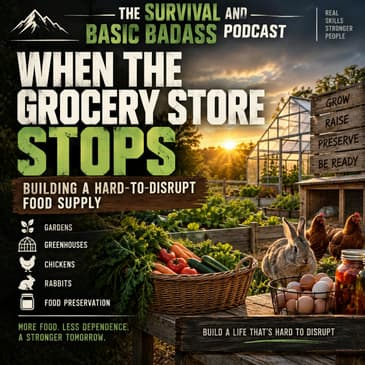
What happens when the grocery store stops being reliable?
In this episode of The Survival and Basic Badass Podcast, we continue the Build a Life That’s Hard to Disrupt series by tackling one of the most important preparedness systems of all: food.
Food storage is important, but eventually stored food runs out. Real food security means developing the ability to produce food yourself—and building multiple systems so one failure doesn’t leave you hungry.
We talk about practical ways to build a more resilient food supply, including gardening, greenhouses, chickens, rabbits, food preservation, and producing food on your own property. More importantly, we look at how these systems can work together to reduce your dependence on grocery stores and fragile supply chains.
This isn’t about predicting whether the next disruption will be an EMP, economic collapse, cyberattack, natural disaster, supply-chain failure, or something completely unexpected.
It’s about asking a better questions
If the normal food system stopped working tomorrow, how long could you keep producing food?
We’ll discuss:
• Building a garden that actually contributes to your food supply
• Using a greenhouse to extend your growing season
• Chickens for eggs, meat, and a renewable food source
• Rabbits as a practical small-scale livestock option
• Preserving what you grow and produce
• Creating redundancy instead of relying on one food source
• Turning your property into a productive part of your preparedness plan
• Building food systems that are useful during emergencies—and ordinary life
You don’t have to become completely self-sufficient. The goal is to become less dependent, more capable, and harder to disrupt.
Stop preparing for one disaster. Start building systems that keep working when life doesn’t.
🎙️ The Survival and Basic Badass Podcast
Build a Life That’s Hard to Disrupt
Learn more about your ad choices. Visit megaphone.fm/adchoices
[00:00:11] All right, welcome back to the Survival and Basic Badass Podcast, Kevin and Chuck. Today we're going to talk about how do we get food, right? If we're building a life that's hard to disrupt, a life that no matter what bad things come, the world doesn't cripple us, right? That's the whole goal is a prepper. I think that's what we're always kind of shooting for. And there's a couple of things we can do to ensure that we're going to have food
[00:00:43] when things are disrupted. The power goes out, the grocery store closes, we can't get money out of the bank, whatever it is. I mean, even COVID, right? You couldn't go out and go shopping. You know, all of a sudden there were like these weird lockdowns at some points for some people, right? Not everybody. Right, weird rules. There were rules, right? That slow you down. Go ahead. Yeah. And nobody really knew what the rules were in your specific area and, you know, until you got yelled at by somebody.
[00:01:12] Right, right. Well, that's story. I've been yelled at before. It's not that big of a deal, you know? That's the military trained you well, right? That's the thing. Yeah. So, no problem. But, so there are certain things I think we can start with. We always think of like long-term food storage and stuff like that. Now, obviously we need to make it more sustainable. And that's my point. We're going to find a way to go on, right? When things
[00:01:39] are bad. But having stuff stored that might, you might not be able to produce on your own, or might just be really hard to produce on your own. Having some stuff stored sounds like a great idea. Yeah. There's definitely a few things that I would be missing. A few modern conveniences that I'm missing. And one of them might be coffee.
[00:02:03] Exactly. That would be a big deal for me. I drink a lot every day. So, that would be a big deal for me. And when you're storing coffee for long-term storage, you want to get the whole beans. It's a lot, you know, they'll hold up a lot better, the whole beans. But Kevin, how do you grind those beans? You need a hand grinder.
[00:02:27] Yeah. The hand grinder. Right. Right. The mechanical grinder. They're not, they're not really that expensive. No. And, and coffee is kind of expensive. So it's, it's, it can be pricey to stock up on it. You know what I mean? It can be expensive to, to really get, you know, enough to, to see you through. Well, the cool thing is you can buy like Folgers and then you don't have to worry. Cause you won't even know if it goes bad.
[00:02:55] It just tastes like that. That's what it's supposed to taste like. Um, so I, I have a bunch of chicory growing in my yard right now. You're supposed to, it's supposed to wait until the fall to dig it up and get the roots. And I'm going to, I'll try it out. I'll let you know how it goes, but I have a suspicion. I'm not going to be a big fan. Uh, it's supposed to taste like coffee, but it doesn't have the caffeine or any of the good stuff that you want from your coffee, you know?
[00:03:23] Kind of, it doesn't have the coffee in it. Right. That's, that's the biggest problem is that it's not coffee. The downside with all the substitute coffees is that there's no, so, all right. So we think about, I know like you go to like black rifle and they'll, they'll sell you a five pound bags of it. Now the weird thing is though, you can't get the bougie flavors. Like they have like just black in the five pound. Um, right. Like that's what it's called. It's just black and you know, like one or
[00:03:52] two other ones that you might be able to get in the big bulk supply, but yeah, you're limited on what you can store. And then you throw that in the five gallon bucket and whatever. And we, you know, say, you know, I, I, on occasion when I'm, when I'm out in the hiking and in the woods and shit, I'll, I'll do the instant coffee. It's not obviously not as good. The trick is, yeah, you have to, you have to put the, the
[00:04:17] instant coffee in the cup and then pour boiling hot water on top of it. And then that, let it cool down. Hotter the better. All right. Well that, yeah, that right off the bat, it's gotta be hot, hot, and then let it do its thing. Cause it's a, it'll make it at least a little bit better. Yeah. Okay. So that's one of the, one of the things, right? Coffee. There are other things that like fill bellies. So big bags
[00:04:43] of rice, big bags of, or, you know, and, and so when I say bags of rice, it's weird. Cause you can buy like the 50 pound bag cheap, cheap. Right. And, but yeah, good luck with storing that and finding a good way. I don't know. I know that I buy, I end up buying like the 12 pound bags and I think that's what they are at like Sam's club or something.
[00:05:10] And they go through the 12 pound bag and then I actually rotate through it. Like we use it in my house. Right. And I don't mean like I'm storing 12 pounds of rice. I mean, I'm storing probably like six 12 pound bags of rice, but that's it. But then I'm able to psych through, cycle through in a usable portion and like that. One of the big things you don't want to store a long
[00:05:35] grain rice. Cause when it has that shell, it can kind of rot. Like it'll go bad sooner. But anyway, something to think about a flower, same thing. You want to, you know, find some flower that you can store kind of again, everything I buy, you know, the big thing with preppers, we like to put it in mylar bags and then throw it in like a five gallon bucket. Um, if it's too much to deal with the mylar bag, a five gallon bucket with a good lid is going to be better than not putting it in a five
[00:06:05] gallon bucket, like just leaking it in the paper sack. But again, you do what you got to do, right? You, you find the best way, but the big thing is to be checking it at least once a year. And like I said, making it in a usable portion where you can still rotate through it. Like we take that 12 pound bag and then go put it in a sealed plastic container, you know, big containers. I think they're for like cereal or something that the wife has that we, you know, put those in and work through it on the day
[00:06:33] to day and usable portions. Right. Um, so that's something to think about. One of the ones like, everyone's always like, Oh, I have to go to one of those fancy companies and buy the freeze dried stuff that last 25 years. I mean, that's cool if you got the budget, right? That's no problem. They don't always taste as great. I mean, just that's the general rule of freeze dried food. It's not that, you know, right. And there are certain freeze dried foods that we all eat regularly that
[00:07:01] you don't really think of like rice and pasta and things like that. But you know, you get those, those pre-made meals and sometimes they, they don't taste great. Sometimes they, you know, are all, and I mean, you know, your budget, you can pick out the best one that does taste the best and that's good things, but you maybe don't want it to be every meal you eat. Right. That's the big thing. So then we do, I do things like I'll buy, uh, I again, back to like the big bulk stores,
[00:07:30] Costco, Sam's club, whatever you can buy. Um, like, uh, the pancake mix, a lot of the, and then that'll say a shelf life anywhere I see from one to two years, but man, it's like 10 bucks. You can buy a lot. Yeah. And if you threw it out every couple of years, you could still go through some pretty good volume and pancakes fill bellies. And it's a good substitute to stuff that you can't
[00:07:58] grow on the farm. Now, this isn't just a food preservation episode. Um, we did one actually on things you could buy without buying long-term storage. If you're really into what type items I should get, you know, we dug pretty deep into it. You guys could, you know, expand on that. Uh, maybe I can get a list and, and put it in the show notes here at some point, but, uh, I'll end up,
[00:08:25] you know what I'll do is I'll work on getting an article in the, uh, on the website. So if you go to like hard to disrupt.com or survival and basic badass podcast.com, you check it out there. I'll put it in the blog, but again, give me a couple of days. It's not going to be there the day this releases probably cause it takes a little bit of effort to get things done, but we'll come up with a list of things you could do like that. Sorry. What do you got? Right. So, so what we wanted to talk about this,
[00:08:55] this episode though, is, is what you can produce on your own property, right? Your own, your own food production, uh, keep yourself from, from starving. Um, just in the day to day, what you can do at home to make, uh, make some food. So, uh, I know a lot of you guys, uh, have gardens and I think that's, that's a big deal. Let's, that's a great, great way to go about things. Um, I'm not a vegetarian,
[00:09:22] so like I will eat vegetables, but you know, you got to mix it up a little bit, but let's talk about what your, what your garden, uh, what you're growing in your garden. I think, uh, my favorites out of the garden are the, uh, um, the zucchinis and squashes. Um, a lot of people do tomatoes. Tomatoes are real easy to do. Um, green beans are real easy. Um, radishes and carrots. A lot of people don't do the root
[00:09:52] vegetables, um, for whatever reason, but you know, if you've got decent soil, if you don't have decent soil, you can make decent soil. It's not, you know, it's not like the, the end of the world there. If you've got some, you know, a rocky yard, you can build a raised, uh, bed. That's great for carrots and radishes. Yeah. Um, my, my wife loves eggplant, uh, and it grows real easy, you know,
[00:10:19] but I hate eggplant so much, you know, I never, I never eat it. You just got to put a lot of cheese on it. You need that. That's it. You got to drown out the flavor of the eggplant with another flavor. You don't even know it's there. And then it just gives you some, yeah. Have you ever tried a raw eggplant? Ooh, Kevin, let's not. It's like eating styrofoam. It's, it's terrible. You don't need to be spreading that kind of hate on the podcast. You know what I'm saying? Yeah. Um, but I mean,
[00:10:47] having a garden is, is a lot easier than a lot of people think. Yes. Um, growing garden. And like I said, you can, you can make raised beds if your soil is not great, but a lot of people make raised beds just because they see other people doing it. You can just grow it in the, in the ground. You know what I mean? You don't have to, you don't even have to build a raised bed. It's nice to have the garden and start growing stuff, you know, but it's nice to have the barrier for the weeds,
[00:11:16] a little line, a divider, if you will. But one of the big things, I think one of the mistakes that people make is you, they do a bigger garden than they want to take care of or have time and ability to take care of. Yeah. Um, actually do a lot better in a very small space that's well managed
[00:11:39] than a bigger space than you're, that you're overwhelmed with. Yeah. Um, so just keep that in mind, like as much as you effort as you can put, you should make the garden that big, but if you can keep on top of weeds and overwhelming things, you might be able to do pretty good. Yeah. I'm trying to think I've got, uh, I've got 14 different raised beds right now.
[00:12:07] And yours is well sectioned. I mean, you have organized, you can walk through it and you did like stone or gravel in between. So you're able to kind of get through without weeds. Is that right? I did. Uh, yeah, I did, um, mulch and it's time to remulch now, but I mean, it's, it's, uh, it's pretty good. But I will fully admit that at least four, maybe five of those beds are just
[00:12:32] weeds now. Cause I, I don't have the time to, to keep on top of it. You know what I mean? You have to, you have to bite size, you know? Right. Certain parts of the season you're using all at once. And so that's a thing. So I think that's, that's still appropriate, but then you're able to cut it down to the section that you're managing. And I think that's nice, you know, cause then you can focus on what you need to do. You can let some beds go like second half of the year or whatever,
[00:13:00] when, you know, it's not appropriate for whatever, you know? Right. But again, use your time, plan it out appropriately. Another thing that's really cool with gardening is greenhouses. And you can really extend your season by having a greenhouse. And this means you can start plants a little bit earlier, um, cause you can keep them warm and then you can keep things growing
[00:13:27] cause you can protect them from the frost and the stuff at, at night. Um, it better, you know, with a greenhouse, you're going to buy that time. So that's something. Yeah. We do, um, uh, we do, uh, cold frames too, in the beginning of the season. Nice. And you can just basically, you can just take a, a, uh, raised garden bed that's small enough and, you know, put windows over top of them, old windows and just put them over top of them in the
[00:13:55] beginning of the season. That way, if you have a light frost, you're not killing off all your, your early, you know, seedlings. And seeds aren't, they're, they're not expensive. You know what I mean? Like if you plant too early in your, your plants die, you can replant. It's not the end of the world. You know, it can work out. Yeah. Yeah. No, that that's absolutely like a cool thing that you can do. Um, I know my wife has, uh, like cover cloth that we put over like,
[00:14:24] Oh, it's going to frost tonight. We have to run out and she has like hoops in sections, but things that are, are more delicate. We'll run out and put this cover over all of it to protect it and buy you more time. Usually for us, that's the beginning of the season rather than the end of the season. But it, you know, we'll, we'll end up, you know, Oh, we started these things. And now all of a sudden we got the unusual cold spot from the North. And, uh, you know how that is. You guys are
[00:14:54] really sending your eight from up there down here. I, uh, got a, uh, uh, peach tree a couple of years ago for the first, you know, first, first peach tree. And first year it was great. Fantastic. The second year, the squirrels found it though. And they were all, they were all gone. They all before, before they're ripe. Yeah. I imagine it's the deer getting my peach trees. Now I have like
[00:15:19] three and well, maybe I have like one, I had three beginning of the season this year. And now I keep looking and I'm like, like one of them has like one green leaf on it. Now it's like, and I'm like, there's something there. It's still alive. It's green. And then we had like this giant drought that's been going on and getting our ass kicked. And about, I don't know, about three or four days
[00:15:45] ago, we got an inch of rain, which is huge. I mean, an inch is significant, right? It's a significant storm. And then, uh, and then that was like three days ago. And then last night we got an inch and a half of rain. So I'm like, yeah. So now I'm like back to kind of catching up a little bit. I'm like, all right. Now when I water things, the well might not go dry, you know? Yeah. Yeah. There's a lot of,
[00:16:11] a lot of places in, in drier climates. I've found that people do really good with gardening because, you know, if you can set up a decent irrigation system, you don't have to worry about the weeds. They're not, they're not growing there. You know what I mean? It's just what you plant is what's growing, you know, and basic maintenance. And you can really, uh, you can really take care of your own, your own sections and grow what you want to grow. Cause that's it where you, you know,
[00:16:38] if you're in control where the water ends up, then you can control where things are going to be growing. And it might be just your plants, you know, you can really hit that. Like they have the drip irrigation lines and like that. I had been very scared of it, but the people who do it really love it. And I really need to embrace it. And I haven't, but that's, you know, it's one of those things. Uh, we're, we're getting there, uh, because of the big drought stuff. Uh, one of the
[00:17:07] local farmers we talked to, it was burying a water tank and actually bringing in water. So he had more, you know, he had a well, but then he had the addition and, you know, buried an extra thousand gallon water tank. And I'm like, Ooh, cause we keep looking, you know, I've always talked about like rain catchment and like that. And I'm like a buried thousand gallons for that rain catchment.
[00:17:32] If we stored it up all winter and then had it to drop back, that'd be kind of cool. You know, I don't know something to think about. Um, yeah. All right. So let's get into, let's get into some, Oh, go ahead. I was going to say, let's go through quick. Some of the other things that we'd want in a garden that are going to be like high yield that are really help. I know you said eggplant, zucchini,
[00:17:56] um, tomatoes, uh, potatoes are actually something that can really fill bellies and keep it going for a long time. Um, like really fill bellies, uh, garlic just having, you can actually eat nothing but potatoes and still get all the, the things that you need physically to, to keep yourself alive. You can exist. It can exist. It's kind of like my pancakes, you know, I'd say,
[00:18:26] but yeah. Um, and potatoes are awesome. I mean, I just have to point that out. Like nobody's like, Oh, French fries, they suck or, or, Oh, potatoes, you know, all crispy hash browns in the morning where you put some in there speaking up potatoes, mashed potatoes, anything, maybe a little garlic in there. Right. You know, he's going to be like, Oh, this is crap. That person just kick them out. Cause they're picky. You don't want that guy around. You don't want that nonsense in your,
[00:18:55] in your life. Garlic, garlic has all kinds of medicinal kind of benefits, you know, with the antibiotic kind of thing going on, kills a lot of bad things in you. Uh, so garlic is something you want to really think about. Plus when you grow garlic, it keeps the deer away, you know, things like that. It's just a win all the way around. Um, what else do we like to grow? They say like a lot of leafy greens, you know, a lot of the lettuces, uh, yeah, those are, those are great because they,
[00:19:23] they grow really fast, you know, you can, you can easily do right. You can easily do two or, you know, two crops of spinach, of lettuce of any kind, you know, then you're getting your iron and your, you know, all the cool things, vitamins, letters, getting all kinds of letters, vitamin all just, you pick a letter, you could be getting it from, from spinach. Popeye knows, bro. He was
[00:19:51] ahead of his time. All right. Probably keep your teeth from falling out too. You know, I don't know. Um, all right. Moving, moving right along. So Kevin, you were saying, uh, what do you want to go? So livestock. Yeah. Let's, uh, let's talk about some livestock and, and, uh, you know, a lot of people, um, get a little sketchy when it comes to these things, you know, a lot of people are,
[00:20:14] uh, on vacation. It's too far. Yeah. Yeah. I don't want to, I don't want to have a dog cause I can't ever go anywhere. Yep. Yep. And my, my wife, I remember when she, we first started, uh, getting, um, uh, getting poultry, um, she was really excited about it. And I was like, this is fantastic. Fantastic. Cause I wanted to wake up at 6 AM every day for the rest of my life.
[00:20:42] You know, the trick is to get family members involved so that you don't have to get up every single morning and you can go on vacation and you can go on vacation. That's right. Right. Keep your family close. There's no reason to, to kick your kids out of the house at a time. You know, if they want to go, let them go. But if they're, you know, if they're looking at rent, that's $3,000 a month, maybe sticking around in, uh, in the room, in the house for a little bit longer is, is a good idea.
[00:21:10] As long as they're getting up and feeding the animals. Right. Right. Still got to do chores. Even though you're 20, you still got to do chores. If you're going to stay, you're going to pay, you know, and it's one way or another. It's either cash or, uh, you're going to be out there taking care of things. You know, that's, that's something you got to do. Yes. So, so, you know, let's talk about that. Chickens are, are fantastic as far as just producing eggs. You know, you can get your protein. You don't even have to kill your chickens. You
[00:21:38] know, I mean, maybe you do it for fun. I don't know. I don't know what your names are, but you do you, right? If you've ever had chickens, you've definitely at least thought about it a couple of times. Um, but yeah, if you can get that bad, if you can get, um, if you can get your, your, you know, a decent amount of chickens, which it's not very expensive and they don't take up a lot of space. They're getting more expensive. You have enough root place that you can have them free range.
[00:22:05] You can save a lot on food and still get a lot of, uh, a lot of eggs. I know a lot of people said that I was, you know, I was planning on saving $3,000 this year. So I got chickens to, you know, to make an extra three grand and I'm only $6,000 away from saving that money. That's right. You know, sometimes, uh, sometimes people go a little overboard as far as, um, as far as getting the setup together and then not even following through with the, with the chickens. And it can be a little
[00:22:34] expensive getting the, getting the area set up, getting the coop built, all that stuff. It can get a little expensive, but it's like a one-time investment, you know, then it's just repairing the coop and repairing the fences. And then, you know, uh, a small amount of food, you really don't need to feed them up. You know, it's chicken. You don't need to feed them that much. You say, pay them in chicken feed. It's nothing. It doesn't cost much. And like you said, you don't need to feed them that much if you can free range them. If you can free range them. And that's the thing,
[00:23:03] the more you get them out, the more you're going to, you know, you've really got to be on top of it. You have foxes and hawks and owls and things. You gotta find a way to balance that. And it is, there's effort. Like if you're not out in the yard, sometimes in the day, free range might come at a high cost, you know? Yeah. I've had a, I've had a couple, um, times when I'd let,
[00:23:29] let the ducks out and, uh, you know, a couple hours later they come back, but one's missing, you know, who knows where to get away. I don't know. Kevin, it flew away to a better pasture that it saw somewhere out in the, you know, it was like, Oh, nice over there. That's where I'm going to go. That's how I imagine they're living someplace in my mind's eye till the dead one drops out of the tree and falls on your wife. And it's like, Oh, well that that's different or just,
[00:23:58] and it's missing a head, you know? And you're like, well, that happens a lot where I, or you'll, you'll just find the head, you know? Yeah. Yeah. Cause that's it. I guess like hawks and owls, one of them likes to rip the head off and, uh, that's their go-to move, you know? Right. And then just take the rest of it away with them. Um, yeah. So that's, that's great. You know, uh, birds poultry for, for eggs is, is fantastic. Um, but also meat chickens. The problem with meat
[00:24:26] chickens is, you know, and you can, you can produce a lot of meat, you know, very quickly, six, six weeks in some cases with some breeds where you can have a full size chicken. The problem is you have to butcher it yourself. You're not going to save any money if you have somebody else butchering your chickens for you. If you don't have the stomach for that, don't, you know, don't bother with that. That's not with me, but it's worth it. I mean, the eggs are just worth it a hundred
[00:24:52] percent. Yeah. Um, you do need to set up. So one of the big things with building chicken coops is you need to be able to kind of have some ventilation in there. It'd be nice or at least windows. I usually like to do windows that open, you know, and they, they can do something like that. Um, you need a nesting box. Cause the problem is if you don't have a nesting box and you don't keep them confined, they're good. You're going to find eggs everywhere, right? They're going to be,
[00:25:19] um, what we usually do is like, we'll go feed them pretty early in the morning, seven, eight o'clock. And then they'll, uh, we leave them locked up till about 10 and that gives them time to do the egg thing and whatever, and kind of, you know, pushes for that. And then we'll let them out to free range all day. Otherwise you run the risk of just finding like eggs all over the property. Uh, when you do put
[00:25:47] in thing is you want to provide a nice nesting box where that's the place like, yeah, this is better for me that, you know, then going somewhere else. So the trick is to have it like under the window, the nesting box. So the light shines into the rest of the coop, but it doesn't shine into the nesting box, right? That's something to think about. And they usually say that you want it so that you're
[00:26:12] facing the sun, but if you only have windows on, you know, so where the sun comes up in the morning, you want that on the side where, you know, rise in the East, whatever you want that on the side with the nesting box and you want it facing that way. But it really doesn't matter if you only had windows on one side, but obviously if you were on the East side, you had windows over there and it shines right into the nesting box. That's going to be a problem for you. So just think about things
[00:26:38] like that. It actually matters how happy your chickens are with how much they're going to be laying. So just like little tidbits, a little secret of the pros. Um, what I do is we have, they sell for like a hundred bucks. You can buy the, uh, like little chicken wire metal frames on Amazon. You can buy like eight by 10 or something like that. That'll like, and I just kind of staple it next
[00:27:04] to the chicken coop. So they have a door that goes into that little fenced area. And the reason that's nice is they can get out of the house if it's too hot, but I can still keep them confined. If that day I'm having a lot of problems with Hawks or, you know, or Foxes, right? Usually it seems to kind of come in seasons and times where things are a problem. Yeah. And if you, if you pay attention, yeah, yeah. If you pay attention, you can kind of see the, uh,
[00:27:34] the patterns of the predators around you. There's certain times of the day too, where it's more likely to, uh, to show up. And I know that in the mornings, um, you know, before noon, there's still a good chance that a hawk's going to swoop down and snatch something up. But after, you know, after about lunchtime, you, it's hard to see, you know, hard to find them in the sky, like looking for something to eat. Absolutely. And I know my wife is like put effort into kind of conditioning the
[00:28:00] dogs where if they see this shadows from a hawk or see a hawk, they, they start barking and going crazy and getting the birds riled up and whatever. So it's let everybody know. Yeah. Control things. And they will go like chase after the Hawks. Obviously they're not going to really catch a Hawk. I don't imagine, but you know, you're going to, right. But the Hawks going to know that it's dangerous down there. That's not the spot. That's not, not the neighborhood for you. The
[00:28:26] neighbor's chickens look a lot better. And that's really the trick. You know, that old joke about you don't have to outrun the bear. You just have to outrun your friend. It's the same sort of game there. You know what I mean? You got to protect your chickens, let the neighbors, you know? Yeah. And the neighbor guy doesn't care about his chickens. So that works out. I mean, I think he cares. He wants good results, but he doesn't put the effort. You got to put the effort. You got to put that for me. And you know, like Kevin said, you just have to be a little bit
[00:28:55] better than the next guy, a little bit faster. That's all. Yeah. So, um, yeah, I, I, I think that if you're not raising some sort of, uh, you know, some sort of poultry that's producing eggs, you're behind the curve. You know what I mean? It's, it's such an advantage. Everyone always jokes. Oh, egg prices are going up, but they are going up. You know what I mean? And, and each chicken you
[00:29:22] have can produce, you know, a half dozen eggs every week. And like, you can knock it out. You'd be eating deviled eggs every day. It'll be like a, uh, you know, festival every day. It'll be like a party. That sounds right. Now, next we got rabbits. Now I do a bunch of rabbits. Um, I have about eight cages
[00:29:48] and I don't know, lots of little bunnies. And, uh, yeah, the big thing, like Kevin mentioned, you like, like compost and stuff like that, but we use the rabbit poos and same thing. We use the chicken poos, right? So we'll put wood chips down in the bottom of the chicken coop. And then that fills with poo, uh, chicken poop. You have to still compost it. You have to wait some time. So
[00:30:14] we'll add that the other stuff we're composting and it'll get mixed in. And we wait, depending how much you're rotating it, how much it's in the sun and things like that. You can get away with how warm it is out in, in like three or four months, you could actually turn it in a decent compost. If you're not really paying attention to rotating it and doing stuff, it might be more like a year to compost it. That's kind of a, you know, how much you're working it. Right. But then the, uh,
[00:30:43] rabbits, that stuff you can put in the garden day one, right? The rabbits are doing the work, so you don't have to, that's the beauty of it. So that's the big sell. Like obviously we do meat rabbits and, and that's kind of their purpose, but honestly they serve as much of a purpose providing good compost for us as they do providing meat and we're turning it over regular. Now the
[00:31:11] rabbit teeth, uh, it's like Timothy grass. So, Hey, um, it'll end up getting mixed with the poos and we end up filling up like a wheelbarrow that we keep next to the thing. And as soon as it's full, my wife takes it and spreads it around the garden. It's particularly important to us. We have a lot of like very clay heavy soil around where we are and to break up that clay, mixing the hay and the rabbit
[00:31:36] poo on everything really makes a dramatic difference. Another secret of the pros that we do is I have a lot of like oak trees. So they drop, it'll be like a foot of leaves, you know, all around them foot deep in the fall. I, I used to originally put all the leaves in the compost. People talk about that, but what I ended up, I realized I could save a step. And what I do now is in the fall,
[00:32:01] I take up all those leaves and I just fill the garden with it. And then I'll go and I'll till it into the clay. And that really breaks it up to help, you know, create good soil. And we're slowly over time, turning it into soil. That's really usable and friendly for gardening. That doesn't take time. And we're trying to, we're trying to change a large amount of land, you know, in useful garden area.
[00:32:28] You know, that's a big part of what my wife does is, is gardening. And so that's something that, you know, keep in mind, but you can use these tools like using the stuff from the rabbits, the poo and the hay and, and all the by-products and actually working it into your land. And this is stuff that's going to make you sustainable where it keeps going. Now there's other animals you could do
[00:32:55] goats. You can get a cow, goats, get your milk, kinds of cool stuff like that. Um, you know, there's different things we can do. Obviously goats can get you meat if that's something you're into and, and butchering, like Kevin said, it is typically, if you're doing it for a straight monetary value, butchering it yourself is going to end up being better. If you're not looking to sell it,
[00:33:21] you might actually do better going to a butcher if you're looking to sell it. Cause you're supposed to have like the certified kitchen and all this stuff, right? Setting that up might not even be worth it to you. Um, I used to know a buddy who did cows and basically he would send four cows to the butcher. And basically one of the cows would pay for the butchering of all the others, you know, the other three. And it would kind of work out like that where, you know, he'd let the butcher keep
[00:33:49] the one cow and then the butcher would sell that meat to other customers, things like that. Yeah. Now I've, I've eaten goat meat and it's fantastic. It's fantastic. It's, I would put it up there with, with beef, you know, it's really good. Well, the thing is with goat meat, uh, we actually had some at prepper camp where they had a butchering class and they butchered the goat in the morning
[00:34:10] and we ate it in the afternoon. The thing is slow and low. And so you want to butcher it and eat it right then a little bit tough, but slow and low. It's kind of like rabbits. You got to cook rabbits correctly or it's not going to be the dream that you want it to be. Yeah. So, and I think that goes with, with most food, you know, everyone's used to cooking Turkey and chicken and, and beef and
[00:34:40] you know, steaks and hamburger, but you know, everything has its own way that you're, you should cook it. And if you cook it like you're cooking beef or you're cooking chicken, you know, if you cook a duck, like you cook a Turkey, you're not going to have a good time. It's going to be a greasy mess. And that's, that's the beauty of it all is you learn that thing like duck or goat is considered exotic, even though they're not really, it just depends where, where you grew up and what
[00:35:09] your life is like, right. Your lifestyle. Um, you know, just like eating chicken gizzards and hearts and things like that. People are like, that's gross. It's whatever. I don't know. I don't need it, but somebody might. Somebody does. Yeah. There are a lot of people out there that do. Whenever I go to the butcher, if I get a half a cow, they're like, Oh, so you get the tongue and the heart. And, uh, and I'm like, yeah, you just kind of keep that. Like, I don't even know what I'm going to do
[00:35:34] with that, but you know, to somebody it's the right thing. And I'm sure people will have comments about how I know my dad has mentioned that he's fond of, of beef tongue and that's just. Yeah. You can keep it, Kevin. That's you. All right. So that's what I got, but you can, you need to think about how ways that we can make our life hard to disrupt, right? If things get sketchy and the grocery
[00:36:02] store goes away, if we have these systems in place and we're already ready, then it's not a big deal when the world ends. Right. Right. And it's, and it's easy to ramp things up once you're already started with something, you know what I mean? And I'm not saying increase the amount of chickens you have. Once you already have chickens, it's easy to increase the amount of vegetables you're growing. Once you're already growing vegetables. Right. Now I did kind of say it's easy when the rest of the
[00:36:31] world ends for you to go on. I don't mean that in any way, but the food production part becomes easy, right? Cause you have that dialed in and that's what the takeaway is to make as many systems ready to keep going. And the thing is when you have 50 pound bags of rice, somebody can come take that away from you. But if you have a garden, yeah, somebody can come in and raid your garden at night,
[00:36:58] but it's going to just grow more tomorrow. Right. It's not, you know, again, they can come in and trample your garden. You know, somebody can come destroy your stuff. They can come burn down your house. I mean, there's, you know, there's so many steps, but you're making it harder for somebody to ruin that life. You know, the government isn't going to come in and take it. Although I've heard of that, that the governments will like come in and like shoot your rabbits and your livestock.
[00:37:24] Yeah. They shot a, shot a donkey the other day, didn't they? In New York, there were shooting squirrels and right. Isn't that what somebody had? Yeah. Somebody had a pet squirrel and they came in and seized it from him cause he didn't know how to take care of it. They said, and then they used to smell. So like, what the fuck dude, you don't know how to take care of it either. I don't know. It's a crazy world, but you guys know we need to kind of make sure that we're
[00:37:52] putting things in the right direction. And just the more, the way the world gets ugly, the more we can take care of ourselves and be self-sufficient, the better the world's going to be. So with that, stay safe. We'll talk to you guys next week.