
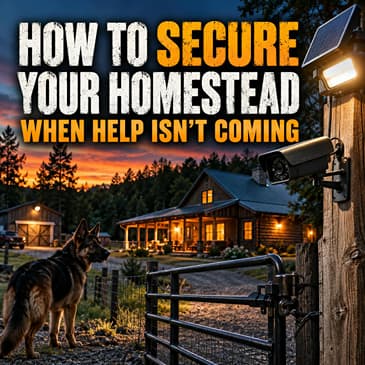
How secure is your homestead when help isn’t coming?
In this episode of The Survival and Basic Badass Podcast, we break down homestead security, preparedness, and protecting your property during a grid-down emergency or major disruption.
Security isn’t just about weapons or defending the front door. A resilient homestead uses layers: controlling access, detecting problems early, protecting critical resources, maintaining communications, and having a plan when things don’t go the way you expected.
We discuss practical ways to make your property harder to disrupt, including fences and natural barriers, driveway alarms, cameras, motion lighting, doors and windows, livestock and animals, fire protection, communications, operational security, and working with neighbors.
We also get into something that is often overlooked in preparedness: having a fallback plan. If all of your food, equipment, supplies, and resources are concentrated in one place, that location becomes a single point of failure. Sometimes the smartest security strategy isn't standing your ground—it's making sure you still have options.
In this episode:
• Layered homestead security
• Property access and perimeter awareness
• Driveway alarms and early-warning systems
• Security cameras and local recording
• Solar and motion-activated lighting
• Doors, windows, and physical security
• Protecting gardens, livestock, and supplies
• Fire and carbon-monoxide safety
• Radios and backup communications
• Family emergency procedures and rally points
• Operational security (OPSEC)
• Neighbors and community security
• Fallback locations and distributed supplies
• Why redundancy matters in security too
The goal isn't to turn your property into a fortress. It's to build a homestead that gives you warning, time, information, redundancy, and options when normal systems aren't available.
Disclaimer: This episode is for general educational and entertainment purposes only. It is not legal, law-enforcement, firearms, tactical, or professional security advice. Laws regarding weapons, self-defense, property protection, surveillance, barriers, alarms, and other security measures vary by jurisdiction. Always follow applicable laws, manufacturer safety instructions, and accepted safety practices. Nothing in this episode should be interpreted as encouraging illegal activity or intentionally harming another person.
🎙️ Listen to the Podcast: https://open.spotify.com/show/4YdMrZ4oWTPKv4YrcZgExg 📲 Follow Us: 🔹 https://survivalandbasicbadasspodcast.com/ 🔹 Facebook: https://www.facebook.com/share/g/15wU8rw6hS/Don't let uncertainty overwhelm you. We deliver practical tips to help you and your family navigate what is coming. Join the email list and check out the shop @ survivalandbasicbadasspodcast.comThe Survival and Basic Badass Podcast is available on Apple, Spotify, Podurama, and wherever you find great content. As always, this show is for entertainment. We are not to be considered doctors, financial advisors, or lawyers, and it's not legal, financial, or health advice.
#Preparedness #HomesteadSecurity #Prepping #GridDown #Homesteading #SelfReliance #EmergencyPreparedness #Survival #OffGrid #HardToDisrupt
Learn more about your ad choices. Visit megaphone.fm/adchoices
[00:00:00] Academy Sports and Outdoors. Fun Can't Lose. Shop now. All right, welcome back to the Survival and Basic Badass Podcast, Kevin and Chuck. Today, well, we're going to talk about homestead security, right?
[00:00:26] So we covered kind of, you know, when the grid goes down, basically trying to be hard to disrupt, right? If your world, you want to be able to handle whatever disaster comes, whatever life throws at you, your job goes away, EMP attack, cyber attack, martial law, anything that happens, right? The prepper survival world, we're always, you know, how do I protect my family? How do I make my family, my life hard to disrupt, right? How do I
[00:00:55] create a world where no matter what happens on the outside, my family and my stuff is all secure? Now, obviously it's not possible to be a hundred percent prepared for anything, but there are steps we can do to get closer and closer. And that's the whole point. So we talked about creating our own water system and bringing that in, how to, you know, create our own food supply.
[00:01:19] We do a video for everything in order to, you know, make the world a better place and we keep moving forward. So let's keep going that direction. One of the biggest things is security, right? How do we protect all that cool stuff we have from livestock, from animals, from two-legged predators, like could be crows. I don't know. There's a bunch of two-legged ones out there. You know, different things like
[00:01:47] that, right? How do we protect? So one of the big things that's super important is controlling access, right? Like you see a military base, it's got a fence all around it. You have a prison where they're trying to keep people in, but they also try and keep people out and you'll see a fence with like razor wire or barbed wire along the top. And they do that. There's a reason they do that. And
[00:02:13] you'll see that they have very limited entry points to prison, right? Like there'll be like one gate in the front that you can come. Maybe there's a loading gate in the back, depending how big it is, but you don't just have doors randomly everywhere, right? To get out. I don't know, actually, maybe, maybe they do now in a modern prison. I don't know what the different things are, but the bottom line is if you're worried about security, you want choke points. I think they count on electricity to do these
[00:02:42] stupid door locks and swipe cards. Yeah. The, the, the way they actually work, those door locks in, in prisons is they're, they're magnetic. So you have to, you have electricity to deactivate the, the magnet. So if they lose power, everything locks and it locks it down, which is nice. Or is it nice if you're one trapped inside? I don't know. So anyway, off the topic of prisons,
[00:03:09] we want to control access. So one of the cool things you can do is you could have a fence around your property. Now it turns out having a fence can be expensive, Kevin. It is expensive, especially if, if you have a large piece of property, it can be very expensive. Right. And that, that was one of the bonuses that, you know, kind of excited me about mine was like, Ooh, but I gotta say, right. So
[00:03:33] if you think like fence company and that kind of thing, it gets very expensive. But if you think, Hey, let me go look at livestock fencing, um, cattle fence, not cattle panels, cattle panels are expensive. That's real thick, really expensive. Yeah. Livestock fencing though. You can go buy like
[00:03:54] for 150 bucks. You can buy 300 feet of fence. It's not that much of $10 green stakes. Yeah. And now keep in mind, I ran some fencing, uh, through some, some woods on the back of my property. Yeah. And I made the mistake of, of attaching it to trees instead of using individual posts. And it kills all the trees, like give it a couple of years and it starts growing over the fencing and
[00:04:19] then be a problem. That's it. Yeah. Then it's a problem. So the green stakes are better off. That's a lesson learned. Um, and you can also, I mean, those are the kinds of things you look for on marketplace, stuff like that. To be honest, like I I've spent a lot of money on fencing over the years. And then now like one of my buddies is like, Oh, I'm moving. Come on over and take all this stuff. And sure enough, there was like 50 green fence posts and five rolls of freaking fence.
[00:04:47] And I'm like, Oh, can you? And you know what? It's just sitting in my property now. Cause I already have the place, but I'm like, but I have options. You have options. Right. And, but those are the things. If you spend the time on marketplace and stuff like that, you might be able to pick up a good deal. You can find a lot of free stuff, but there's other ways, right? It doesn't just have to be a metal traditional fence, right? You can do dishes where you're stopping a vehicle. You can grow
[00:05:16] trees. Kevin, you can transplant trees on your property. You can start trees. You can grow a, like some of those horrible plants that are invasive and just go up all over the place. And then you, whatever. They're great because they're invasive. They're already like, you know, they're already growing out of control. So it's, it's perfect. The idea is you want to be able to naturally create joke points, like where people go,
[00:05:41] right. You know, to a certain point where they're going to have limited access to your property, right? Thorns, uh, things that are a little more, you know, and you can find things that are, they may not be unhappy the day they come and attack your family, but later, later, they're really going to be unhappy. You know, at least you can leave them with a bad taste in their mouth. They'll tell their friends, Hey, don't go to that guy. He's got poison Ivy all in the back there. Yeah. That's probably not what I would start with,
[00:06:10] but you know, you got to keep your options open, right? Kevin. That's right. That's right. And you know, you can get, uh, thorny plants that are somewhat attractive. You know what I mean? Like it could be roses. Right. It doesn't have to just be nasty thorn bushes. You can have good looking things. One of the things that I saw, uh, somebody down in Florida was talking about was, uh, lemon trees. They had planted them around the house by their
[00:06:36] windows because they have thick thorns and they just trimmed them down to be like, you know, more of a bush than a tree that just kept it trimmed. But when I was looking into this, I saw there's like a rash of lemon stealing whores. They say, I don't know what this is, but I looked into it. There's all these videos about prostitutes breaking into people's yards and stealing their lemons. I don't understand what the situation is. Google it. There's a meme. There's a whole thing.
[00:07:05] So just be wary. Do miscuousness have something to do with why they like lemons or? I don't know. I was going down a rabbit hole and I had to just pull myself out because there's just too much information about this. I don't think it's a problem, but I don't live in, I don't know what's going on in Florida. There's always something weird going on there. You know what I mean? So he's, you know, a Florida now it's a Florida woman. Yeah. Just do your research is all I'm saying
[00:07:33] before you get the lemon trees. All right. So that's it. I mean, you can absolutely, but the big thing is like, you can definitely set up things where a vehicle isn't going to, you know, be able to roll in. Yeah. Another thing to think about when you're with your, your landscaping is you want to trim your, your branches, your, your shrubs. You want to trim your shrubs below three feet. Okay. You want to trim the branches of your trees up above seven feet
[00:07:59] so that you can see somebody walking around your yard, even if they're behind, you know, behind the plant. All right. I like that. Now there's other things too. Like, so if we're setting up our property, we can set up, you don't want to have like areas of concealment where somebody can sneak up to your house without you seeing it. Right. Right. So having my house blocked from the road
[00:08:26] is always a dream of mine. When I look at a property, I'm like, Ooh, like, like my, my property that I'm at, I have a bunch of pine trees. Like I have kind of a pine forest as a front yard, you know, like right in the front. And then there's, but then before the house, I have a gap, right? There's no trees for an open perimeter, you know, area. And, and it's actually fenced separate. It's like pine
[00:08:52] forest fence, then my front lawn and then the house. And you want to keep that closer area open. So nobody can be like hiding in the bush when you come to your front door, things like that, that, you know, you're able to see out and see somebody sneaking up, you know, when the ATF is stacking up in the front yard, I want to know about it. Right. You want to know. Right. Like I have a
[00:09:18] camera out front just so I know, Hey, the ATF might be staging out on the street and then getting ready to come in. I'm going to be aware of it. Right. That's something, you know, randomly you might want to think about it for no apparent obvious reason. Right. Right. Another, um, another thing to think about is, is that, that distance there. And I think you may make a good
[00:09:42] point is that distance from your house to the tree line is, you know, it's, it's a, you want to be able to, um, range in all the spots of your, your property from different places inside your house. And you want to be aware of what's going on when you pull into your house, you know, that somebody isn't hiding next to the front door. You can see that when you, you, you know, pull into your driveway after work or something, you know? Right. Absolutely. So a couple of things here. So,
[00:10:11] you mentioned like somebody pulling in, you know, sneaking in when you come home. So driveway alarms are a great thing. Um, if we were in a law list, you'd have to check your local laws and things typically having like trip wires that anything kind of dangerous out there is illegal. Like anywhere, you're definitely accountable for anything that happens with stuff you do. Now there's also trip wires that can just make noise.
[00:10:41] Right. That's definitely something you can do where that way you don't have to worry about pets. You don't have to worry about who's coming. And I'm saying that was, you know, if you're in some kind of crazy place where, you know, you're desperate to cover things that becomes like a force multiplier. Another thing about concealment is there's places bad people could hide. But another thing I see people,
[00:11:07] like I read books and they're like, Oh, this bad person's coming to attack our house. We better get ready. And they plan to like sit in their bedroom window and shoot out like a sniper, you know, whatever. But you guys need to think about cover, right? Cover is something that stops bullets from coming through. It's not just hiding. And it turns out having a piece of plywood and sheetrock behind it,
[00:11:32] it doesn't stop. Not every bullet, right? It's going to be stopped. So, so I did do a little looking into this and it says AR-15s lose a lot of their force when they hit, you know, anything, any kind of resistance, especially if you're not using full metal jackets, they'll kind of break apart when they hit the plywood and then they'll splitter. And yeah, it still hurts you, but a nine millimeter,
[00:11:59] no problem going through a wall shotgun, no problem. All right. So, and an AR-15 with full metal jackets, no problem. So just think about, right. If you're staging your house, just think of areas where you could add cover, right? Like if you had a plate that you could slide in front of it, maybe another layer of thick board to slide in front of it, you know, a bookshelf full of books,
[00:12:25] a bookshelf full of books that you could slide in front of it. Just have something nearby, even if it's not always there. Hey, something bad is happening that you could add to that layer of defense, right? Actually, you know what? Dirt is great at stopping stuff. Um, if you kind of said some, you know, during the wars, they used to dig trenches. You know why they dug trenches? Cause dirt stops
[00:12:51] bullets and they would dig trenches and they'd dig out the dirt and they'd mound it up in front. Uh, there's something called spider nests, right. Or spider holes. And you basically have a hole and, and like a lid that you can pop up and have low cover and things like that. Right. So if you can create a couple of points and again, maybe you're not that involved, right? You're like, Hey Chuck,
[00:13:16] I'm not crazy. I'm not digging spider holes all over my yard. I'm saying if you have a big flat yard and you don't have options, that may be the answer, right? But you could have that lawn ornament tractor that you leave in your front yard. I don't know what's wrong, what your neighborhood is like, right? Maybe you live in that neighborhood. You have that old beat up car that you've been working on for 15 years. It's just rusting away in the front. You know, maybe you in the engine block
[00:13:45] or you in the tires, that's where you have cover, right? So you just have to think about where can I set up and are there places, right? One of the cool things now is, uh, you can see behind me, I have, you know, foot thick wood walls. That's going to really help that they're solid with cover. Now there are still things that can maybe get through that, but it's going to be a lot
[00:14:13] better against light ammo. Now, if somebody is pounding away with an AK against this, they're going to get through eventually, right? This is, you know, a serious bullet like that AR 15, probably not, probably not going to get through that, but somebody with a heavier bullet, you know, eventually they're going to get through it. Especially now that everybody's got FRT triggers, those forced reset with the little rat or you know what I'm talking about, you know,
[00:14:40] then maybe they're cutting through, but either way they're putting in effort to shoot at you, right? Right. It's not going to be something that just happens. So anyway, so moving right along. So we have drive driveway alarms. We have trip alarms. Now, sometimes we have things sneaking around on our property, scoping it out, right? You know, they, they actually put effort in over time.
[00:15:03] So you have things like maybe trail cameras, right? In an off grid, you know, no electricity from the power man kind of world, having trail cameras around the back of your property or any kind of access point that you're not keeping an eye on maybe back by the barn, maybe, you know, where they come in through the woods, there's a trail that the neighborhoods kids use, you know, that's a kind
[00:15:29] of public lot of woods. You know, everybody's kind of got those woods around you where everybody goes through. Maybe there's a trail there and where it enters your property, you could have a trail camera, maybe even off your property. You could have a trail camera. I don't know what people do. I mean, you choose your own destiny, right? Right. So that's, that's something trail cameras. They sell them where you can have a little solar setup. Now the ones like I use, I use spy point. So it connects
[00:15:57] to like Verizon or somebody, you know, I think I can choose the AT&T version or the Verizon version, and then it can be sent to my phone, but they also have cameras that work off a little card and I can go out with a card reader. If those cell towers were down and say, Hey, has anybody been moving through my property last night? At least I know, Hey, this has been going on, right? I can see. Plus you can also keep tabs on the deer, be another happy accident. You know, what's going on.
[00:16:25] Right. Um, you know, where the Fox is moving when he's trying to get in there. Yeah. Yeah. He's been my, my, uh, biggest enemy is, is the local Fox. Yeah. And my wife thinks they're cute and feeds them. And I'm like, that's not helping. Let me leave a can of tuna out for fish. They're all about the fish. All right. Oh, the fish is the go-to. Um, especially if you want to get them in maybe a live
[00:16:49] trap can of tuna is your go-to. I also find that possums seem to go for that as well. I've even seen other things. Yeah. Possums love cat food. So I, I absolutely make sense. And then if you guys read about like ambushes and kill zones, I know I had, when I had the property in New York, there was
[00:17:12] like thick brush all around in my backyard. But then I had a trail where I accessed the bigger woods, you know, behind my property. And that was a obvious choke point. Right. And that would maybe be one, something you want to keep an eye on for, Hey, who's coming and going. And two, maybe you could set up some kind of ambush or something. If the end of the world, when you're being attacked by zombies,
[00:17:40] that's what you can do. Right. So, all right. Overlapping camera coverage. That's nice. I got to say like as far as cameras. So, you know, we do talk about having solar and options and some electricity. So maybe you could have a camera system. Now you do want to have something like I, I did not spend that much money. I think it was like 159 bucks, got me eight cameras day and night
[00:18:08] vision. And they have a 60 day hard drive that it kind of backs up like a rotating 60 days. Now that I can view live on my phone. Again, your phone service. Well, if my phone's just connected to the internet, so the cell towers could go out, but I would still need some kind of network, right? Like you're hearing I say, internet really it's connected to the wifi. It doesn't need to be
[00:18:35] connected to the internet. If that makes sense. Like they could be on the same wifi network where they're networked together, if you will. And, uh, but anyway, make sure that it's something not stored in a cloud somewhere far away. People are like, Oh, I can pay a dollar a month instead of buying that hard drive. And then it's onsite in China and I can access that anytime on my phone. Well, you might
[00:19:00] not be able to access it anytime on your phone if things fell apart and got disrupted. So that's something to be aware of. If you do have cameras, think about overlapping. And I got to say with cameras, like, I think I could get a good license plate with my cameras and I haven't set up for that, but I really couldn't get a good facial recognition at night, stuff like that. If you knew the guy, you might like recognize their gate and be like, Oh, that's, you know, I can tell by the
[00:19:29] size. That's me. That's the kid. That's right. Like all that makes sense, but you're probably not doing like a big lineup. Like, Oh, here's Jimmy. And you'll see like the blurred out, you know, that's not. So anyway, enough about cameras. Cause you know, we're talking off grid end of the world, no electricity. It's just, I wanted to kind of cover those things. Right. Um, all right. Perimeter lighting though, that is something that we can do. Right. Right. They do sell like those,
[00:19:59] they used to the big brand was, uh, I think sun force made a lot of those, like where it have the little solar panels and they'd have those motion lights. Yeah. I have, I'm actually looking at some across, across the room. I've gotten boxes still there's, there's, there's, they're, they're great. They're so bright and, and they re they really, you know, they really work and, and it doesn't take that much electricity because they're only running at night when something's in front of them.
[00:20:28] So a small solar panel is it's easy enough to power all these things, but that, you know, obviously if you're in the woods, it's going to be a little bit more, uh, difficult to get, get direct sunlight, but they, you know, you just have to, you just have to plan accordingly. Exactly. Um, another thing, so you want to make sure your doors in your house, your house is secure, right? Like a lot of us, we, you know, everybody wants a lot of windows. They want to
[00:20:56] be able to see, and honestly being able to see the bad guys, that's awesome. Being able to see the things that are, you know, going on, on your property. That's awesome. Uh, being able to see if there's a fire starting somewhere, if there's a Fox in the yard, be all these things, right? Having, being able to see is awesome, but also having strong, secure doors,
[00:21:20] having a way to put plywood over some of the windows and thin it down. Um, you know, in the past we've talked about that 3M film that you can make your glass shatterproof and they show people like takes like, you know, three minutes, four minutes with a baseball bat trying to break that window. That's kind of cool. That might be something you want to look into. Plus you can
[00:21:45] actually have it so that it's mirrored. They sell like the three hours. You can't see in, you can do mirrored so you can see out. They can't see in, they have shading options. Um, you know, that's something really cool. You guys might want to look into. There's a lot of cool things you can do with, you know, setting up protection that way. So that's something else to
[00:22:09] think about. Um, like I said, lighting, securing your windows. I, one of the cool things I have plywood set aside that I actually could cover and it's thick like three quarter inch that I can cover my windows. If need be again, cover some, you want to make sure you can still see, Hey, who's at the front door. When somebody comes up, you don't want to close everything out on the first floor
[00:22:34] for security. And then somebody comes by and you're like, Oh, that's Jimmy. I hear a secret knock. And then you open the door and it's not Jimmy. That would be bad. Right. Cause yeah, I mean, Jimmy's friendly, but Stan, what if it was Stan? Exactly. Uh, so think about that, right? Strengthen those things, strengthen your windows, those film, you know, like I said, that's really a great way to go.
[00:23:00] Another thing is keeping what's important to you close to the house when you lay out the property, right? So actually putting the garden, I know cosmetically, this isn't what people always want, but having the garden right next to the house, you can keep an eye on the critters that are getting in there. And that's something that's really cool, you know, to be able to, Hey, there's, you know,
[00:23:26] the Fox isn't going to come around if there's people in and out of the house all day long. Right. Um, you know, just something to think about. You're able to keep the, uh, Hawks from grabbing your chickens and biting their necks out if you're out there and close by, but if they're, you know, 200 yards away from the house, they don't really give a crap if you're out there doing something. So that's something to, you know, be aware of. Think of the layout. Now, Kevin,
[00:23:52] well, let's talk about some animals that you can keep in on your property for protection. Obviously the number one, um, number one thing you want is, is a dog that's especially like a herb protecting dog. Those types of dogs are really great at defending your property from, from people and animals that, that wish to harm your animals or you. Uh, the one drawback is like my dogs,
[00:24:22] really aggressive. If somebody broke into my house, they'd, you know, they'd really make a mistake by fucking mouth. But if they broke into my house with a vacuum cleaner, it's all over. Those dogs are, those dogs are gone. Uh, I mean, the vacuum noise on their phone. So if you, you just want to kind of be aware of the things that, you know, that, that trigger, trigger your animals sometimes. All right. Cats, cats are great for the small pests. You know,
[00:24:52] there's things that are great for the small pest, uh, geese really good at, at geese, keeping you aware of what's going on. People, animals, whatever they got. It doesn't matter. They they've got you. And they're, they're really good at scaring hawks off, which I have a problem with where I'm at. I have to take a lot of measures to, to protect my, they're good at scaring me off. I'm just saying like, if you have a goose, they're nasty, man, they get real nasty. You know, it's the most terrifying though. I went to somebody's house and they had a pig
[00:25:21] and it looked like a straight wild hog. Like it was all hairy and whatever. And it would just come at you and snort at you a little bit. And I'd be like, I'm not going to knock on the door. Like I think to eat people, I'm not, you know, like that's not no sure. Like you got to be dead first, but I don't know what he could do his teeth. Nope. Am I going to be dead? Uh, yeah, I don't know. Yeah. Yeah. They say never trust somebody that, that runs a pig farm because of that,
[00:25:48] because they might just be using it to dispose of bodies. Exactly. So just, you know, I mean, I'm not saying everyone like that's our disclaimer right there is not everyone who has pigs is feeding them people and not pig. All pigs are eating people, but all pigs can eat people. That's the thing. That's the thing. That's the thing. So you just have to be aware that pigs or something. And I got to say they are freaking terrifying. Like I understand like, you know, babe,
[00:26:18] you saw that movie with the old guy, right? That's not probably going to scare away people, but you get some kind of like snorting honking thing that, you know, is all hairy and you got to let them grow hairy. That's the big, I used to live off the, um, live on the back end of a farm. And they had a 500 pig there and he broke out of the fence and I was sitting on my front porch and I see, I see this pig running at me. And you know, I just went inside, closed the door and the
[00:26:48] pig ran across the porch. He just tore apart everything. Didn't even notice like smashed tables and knocked over everything, broke everything. You didn't even notice. And you know, the farmer came out with a box of cereal and just kind of drew a little bit of cereal on the ground and led the pig back, pig back to its enclosure. You know, I was, I mean, one of my most terrifying things at night with as far as animals is, uh, I was at your place one time in New York and not,
[00:27:15] not where you are now, but, uh, when there was a cow moving in the woods at night and that's right. Yeah. I remember something large and moving and we're like, what? And then the thing is, you're like, Oh, thank God. It's just a cow. And then you're like, all right, move along. And the cow's like, no, no, wait, I'm good. I'm good. But the same thing, like you break out
[00:27:39] that box of cereal or some fancy hay. Yeah. I was like, Oh, okay. Oh yeah. No, it's better that to realize it's a cow moving around in the dark than a bear or something, you know? Yeah. But a cow is kind a little intimidating. They had the horns there. I don't know what they're called, but the females with the horns, it was a female cow, but it, yeah. And they just, they don't stop easy. You know,
[00:28:05] it's, it's so anyway, cows, all right. Crows. Crows is my neck, the next on my list. Now, if you can befriend a murder of crows, they'll let you know. And you know, I've got, I've got a crew that lives in my backyard. I give them, go out there and I feed the crows and they, they bring me stuff, but they will go crazy when the fox is moving through the woods. So I know when the,
[00:28:29] when the crows start going crazy, I can set the dogs out after they'll chase, chase the fox off and everything's safe. But I know ahead of time when that fox is prowling around looking to eat something. My wife likes to work with the crows too. Again, the same thing, you know, keeping the hawks away and whatever. And yeah. And that's another thing. If a hawk shows up, the crows will go after him. You know, they, they joined together and just chase it out. So it's, yeah.
[00:28:58] And they're stupid smart. Like their stories, there was a whole study at a college. You guys should look it up if you've never heard about it. Cause it's crazy, but like they had crows that were watching street lights and they know like when it's red, that it's safe for them to go down and get the dead animal out of the road and things like that, like city crows. And there were things like, like that, that's crazy. And they were, they were certain like they, you know, they were actually
[00:29:24] timing, you know, off of the streetlights, what they could do and get away with. And then same thing, they realized they would recognize people. And if you were a jerk to a crow, they would remember that. And so during that, they would actually, yeah, they would actually teach the younger ones, ones that had never even seen the asshole before. Right. Would know which who to watch out for. They said it was one of those weird, like genetic things, you know, where they talk about where they
[00:29:51] get rid of the older generation, you know, like they teach them to like monkeys to hate bananas or whatever. And then, you know, they, the other ones are like, shame them, you know, if they got shocked every time they touched a certain fruit or whatever. And so the, the same thing, then you'd get rid of all the original ones, but they still teach the babies not to, so you could teach them to hate certain people and things like that over time. Even if the original
[00:30:17] people never, you know, the original crows never saw them. They were out there wearing like Dick Cheney masks and all kinds of stuff trying to, you should read this study. It's crazy. I'm sure it's out there somewhere. You can dig into it. It was crazy what they, you know, learn and remember how smart they are. Another thing like, so my wife and I, it's always a frustrating thing and she's a
[00:30:41] hundred percent right, but you want to teach where people will tell their dogs not to bark at things because, Oh, barking dogs, annoying, right? Nobody wants that in the neighborhood, but you need your dogs to be alert. You want to train them to pay attention and to let you know when something is out of place. Now, again, it's cool if you're like, Oh, when Susie, the neighbor comes over,
[00:31:07] you know, one bark is enough and you want to teach them that. But if it's somebody they don't know, they need to learn, you know, now I don't know if you can teach them to recognize when it's the bad guy in the UPS van or the prime van or whatever. And, or it's the good guy in the prime van. You know, I don't know. Like maybe they might make me or something. My dogs, my dogs hate the Amazon driver and it doesn't even have to be at our house. If they see it drive down the street past the house,
[00:31:37] they'll, they lose their shit. My, my dogs hate anybody with a trailer, like any trailer. Yeah. 18 wheeler could be a truck with a trailer. You're pulling a track. That's the worst. If you're pulling a tractor, they're going nuts and I don't know what it is. And I'm like, Oh, you missed that trailer. They're all they'll go crazy. All right. Another one for, uh, having, having out in your, in your
[00:32:02] yard with your livestock is donkeys. They're just, uh, that, you know, they, they can be very friendly with their owners, but they are nasty animals and they bite and they kick and they're, you know, they're very, they're aggressive, you know, when you come on the property, you're not supposed to be there. Absolutely. Watch some of those videos of, uh, I'm attacking a mountain lion or something like that. And it's crazy. They're, they're hardcore. Like they're just beating it to death and you're
[00:32:29] like, Whoa. All right. Hey friend, you know, we're here. Um, so, all right. So we talked about that, you know, geese, dogs, donkeys. Oh, one we didn't, we didn't mention is, uh, cocaine hippos. Oh, sure. Yeah. So obviously, uh, so, uh, Pablo Escobar had a bunch of, uh, hipp hippopotamuses and when they killed him in 1992, he had, he had, uh, one male and two female. Okay. Uh, so
[00:32:59] they, uh, when they, when they killed them, they took most of his wild animals and brought them to zoos, but they couldn't move the hippos. They're too big. Now hippos are the most lethal animal like out there. Like why really use one for protection kills a lot of people like kills more than, more than alligators kills more than, you know, almost any other animal. And the thing is they're predator. They're not predators. They're, they're herbivores. They only eat plants.
[00:33:25] They just like killing shit. You know, that's just, they're in it for the game, you know? Uh, so his hippos got out and they've just been moving in all the local water streams. Now there's 200 of them. They say by, uh, uh, no, they're not all on cocaine, right? They're not all. As far as I know, none of them are on cocaine anymore. I don't know what Pablo was doing with them, but they're not on
[00:33:51] cocaine now. Right. Well, that's where there was, they were called because they were bought with the cocaine money. Oh, I see. I thought he was, you know, giving them a little, little taste. But there's now there's 200 of them. They said there's going to be 500 by, by, by 2030. And there's going to be a thousand by 2035. Like they're not native to South America in any way. But there's no sort of predator. There's nothing that goes after them. So they just really going after a hippo. I don't know in, in the wild where they're supposed to be. I don't know who,
[00:34:21] I don't know who eats hippos. It's always the lion like bites him in the leg or whatever. I saw those movies. I watched. Yeah. You got to get them out of the water. Once they're in the water, you're done for. You're done. But the hippos, there's nothing you can, you can do about it. I don't like it. All right. I mean, there's obviously when you say security, I mean, it should be touched on here. Think about like fire security, how you deal with a fire. We did an
[00:34:46] episode way back on protecting your homestead from a fire, having your own kind of water truck, different things you could do, cool things, things to protect against like wildfires, things like that. So that's definitely, but it's a whole other deep road to go down, but at least like think, you know, having the smoke detectors, the CO2 detectors, the fire extinguishers, things like that.
[00:35:14] It's going to be even more so when people start bringing in the wood stoves and using the fireplace, especially if that's not something they're used to using, you know, protecting yourself from that world. You know, everybody, all of a sudden they're running generators inside or, you know, stupid things. Oh, absolutely. You can't do, you know, they say warning labels do not use in the, in the house or a covered area. Like even just putting it on the porch where it's covered,
[00:35:41] you might not have enough air movement to protect, you know, cause you're like, well, I have to keep the generator out of the rain, Chuck. I get that. So you might want to look in and like setting up some kind of exhaust or think about something like that, that, you know, vents it out to a safe area, read the owner's manual, whatever the government says is the right thing. That's what you should be doing always. That's always my go-to. Always listen to the government and do that.
[00:36:07] So that's, you know, that's your option. Another thing I want to talk about communications or having radios talking to your neighbors, even if it's, you know, you ignore everything I say, you don't do anything. You don't get those cool Motorola talk about some always preaching about and you don't have a way to solar charge them. And cause remember communications are a force multiplier. At least remember back to those bootcamp movies or when you were actually in bootcamp,
[00:36:37] and how they go out with a pot or a trash can lid and something to bang on, maybe a whistle, some kind of way that you can alert your neighbors. You're going to need help or everybody on your property. If they're spread out, you're going to want to be able to alert people to rally and to have a communication actually set up a signal, set up where you're going to go.
[00:37:02] If there was a fire on your property, where would everybody meet up? Right. Or what if bad people come? Do people have stations, right? In the military, we had battle stations, at least in the Navy. Right. They'd be like general quarters, general quarters. Right. Right. And you all go to the spot. You know your spot and the job you're supposed to be doing that. There's a reason the military does that because it works, right? That's something that you should be teaching people about and how they could
[00:37:32] do it. So have like set procedures. Also think about having like a fallback point, right? Like where you could go retreat to. If it turns out you have to prepare, there is a possibility your house could be overrun. And if there's, you know, the mob coming out of the city of a hundred people that are like locusts that are just going from house to house and devouring all their supplies. One,
[00:37:59] having some supplies stashed or hidden in secret places might be a good way to protect them, right? To keep them available long-term. If you had half of your food buried or set up in a secret hidden location in the basement, in the neighbor's house, whatever, you know, you have a secret place then you can retreat and say, okay, we'll give up this house for the hundred people in the horde.
[00:38:29] And they'll move on. Once the vultures go through everything, they don't stick around in the carcass, right? They keep moving, looking for more to feed on. So that's something to think about having stuff stashed. That's a big part of your security because you're giving yourself the option to, you know, be able to retreat because everything you have isn't there. You know, when you're like, well,
[00:38:53] every scrap of food we have is in this house. I have to die to defend it. Cause if they take it, I'm going to die anyway. Right. That's not the option you want to have. You want to be like, Hey, half of my supplies are somewhere else, or maybe two thirds of my supplies are somewhere else. I don't have to worry if they overrun the house. I can come back for my supplies later or go to my
[00:39:19] fallback location and I have options. So just think about that. And that's where neighbors come into play too, right? Have something like that. Another thing is don't advertise your supplies, right? If you're the only guy with lights in the neighborhood, that's going to be a thing. So, you know, but the motion lights, you know, they come on and surprise people. That's a different story than attracting people. If you're out cooking barbecue when everybody else is starving to death,
[00:39:47] probably not your best move unless you're sharing a little bit. Sometimes having a little bit to give away is a good thing. Right. Right. And then honestly, in a, in a situation where the power goes down, all your freezers start warming up and your grill's still working, you might want to, might want to do that. Get some, get the neighbors, get it, you know, let everyone know that food's going to spoil anyway. And then you've got a little bit of goodwill, you know,
[00:40:16] when you need toilet paper, you might be able to get a friend, a friend to give you something because you gave him a hamburger, you know? Absolutely. So one of those both ways. Absolutely. No. And that's the thing. You don't want to be the guy, Hey, I have lots of supplies, right. You can come, come to me. I'm going to help you. But, and also like sometimes, you know, I was reading a book and, and somebody kind of needed charity and they were like,
[00:40:46] you know, cause something unexpected happened and they did plan and they, whatever. And they were like, but how do we share our supplies without telling everybody, Hey, we have more, you know? And so it was like, Hey, let's just drop a food bucket in the night in secret and just give them a little, you know, sometimes blessing somebody anonymously. You don't get the pat on the back, but you don't expose yourself either. Right. Just saying, keep your options open. Right. Now,
[00:41:12] last thing I really want to touch on before we wrap this up is you want to make sure that you take care of the basics first, right? Make sure, you know, Hey, I, the world might not end, but I don't need somebody to break into my house. I don't need my house to catch on fire. And I don't have a smoke alarm when it tell me to get out. I don't have, you know, the, the basic things,
[00:41:38] right. Make sure you think about the simple things and how to protect, you know, before you get on a big crazy, right? Like maybe set up a camera so that they're not stealing packages off your porch. But I feel like if you have a video of a porch pirate taking something off your porch, cops are going to be like, yeah, get right on that. Like, yeah, they don't grab it. They don't give a shit. And Amazon's going to be like, yeah, we'll just send you another one, whatever.
[00:42:04] But if you booby trap a package and leave it on your porch and it blows up and blows their fingers off, you're still going to go to jail. It's not going to go to jail. It's still not okay. That's not okay. Kevin criminals in all forms should be punished. We all have to learn to agree to society's laws. Remember that. Yeah. It's like, if you have a job,
[00:42:29] if you have a job and somebody keeps stealing your lunch out of the, out of the, the office kitchen, out of the office refrigerator and you poison that food, you're going to go to jail, but you're going to lose your job. Yeah. Now you can, you can make yourself a sandwich with a lot of ghost peppers on it because that's, you like it super spicy today. Right. That might be something you like. That's okay. That's different basics. Right. So choose your boundaries, right? All right.
[00:42:58] That's fair, Kevin. That's fair, but less than lethal or non-lethal. One of those, one of those is right. Um, so there was with that, you guys are awesome. I appreciate you're always sticking around and, and checking us out and we're happy to do it. So with that, stay safe. We'll talk to you guys next week.