
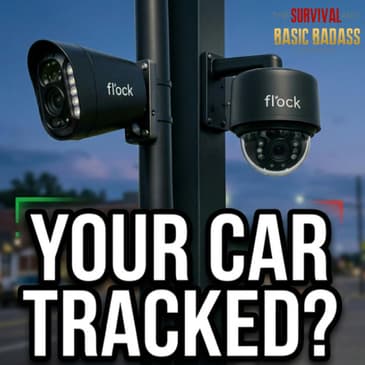
Discover the truth about Flock Safety Cameras in this revealing video. Learn how these cameras are being used to promote community safety and prevent crime. We'll delve into the features and benefits of Flock Safety Cameras, and explore the impact they're having on neighborhoods and communities. If you're considering investing in a Flock Safety Camera for your home or community, this video is a must-watch. Get the inside scoop on the technology behind these cameras and find out if they're really worth the investment. Whether you're a homeowner, a community leader, or simply a concerned citizen, this video will provide you with the information you need to make informed decisions about Flock Safety Cameras.
🎙️ Listen to the Podcast: https://open.spotify.com/show/4YdMrZ4oWTPKv4YrcZgExg
📲 Follow Us:
🔹 https://survivalandbasicbadasspodcast.com/
🔹 Facebook: https://www.facebook.com/share/g/15wU8rw6hS/
Don't let uncertainty overwhelm you. We deliver practical tips to help you and your family navigate what is coming.
Join the email list and check out the shop @ survivalandbasicbadasspodcast.com
The Survival and Basic Badass Podcast is available on Apple, Spotify, Podurama, and wherever you find great content.
As always, this show is for entertainment. We are not to be considered doctors, financial advisors, or lawyers, and it's not legal, financial, or health advice.
#FlockSafety #Surveillance #FourthAmendment #Privacy #LicensePlateReaders #ALPR #ArtificialIntelligence #PoliceTechnology #Constitution #CivilLiberties #Preparedness #TheEssentialPrepper #SurvivalAndBasicBadassPodcast
Learn more about your ad choices. Visit megaphone.fm/adchoices
[00:00:00] Meditieren, Yoga, Joggen, nichts entspannt mich. Echt? Mich entspannt meine Steuer total. Steuer? Wie Finanzamt? Die Steuererklärung? Ja, ich hab ganz locker über 1000 Euro Zugriff bekommen. Hast du geheime Connections oder Excel-Superkräfte? Nö, nur die Wieso-Steuer-App. Wow, und das ist einfach? Klar, die macht fast alles automatisch. Ich fühl mich plötzlich so... entspannt. Hol dir dein Geld zurück. Abgabefrist 31. Juli. Was? Schaffst du ganz entspannt mit Wieso-Steuer. Ach, ach ja.
[00:00:41] All right. So, let's talk about Flock Safety. We're going to talk about the Flock Cameras. You know, the black license plate readers you see all around your community. Yeah, that are just for reading license plates. They just read license plates. At least that's what Flock Safety says. You know, they're just there. You know, it's funny. I drive to work. Like, the most back roads you could ever take.
[00:01:09] And I drive through one town which has a gas station, a small engine repair shop, and a post office. And I drive through the intersection, and I was like, that's a Flock camera that I never noticed until, you know, I was doing this episode. And I was like, I don't know. They put those Flock cameras in places that the most crime takes place, supposedly. So, just stay out of that town, dude. I wouldn't go in that town. Danger.
[00:01:39] It's a dangerous place, man. Now, we keep seeing all these people. So, what are our Flock Safety Cameras for? Like, I guess that's the big, you know, before we jump into why it's all wrong, right? Right. You know, why is it going to be 1984 in surveillance state? That's what everyone's always wondering. And I'll tell you, you know. But, all right. So, what does it do? All right.
[00:02:05] It basically is meant to, they say, just read license plates. So, we can find stolen cars, Kevin. You know, stolen cars in some communities using Flock cameras are down 60%. That's very impressive, I guess. I would love to see how they got those statistics. Well, they kind of, that's the thing. The more we dig into Flock Safety, again, this is all opinion and for entertainment.
[00:02:33] But, it feels like there are contradictions in their stories. A lot. A lot. It seems very suspicious. So, yeah. Let's jump into it. So, what does it do? It supposedly just reads a license plate. However, they brag about, it checks the paint color, the make, the model, the body style, any visible damage. Checks the wheels. Are they factory? Are they custom?
[00:03:01] Roof racks, decals, stickers. Maybe you have a sticker for your yoga club, Kevin. That's probably what you have in your car. That's what mine, yeah. That's what mine says. And, or, let's go Brandon. Let's go Brandon. Yeah. Yeah. If you're listening to this podcast, you probably already don't put stickers on your car. That's not a smart thing to do. It's just not a wise decision if you're security minded.
[00:03:28] Now, so, when you're trying to sell it to the community, they say things like, oh, if a vehicle's reported stolen, we could search that out and help you find it. If a vehicle is wanted, maybe a suspect in a crime. Amber alerts. You know, Amber alerts. They're a big deal. And people, they're not that smart looking. So, how great would it be if we could have a, you know, something like that going.
[00:03:54] Then they say for missing persons investigations. Now, we're going to kind of delve in a little bit about, is it tracking people or is it tracking cars? Because there's something there. No, you could say, well, Chuck, missing people could be last seen in a car. And then, ergo, it'll help with a missing person investigation. True. All right. Or a bolo, the be on the lookout when cops are like, hey, there's some guy.
[00:04:24] Or, you know, they have things like, you know, you used to watch like NCIS and crap like that back in the day. Okay, show. I enjoyed it. Whatever. Not my point. But it was, they would be like, oh, were there any F100s that drove through that area that are black in the last three hours? You know, between two and four o'clock. And then they'd be like, oh, look, here's one here. And look, we can follow it all these places.
[00:04:51] And Flock Safety is the guys that are doing that for you. Well, people are a little upset about these cameras, Kevin. They're not happy. Really? What have you heard? Well, I know that if you're in law enforcement, you have unrestricted access to these cameras. But here's the thing.
[00:05:13] If you are in a small town and you want to only look at your town, then you can have that isolated. But if you want to look in other towns, those cameras have to be accessible to other law enforcement. Right? So you don't need a warrant for this. You can just look. It's just look for it. You want to find a guy with a blue shirt and a red baseball cap? Kevin, it's not tracking. Type that in and it'll track you. Oh.
[00:05:43] Oh, right. Actually, it will. It will. It's not tracking people. It's not tracking people. But it will track people. Right. They keep asking them in interviews. And they're like, well, why would you, you know, you can't track people. That's wrong. And we'll end up like 1984. And it'll end bad. And everyone will be, you know, getting stalked like China. And we'll all of a sudden have social credit scores and everything else.
[00:06:13] And oh, that guy jaywalked. That's the thing. They're like, oh, that's not going to happen. We're just tracking license plates. They keep going back to that. And then I point out, well, no, it was a little broader. You're tracking whole cars and movements and creating patterns. Then they say, we're not listening to conversations. We're not doing anything. However, some of them do have microphones. Very odd. And then they're like, well, yeah, but we're just listening for people in distress.
[00:06:43] Kevin, they might be in distress. Well, what are sounds of distress? I don't know. I'm in distress most of my life, you know? Are you always listening? You know, when you hear about those gunshot microphones in cities, that's these. These are them. And then, all right. So then they're like, well, we don't track people. And then they push on that. Well, then why do you have it on bike paths? And why do you have it on, you know, hiking trails?
[00:07:11] And then they say things like, well, you know, we track objects. So just you're worried about random objects being on the bike trail. Like if a kickball falls and goes across, you're like, oh, there's that kickball. We lost it. And there it is. It gets very suspicious, Kevin, is the dark road that I'm going down.
[00:07:35] So there's actually a story on Yahoo News that I tried to kind of get the article so I can show you. But it just they they're so full of junk on that site. But anyway, flock safety employees watched kids gymnastics room in order to pitch how they can see everything. But now, are there a lot of cars going through the community center?
[00:08:03] No, I know there are a lot of young girls in gymnastics classes. Now, luckily, flock safety cameras have never been used for anything nefarious. That's 100 percent true, except for if you ask flock safety, it is. If yeah, there has been a lot of a lot of stalking and harassment.
[00:08:27] A lot of police officers tracking girls that they were into or ex-wives or ex-girlfriends, which is great. If you can keep track of somebody. I mean, after all, they broke your heart. You better make sure you know exactly where they're going at all times. At all times. Right. And that's like it goes. It is such a surveillance state.
[00:08:51] And we used to like think, oh, you know, these are are you know, you're crazy. There's always been like license plate readers for a long time. You know, we used to get them. New York's all full of them where you're told. Plazas don't even have. Don't even have people anymore. You know, you just drive through and they send you a mail and whatever. And oh, we know your vehicle. And that's thing. You're like, oh, well, I'm clever because I can get the little shielded.
[00:09:20] The license plate thing that makes it look like a mirror. If a picture takes it, it becomes like a bright light. Doesn't matter because the one time that it did see your license plate, it memorized everything else about your vehicle. And so now it already knows who you are. It doesn't matter. They already know. And, you know, they can just track you. Oh, that's Jim.
[00:09:44] Jim has a black F-100 and I see him in his other car where the license plate isn't covered or he rides with his wife. And I know that, you know, when I see that F-100 with the blurred out plate, that's just Jim's. And I can go to the DMV records and I can pull up and see exactly what his license plate is. It's not, you're not getting away from these. And that's the whole thing.
[00:10:11] Like you might have a little, you make it a little bit difficult for them, but it's gonna, they're gonna know who you are. Right. You're not getting around it. That's why I wonder, you'd see all these people are out trying to destroy them. I'm like, so did you drive there with your car and park like in the parking lot next door? And then a lot of the people that have damaged flat cameras have been tracked on other flat cameras. Exactly.
[00:10:39] You know, they talk about guys are buying like green lasers and pointing them at them and they're doing. I mean, those are those cheap lasers that you can buy. Can do a lot of damage to those flat cameras, you know, so be careful. So when you, when you get those lasers, do not point them at flat cameras because it can permanently damage the camera.
[00:11:01] But to be fair, and this will emphasize the point that I'm not pushing for people to go out and be destructive is there's a real good chance you're getting caught. Cause they're gonna know they're tracking you, right? Right. They're already tracking you. And if they see you driving through five cameras and you're wearing your survival and basic badass podcast shirt, podcast shirt.
[00:11:26] And then you show up and you're wearing a black ski mask and your survival and basic badass podcast shirt. And you walk up and point the laser at it. They're going to be like, I know who you are. And they'll send you the bill for the camera, you know? That's right. So a lot of these towns are pretty upset about it. Kevin, you, you see these community meetings and you know, the town council or whatever like that.
[00:11:53] And people are like, Oh, this is ridiculous. We don't want them and whatever. And I looked up Glock or something. And I was like, you know, if everybody doesn't want it, why are, are all these towns approving it? And they said, just cause people are vocal and show up to these meetings in droves. Those are just the fringe outliers and are crazy. Everyone else really wants it.
[00:12:19] But also the big thing is basically it's the local law enforcement saying we've cut our police budget like crazy. And now we have no cops. We need help in order to do any kind of investigating or whatever. Kevin thoughts on that? Yeah. Well, I mean, it's, it's a great, you can actually make money by installing the flat cameras.
[00:12:47] Cause you can just mail out tickets now. Have proof evidence. No, you don't need any of that stuff. There was an article I read on, on the internet of, uh, you know, that, uh, in the LA County or something, they had stopped 60 vehicles that they found that were stolen because of the license plate. And then they weren't stolen. And, but you know, you drag those people out of their car, point guns at them, put them on the ground.
[00:13:14] But you know, that was probably didn't happen is my guess. That was fake news. Fake news. Must've been fake news. Fake news. Kevin, there's a lot of that on the internet. You don't know. That's the thing. Like, how do you even report a news story? Cause you're like, ah, yeah, it was CNN. It probably wasn't real or it was Fox. It probably wasn't real or it was. Where do you go? How do you even know what reality is?
[00:13:38] I mean, that was one of the things is you see, I keep watching these, uh, videos. I was watching tons of stuff and you hear the, either the CEO or, you know, the, the representative from flock safety. And they're like, oh, we don't track people. Oh, we don't use it for this. Oh, we don't use it for that.
[00:14:01] And then they show the, the marketing videos where they're trying to sell it to law enforcement and they're like, oh, you'll be able to track people. You'll be able to, you know, see people and do this. And you're like, wait, that's a complete contradiction. So when you try and look up the facts, they're like, oh no, you're completely wrong. Because look here, they, the CEO said we don't do that. Mm-hmm.
[00:14:29] And then if you want to look up the facts the other way, oh, look, they're, they're training videos or sales videos say they do do that. You're right. That is something true. I always liked that about like, what is it? Chat GPT and stuff where it'll be like, this is something that's a fact. And you're like, well, okay, but here's the proof that you're wrong. Oh, I'm sorry about that. And let's move on.
[00:14:57] That's what you get trusting the internet. I feel like that's what we get for trusting the news. But it's, yeah, well, it's the presumption of, of guilt instead of innocence. You know what I mean? You're guilty until proven innocent. And when it comes to these situations, especially when they just send you a ticket in the mail and you pay the fine. Yeah.
[00:15:19] So one of the other interesting things about the flat cameras is they're running on outdated software. Android 8 software is what they're using, which they don't sell patches for that anymore. You know what I mean? And it's still easily hackable. And you don't really even have to hack into it.
[00:15:44] You can go to your local Flock camera, write down the IP address and write down the model number. And then you can go to Flock's website, log in without a password and use these things. And then you can watch that camera and you can access video and pictures from that camera and look at whatever the fuck you want it. So there you go. That's the thing. You see tons of these, you know, live feeds.
[00:16:13] You can get them all over the place. It's really pretty crazy. Now, one of the big problems people are having is they're saying, all right, it might be legal to like have a camera at a stoplight and take a picture of the license plate and be like, oh, that guy blew through. But when you start tracking people over time, then you realize it does violate some Fourth Amendment issues.
[00:16:42] And there haven't been any cases that have gone to the Supreme Court. Some of the cases that I have reviewed on it do say like, well, it's tracking, but the guy was in a stolen vehicle, so it wasn't really a right to privacy. Turns out when you're in a stolen car, you don't have a right to privacy. You would think you would, but you don't. There's United States versus Jackson.
[00:17:11] The court held that police use a flock to track a vehicle over a single day doesn't violate your Fourth Amendment. However, they're saying over time and building a kind of profile on you that then it gets into a different area. State versus Simmons. The court ruled fixed location because it's a fixed location doesn't violate your Fourth Amendment.
[00:17:36] However, then when you put them all over the town, then are you not really tracking their movements, right? You are following them. You see the dilemma there. So you got to frame your court case properly. That's how, you know, the long term tracking. So there was an older case, United States versus Jones that involved GPS tracking or Carpenter versus the United States cell phone location history, right?
[00:18:04] So these things, they were like, oh, if we follow that, then you are violating somebody's Fourth Amendment. So that's where you're getting into danger. But they haven't really put it together with flocks. So that's something that I think is coming, you know, these court cases. But they're not there yet. This is still – the thing is people aren't aware of it yet. They don't know.
[00:18:28] But there are people – there's a story, again, was on Yahoo News about a lady who had a cell phone sitting on her lap in her car as she was driving. And it was upside down in the picture that it took. And it was face down just sitting on her knee. And the town just sent her a – here's a $1,200 fine for being on your cell phone while you're driving. Kevin, that's a no-go for me. I feel like –
[00:18:58] Not a fit, but that's a huge fine. And whose responsibility is it to prove that it's not – that you weren't using your cell phone? You know what I mean? You have to go to court. You have to take time off of work. You have to potentially invest in legal fees. You have to deal with that. That's your problem now. Yeah, no, and there's been multiple cases of this.
[00:19:24] Police officers went to a lady's house and said they have her car driving through a neighborhood where she was obviously casing houses for robberies. And somebody got robbed. Obviously. Somebody got robbed. She did it. They had video of her coming and going in the specific times. And they said, I am 100% certain it was you because we have you on video. And then she had to go to court and prove it. Turns out you can't be 100% certain if you're wrong. You know what I mean?
[00:19:54] You're just a fucking asshole when you had it on video, right? They had it on video, but then she had cameras at her house of her vehicle in her driveway. In her driveway, right. And she was like, yeah, that wasn't me. Oh, that's awkward, you know? And that's the thing. It turns out they misread license plates. I don't even see how that's a thing. Yeah. Sometimes they misread license plates.
[00:20:20] You know, I saw one where they tracked a woman to Walmart. Held them at gunpoint. And it turns out it was the license plate was from a stolen motorcycle from a different state. But that doesn't matter because the kids were still in handcuffs on the ground in the Walmart parking lot. We can talk about political surveillance. You can do this. You can use this to, you know, keep your eye on your political opponents. They're tracking bumper stickers.
[00:20:49] If you've got political bumper stickers, then you might be on the situation. There's no accountability to this. You know what I mean? You can't sue flat camera. They're not, you know, they're not responsible for the misuse of their equipment. You can sue the cops, but they, you know, you can't really sue the cops because they have qualified immunity. They can actually collect your data. And this data belongs to flat camera, the company.
[00:21:18] And they can decide what they want to do to collect your data and use it how they wish to. So you're paying your tax money to put, have these flat cameras installed. And then they're being paid by the people that they're selling your data to. So this is like a perfect, this is like a perfect business model. You know what I mean? You collect money from the subscribers and then you collect money from when you sell that information of your subscribers.
[00:21:45] So it's like, you know, when, you know, like when they say a thing is free, you're the, you're the commodity. Well, it's not free. This costs money on both ends and they make money on both ends. Well, it's kind of like when you pay for your cell phone, right? Right. Right. But, you know, it's, it's one of those things that it's like, uh, it's not good for the people, but it is good for the government.
[00:22:14] And, you know, for some reason, I, you know, I'm, I'd go so far as to say, you know, I think it's appropriate. Like if Walmart has their cameras up in their parking lot or you have a camera in your property, I don't think it's appropriate for the government to have any cameras. I don't think the government should have cameras at my town hall. Like, why are you spying on me? Why do you need to spy on me? Like they're not police officers that are available to be there. You know what I mean?
[00:22:43] I know you need a camera to keep track of me. Like what the fuck are you spending all my tax money on is what I'm wondering. It's a lot. I pay a lot every year in taxes and property taxes that goes to pay for all this bullshit. Yeah, absolutely. And that was the thing. So basically towns are paying about $3,000 a camera for everyone.
[00:23:05] And that's like an annual lease for both the camera product as well as, you know, the access to the software, that kind of thing. Right. So think of it like that. And typically they're able to get federal grants. Right. So the federal, your federal taxes are paying for some of it, not just your state and property taxes. You're getting hosed on both ends. Right.
[00:23:28] And what's weird is federal grants, which means everybody in the country is paying for it and only certain communities are utilizing it. I point out that's kind of not really something the federal government can do. So that's also a little concerning. I would also let's talk about 1984. Remember that? That was what people were afraid of, right? Yeah. George Orwell, right?
[00:23:56] That was a book written after right after World War II. They were going to observe citizens, collect information, discourage dissent, remind people in that they may always be watched. Right. Do you feel like when you go out in town, Kevin, you might be being watched anywhere you go? Well, I mean, you are watched everywhere you go at all times, whether you're on public or private property. And just assume that, you know what I mean?
[00:24:25] You might not see the cameras, but there's cameras almost everywhere now. It is. There's always some angle of something, you know, that can see you. You know, I just watched it. They didn't have that Kirk shooter on camera doing the shooting. You got to be on the rooftop. The rooftop. They saw them running across the rooftops, but they never got the right angle on that one. Yeah. Well, Kevin, it's hard to prove a negative. That's right.
[00:24:55] You know how that is. That was one of the things. So I looked up, you know, how is it legal that I can't set up cameras and spy on people, but somehow the government can. You know, I saw one where they were setting up flat cameras in a neighborhood and a guy went out and was filming the people setting up the cameras. Yeah. And he called the police on them. They called the police on them. And we're like, oh, they're stalking us. And he's like, what?
[00:25:25] Because that's. He's like, you're in a public place. And they were like, no, it's not a lot. So I started digging into that. I was like, well, how is it legal that they can do that? And we can't. Right. That's the whole concern I had. And basically, think of it like, oh, the Walmart parking lot. Then Walmart can do that because that's in their purview. Right. Like they own the, you know, it's a private property.
[00:25:55] And then I was like, yeah, but what about the town? You know, and they were like, well, then it's a public space. And I'm like, yeah, but if I'm doing it, it's a public space. And they're like, yeah, but it's under, it's only being used by law enforcement. And then, like you mentioned earlier, isn't this stuff being sold to everyone? You know, a lot of it's accessed by local, you know, people can find it. That was one of the things they said, oh, well, it's never been hacked.
[00:26:25] Well, yeah, it hadn't. Well, yeah, you say it's never been hacked. But also, well, we accidentally made them all public IP addresses so anybody could go and pick up the feed. And they were like, yeah, but that was Verizon made that mistake. It wasn't us. Right. It's always somebody else's fault, right? But are you not accountable?
[00:26:48] Like if I go in and, you know, take your stuff and then I accidentally show it to everybody, all your information, am I not liable? Well, it was an accident, you know. You're still liable for things that happen, but apparently not in America, you know. They're down for a little bit. Not if you're a multimillion dollar corporation, then there's no accountability, right?
[00:27:16] They consider corporations to be people, you know. They can spend, they can invest in politics. They can, you know, spend money getting people elected. But they can't be charged with murder. No. So, you know, that's like the best of both worlds, you know. You can't be charged with a crime, but you can do, you know, you can get all the rights that a citizen gets. So that's cool. So these are everywhere and they're starting to be a thing.
[00:27:44] And you get all these people who want to take stuff down and, you know, do that kind of thing, you know, try and stop them. Well, I think your best bet, though, is to try and do it legally, you know, to show up to these town meetings, to be writing letters. I think the more people, I think people in general are very reactionary, right?
[00:28:06] If you come in and the police chief says, you give me two people to police an area of 5,000, you know, people. I can't be everywhere at once. I can't do anything. Ergo, I need, you know, cameras to help me. I need some kind of surveillance network. Well, then that sounds logical to people and they don't think bigger repercussions, right?
[00:28:33] Like they don't think, you know, what does this really mean for our community, for us, for, you know, that kind of stuff. So that's that's the thing. I think the more these discussions are public and whatever. Now, in theory, I should be safe with this podcast because we're not telling people to go out and destroy them. And according to the Flock Safety CEO, he says people who say that and do that are terrorists and they're out doing it.
[00:29:04] Just telling people where the Flock cameras are. Yeah. Those people are terrorists. Yeah. Like like if I was to recommend a website like D Flock and were to go and look and whatever, you'd just be crazy. Yeah. Right. If you, if we were, were to recommend, we're not recommending you go to D Flock and check out where all your local surveillance cameras are. Or find out what you could be doing to stop them. Yeah. We're not, we're not doing that. Right.
[00:29:33] Because we would be, we would be terrorists apparently. Right. You know, and I love that word terrorist. It used to actually like mean terrorists. And now it's just anybody. Anybody's a terrorist. Kevin, that's just because you're probably like a racist at heart. And that's why you take that. That's why those images that come up in your mind for terrorists. Oh, okay. I used to play a SOCOM with the PlayStation or whatever. And that was always that. Yeah.
[00:30:01] And they'd always have certain phrases they'd yell and, you know, you'd be like, oh, that's a terrorist. Yeah. You get an image in your mind, but that was your white, what is it? Hierarchy. I don't know what, what, what the evil words are that people do, but yeah, that was your upbringing that made you think what a terrorist is. It's really, it's somebody going out and marking where flock cameras are. That's what a real terrorist is. It really is. Yeah. Now you get it.
[00:30:29] So the flip side of that is there's, they say that if you do it legally, like the ACLU or these groups that are trying to bring them down, then we can have civil discussions and debates and then it's all okay. So I would encourage you at least take that option of the civil discussions and I think putting the information out of what these cameras are capable of.
[00:30:58] They absolutely like the Condor camera and they have a bunch that are tracking people. They're tracking people's gait. They were saying, you know, that you might want to, you know, it turns out that the people in the Middle East who are kind of wearing the robes all the time. Mm-hmm. That kind of hides your gait and that might actually be the better way to go. Like they might be on to something. Got to start wearing a burka. Yeah.
[00:31:24] Because I identify as a Muslim woman and I can just have the face covering, the scarf, the dress, the whole nine yards. You get it. So I'm just saying they might be on to something. I need to start working on my identity politics here, man. Kevin, it's an ugly world. So anyway, I'm just saying start paying attention where the fuck cameras are. Start paying attention, you know, with what's going on with it. See what's out there. See what they're doing.
[00:31:54] Kind of look into their capabilities a little bit. Pay attention a little bit and you're going to realize these might kind of be a big problem. So that's what I got. Kevin, any last thoughts? That's all I got today. All right. So I appreciate you sticking through the interruptions. With that, I'd say stay safe and we will talk to you guys next week.