
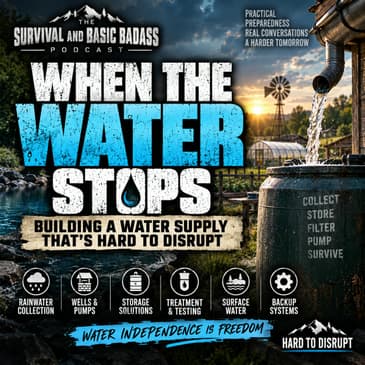
What happens when the water stops flowing?
Whether it’s a power outage, contaminated municipal water, drought, equipment failure, or a long-term grid-down situation, water is one dependency you can’t afford to ignore.
In this episode of The Survival and Basic Badass Podcast, Chuck and Kevin break down practical ways to build a water supply that’s harder to disrupt. We cover rainwater collection, how much water you can actually collect from a roof, storage tanks and barrels, gravity-fed systems, wells, 12-volt solar well pumps, hand pumps, shallow well points, ponds and surface water, and the importance of testing and treating the water you plan to use.
More importantly, we look at water as a system. Having a well doesn't help much if you can't pump from it when the power goes out. Stored water eventually runs out. A backup that depends on the same thing as your primary system may not really be a backup at all.
The goal isn't to predict the disaster. It's to identify what your life depends on and build alternatives before you need them.
Build a life that's hard to disrupt.
Topics include:
• Rainwater collection and storage
• Wells and off-grid pumping
• 12-volt and solar-powered well pumps
• Hand pumps and shallow well points
• Gravity-fed water systems
• Water testing and contamination
• Backup water sources
• Building redundancy into your homestead water supply
Learn more about the Hard to Disrupt approach at hardtodisrupt.com.
The Survival and Basic Badass Podcast — practical preparedness, self-reliance, homesteading, and building systems that keep working when everything else doesn't.
Learn more about your ad choices. Visit megaphone.fm/adchoices
[00:00:00] Academy Sports and Outdoors. Fun can't lose. Shop now.
[00:00:30] Passform. Altra versteht das einfach. Altra, stay out there.
[00:01:07] Electricity. We worry about things coming from the man, you know, the municipal water supply. We worry about, you know, all the resources. What if the water supply got tainted, right? You know, we occasionally hear stories about, you know, large areas getting bad water. Sometimes it's lead or sometimes something bad gets in the river, you know, where the water comes from, different things. And it shuts down what we have access to.
[00:01:33] Now, obviously as preppers, the goal and dream is always to have a well and be kind of self-sufficient. Even better if that well works off, you know, solar or some kind of off-grade electricity that we're able to get that water out. That makes it a lot cooler, makes it accessible. Maybe grid power goes away, you know, maybe something like that.
[00:01:59] You got to keep your options open and see what you can do. But there's a lot of ways. And sometimes we just want to set up a homestead in the middle of nowhere and we need water. And I know this season, this year, we had a hard go of a lot of drought, a lot of, you know, just long periods without rain. And with that, it, uh, it kind of made it a little unnerving to keep watering the garden.
[00:02:27] And it would have been nice to have extra water. Uh, cause I use, you know, I use my well, but you always hear stories. Like I actually, I heard of people in my town where their well is running dry this season, you know, cause they go so long, you know, watering big areas. Now, usually a good, well, that's not really a problem, but it always can be. And there's always a little fear in the back of your mind that, Oh, I might push it. You know, maybe I don't water as much as I should. Right.
[00:02:57] Maybe I don't fill the kids swimming pool cabin. Mm. Yeah. Now there's some places, uh, in the United States and in the world where, uh, water is scarce, right? Um, a lot of places in the United States, especially the Northeast have, you know, as much water as you can use. It's, it's not going to run out. If your well is, is deep enough, you're never going to run out of water.
[00:03:21] Um, but that's, that's not the case in, you know, a lot of places in the Midwest, uh, in the Southwest. That's not the, not the case. You know, you can have water shortages that are, you know, significant. Yeah. And, um, you know, when it comes to, to, to water, you can, it's not something you can go without, you know, and maybe your crops dry up, your vegetable garden dies, but you're going to die pretty quick too.
[00:03:50] If you don't have water for yourself. Right. And so that's it. I just wanted to kind of dig deep into what are our options? Like, what could we really do? So one of the big ones, right. Is well, one as a prepper, we want to make things easy. Right. I mean, I might have a, uh, a big, they call it a surface. Well, you know, a big hole in the ground where I can throw down a bucket and wheel it up, bring it back over to the house.
[00:04:20] But that's a lot of work. Um, or, oh, I want to flush the toilet. Let me take 15 minutes to go collect enough water, bring it, you know, bring the bucket back to the house, dump it, you know, put it in the toilet and I flushed it. Yay. You know, that, that makes you want to flush once a day. You know, you gotta keep options open. We don't need things stopping up when we can't call the plumber.
[00:04:45] Um, hopefully if you're prepared to live in this world, you don't need to call a plumber for a stopped up toilet, but you never know. So Kevin, you got to keep your options open, right? That's right. Um, so what do we do? So there, there's a few things available to get water. Uh, turns out that stuff just falls out of the sky, Kevin. Yeah, it does. Just right, right out of there. So you can actually set up some kind of rain catchment.
[00:05:15] Um, and there's a couple of cool ways that you can do this. Uh, basically, so obviously we're talking about gutters first. Um, so on a roof and we can actually implement a roof, right? You can take a big tarp, run it up with four poles and have it, you know, kind of pitch to a middle point, you know, have it sag low and angle things just right where it could flow into a bucket.
[00:05:42] I mean, you could do that and you know, that's an option you have available to you. But obviously it's a lot easier if we have a big metal roof somewhere. I like metal cause it's not all full of, you know, gravel and tar and all the things that come with shingles. But, uh, and water with gravel and tar and it puts hair on your chest. Is that, that's how you do it, Kevin? Okay. So we could catch that, you know, in the gutters.
[00:06:10] And then that goes down into a, uh, in a, maybe 55 gallon drum, whatever kind of big storage buckets, um, containers, you know, that we could use. You could also use buried containers.
[00:06:22] Now, the cool thing is if you had a setup with either stacked barrels or a setup with something possibly high on stilts and by high, I mean, three feet off the ground, four feet off the ground, basically above the height of a hose that you're going to want to use. Right.
[00:06:42] Then you could attach a hose to the bottom of that water system and the weighted the water will be enough pressure to kind of run your things. That's kind of a cool option you have available to you. Um, now, obviously that water pressure would depend on how much water is above it. Now it might not be high flow, but when you have a full system of, you know, 300 gallons of water, all that pressure, that will kind of be high. High flow.
[00:07:12] When you have a system with five gallons of water in there, it might kind of slow down closer to a trickle, but the trick is to have it up high and let gravity do the work for you. Um, when you set up a system like that, you're going to be wanting to look for a way to kind of filter that water as it comes through. Now, again, a metal roof, no big trees or anything crazy hanging over that roof.
[00:07:37] You probably don't need much, maybe just a screen and you're able to kind of clean up and, and purify that kind of thing. Now notice I said purify, and that's cause you want to make sure this water is still safe to drink at this point or something, you know, when you get into a more sketchy area, you might need a little more of a setup, you know, where it does run through a water filter.
[00:08:04] They do sell water filters. It's definitely possible to make your own out of stuff that you just have on the property. That's another way you could go. So that that's definitely an option, but yeah. Yeah. Rain catchment. Um, one of the cool things we used to, uh, if we catch it and fill a barrel of water, we could put it on a pallet and we'd end up taking it like with the tractor with pallet forks.
[00:08:31] And we could move it around to an area and have that hose and water kind of on demand. So that's another thing to think about. You could do, maybe you don't have a tractor and pallet forks. Maybe you have an old truck. That's a farm truck that you kind of leave it, you know, in the bed of the truck and, and work things that way. You know, there's definitely options available to you, but how much water can you actually get Kevin from a roof? Like, is it even significant? Is it worth it?
[00:08:58] Yeah. So, uh, there is a significant amount of water you can collect from, uh, from your roof. Um, so it's, um, uh, 0.63 gallons per square foot for an inch of rain. So every time, you know, and that's an inch of rain is a lot of rain, you know what I mean? So, but a square foot is not very big, right? So, so your roof is, is probably, you know,
[00:09:26] if you have a decent sized house one, you know, your house is gabled. So you have each half. So you probably have almost a thousand square feet on one roof. So that's almost 500 gallons for a heavy rain. Nope. So that is, that's a lot of water for a heavy rain, you know, cause that's it. I would say, I mean, it's rare. You're going to get an inch in one rainfall, but a half inch where I live, that's fairly typical.
[00:09:56] I would say, I don't know. It's summer. We're getting really lighter, more sporadic rain than we usually do. But I would say if you're looking for something like twice a week, it's like 0.2, 0.3 inches we'll get.
[00:10:10] But I would say once every three weeks we get like a 0.6 inch, 0.8 inch, you know, rain, you know, that those hard day where it's kind of raining all day and whatever. I know last night we just had like a quick storm roll in and I go out, check the rain gauge half inch. I'm like, all right, you know, that's decent for, you know, a quick little burst of, of energy there, burst of rain. So that's something to think about.
[00:10:37] Yeah. So there's 47 states in the United States. There's no restrictions at all on, on collecting rainwater and using it. However you see fit. There's three states though, that, that give you a hard time. Yeah. So the Colorado is the strictest one. They get very little rainfall. And so they, they have significant restrictions on it. What you can do in Colorado is two 55 gallon drums.
[00:11:07] Um, but you have to use that water for watering your plants. Like, uh, you know, you can't use it on somebody else's property. You can't take it to a different location. You have to use it on that property. I can drink it if I'm dying though, on my deathbed. Right. Well, I mean, what are they going to do? Really? You know what I mean? You, you can drink it if you want to drink it, just make sure you piss it back out in the lawn. You can't do it. You can't flush down the toilet.
[00:11:35] Right. Because if I go to work and then piss there. Yeah. That's a different location. Or remove the water from the property. Okay. Yeah. All right. So Nevada, um, some counties require a low cost permit, but it's county by county there. It's not a, uh, statewide. There's no statewide regulations. Okay. Um, Utah, uh, you can store up to, uh, 2,500 gallons. That's pretty significant.
[00:12:03] Yeah. But if you want to store more than a hundred gallons at a time, you have to register it. It doesn't cost anything, but you have to like let them know you're storing water. I feel like the government's always trying to put me on a list. Yeah. That's it. That's it. I'm already on the tax roll list, but now all of a sudden I'm on the crazy water storage guy list. Uh-huh. I know about that. Yeah. Now that, that's something you gotta watch out.
[00:12:31] They're gonna come and seize your water. They, they know where it's at. They know where it's at. Oh, that guy's a water hoarder. Right. A hoarder, Kevin. But most places in the United States, you can just do, I mean, it's just, you just do whatever the fuck you want. It's how it should be, you know? All right. Just do what you please and make your own choices. You make your own decisions. All right. I like that. Now that said though, laws are changing all the time and everybody should check their own laws.
[00:13:00] You know the, I know I, I never understand like things like slant drilling and stuff. And they actually do that for water in like California. I don't know. There was some series on prime about Big Sur and, and all that stuff, but there is a big thing to water rights and things like that. And it's kind of crazy. Absolutely. If they can steal all your water and make you buy it. They're the big ones. They're, they, they love that.
[00:13:25] They're, I think it was their CEO that got caught saying like, um, clean water isn't a human right. Which is, which is fine. Like whatever is a human right is a whatever. But at the same time, like, what do you mean by that? What do you mean? It's not a clean water isn't a human, like you can poison it and have no consequences. Is that what you're implying? Like, what do you mean by, by saying that?
[00:13:51] Clean water is a human right in the sense that it's a right to, you have a right to live in the United States. Right. It's the first one. Life, liberty, and pursuit of happiness. It's the first one. You know what I mean? Kevin, in no way is that representative of the, the values here at, at wherever we are. But no, you, you need to, I mean, this is Kevin's opinion and his interpretation of what that guy said. But that's just my opinion.
[00:14:20] And this is why Kevin's not allowed to have free thoughts. I mean, it's in the constitution. It's not, I'm not just making this up, you know? But whatever, you know, do whatever you want. If you hate the constitution in America, I guess that's okay to do. That's okay. Yeah.
[00:14:39] And if you're run a major corporation in the United States and you can use your money and power to affect regulations, then just do what you think is best brother. There you go. All right. Cause money buys freedom, Kevin. Let me tell you that. And it also buys other people's freedom from them. So that's, that's cool. You can do that. Kevin, shame, shame. All right.
[00:15:08] Let's look at option number two. All right. Now maybe we don't have the area, the square footage to, you know, the roof space. Maybe we don't like gutters for some reason. Um, we, if we live in the middle of nowhere, um, we might still have a well though on the property. And a lot of times properties used to have a well and then municipal water came along and the well doesn't get used anymore. Right.
[00:15:37] Um, there are 12 volt, uh, pumps that, you know, people usually connect solar to that kind of thing that. So, cause running a 12 volt system and solar, that kind of goes hand in hand. Um, but what you can do is they have 12 volt pumps that for like 200 bucks, you're easily getting out of a 200 foot.
[00:16:03] Well, you're pumping it up and you know, that's pretty cool. Pretty easy. You can run a hose usually, you know, three and a half gallons a minute. That's running a hose. No problem. Um, um, I, I was questioning, I was like, well, cause my, my, my 12 volt pump is, is three and a half gallons a minute. And I was like, is that even enough to run my hose or sprinkler or something? I was like, it sounds light to me.
[00:16:27] And then I was taking a shower and it was like 2.7 gallons per minute out of the shower head. And I'm like, oh, okay. Now I know, you know, that three and a half does pretty good. Cause the shower is decent and I'm not crying, you know, so we can deal with that. Um, you know, again, uh, that's where also pressure tanks come in. Like you can go down that whole rabbit hole of, uh, you know, plumbing and storage and, you know, that kind of thing.
[00:16:57] But so that, that's definitely something to keep in mind. Um, yeah, 12 volts. Uh, what I did is I actually put it like in line. So that pump feeds my system as well, as well as my one 20 volt system, you know, well pump. Feeds the system. So they just both plug into the same thing. And there's a pressure switch that'll turn on either one. You know, I have two separate pressure switches, one for each.
[00:17:27] Um, you know, I've, I've dug into that in the past, but again, a good 12 volt system. Like that is pretty cool. Pretty easy. Uh, definitely not a bad way to go. You can, you know, maybe a battery and a hundred watt solar panel, and you're probably pumping as much water as you really need. Um, again, a bigger pressure tank would give you more flexibility on what you could do. Another option is a hand pump.
[00:17:54] Now, again, I talked about like in the beginning of the episode is a hand pump isn't as awesome because you got to do the work. Right. Right. It's something. And if you're, you know, carrying a lot of volume or, or you need any kind of significant amount of water, it's going to be work. Now, usually up to a like 40 gallon or sorry, 40 foot deep.
[00:18:21] Well, you have, you can buy those regular like pitcher pumps that you see on a farm and like that. And they look simple and easy and they kind of are, uh, you know, those, they have to be primed. Basically if they leave the handle down, right. Then it stays primed and then you lift it up, the water drains out. Right.
[00:18:43] But, uh, if you're not continually pumping with it, uh, and so what people do is in the winter time, you'll lift it up and drain it down. That's why they'd always, you'd always see one of the weird stories from back in the day is you'd go up to a, a well and you would see a bucket full of water. And the well pump, now people would just take the bucket of water, be like, Oh, there's water here. Great. And then you're stuck.
[00:19:11] But if you use the water to prime the pump, then you can keep it going and you get as much water out as you want. Right. Right. That's the trick. And that little lesson that you have to learn the life lesson is you need water to start. And that's, you know, and then it's kind of perpetual. So that was always a thing. There's some stories in the Bible about things like that and different things. I don't know.
[00:19:38] Things I've read over the years, but that's what you want to do is you want to be able to prime the pump. In the winter time, they worry about it freezing. So they would lift it up and let it drain down. Right. Right. And then it'll crack, crack the casing if it's. Right. If it's. It's a thing. So that's something to think about. Anyway, but most people have a deeper well than 40 feet. 40 feet is not that deep.
[00:20:06] I thought I have a, they call it a surface well, which usually are shallow wells. That's that like three foot wide, you know, big with a cement casing. Usually might've been stone back in the day. Depends how long it's been there. But anyway, with that, I thought, oh, I'll get away with a pitcher pump and whatever. Nope. Not it. Mine was too deep. Like it was weird. Cause when I first checked it, it was like 20 feet.
[00:20:36] And then I came back in like the season when we're low on rain and then it was like 40 feet. And I'm like, oh, I mean, the well goes plenty deep. That wasn't the issue. The issue was. Yeah. How far you got to actually move it. Right. Right. And, and so a pitcher pump won't work for that kind of, of setting. Um, but that's, you know, that's the option that you need to, you know, consider what you have available to you.
[00:21:04] So the next thing is there are companies on the internet and you can search it out. They do deep water hand pumps. Um, but they can be ridiculous in price. Uh, I looked one up and it was like 1900 bucks. I honestly couldn't find a good option that would do a 200 foot. Well, for a hand pump, that was cheap. Uh, but like I said, but there's no reason you can't do a 12 volt.
[00:21:32] Well pump and throw it down there and pump out 200, 200 feet deep. No problem. No problem. You just got to look at your options and what's available to you. Um, and thinking outside the box, that's, that's definitely the trick. Now, obviously getting a well dug, that's another big expense. And a lot of people, that's why they don't do it. Right. They're like, Ooh, you know, it's like 20 grand to get somebody to come in with a big truck. It depends how deep it is, where you are, how much it would cost.
[00:22:01] But I, I think I rarely hear of a story where it's going to be like less than like eight grand to get a well dug, but maybe I'm, I don't know. I haven't been all over the country. I don't know what people do for money, but. Yeah. There, I mean, there's some rednecks out there that'll do a lot of work. Yeah. Okay. So the next option is a well point. Now this is kind of cool. Uh, they sell kits on Amazon.
[00:22:28] I saw one for 178 bucks and basically it's a metal point, like a, like the end of a spike or something. And it basically, after that, you're going to have a long piece of tube pipe that, uh, it's going to have like a screen with holes perforated through the side. And it's going to be like usually two feet of, you know, openings to be able to let water
[00:22:57] seep in. Uh, so what you'll do is you'll put a cap on the end of that. Cause they're threaded right at the end of each piece of pipe cap on it and you'll bang it into the ground. Then you'll undo the cap. You'll put another piece of pipe, thread that into it, bang that into the ground, you know, with the cap. Cause basically the cap is to not beat up the threads, right? That's the idea of that. And you just keep repeating that until you hit a depth that you feel like you're going to hit water.
[00:23:27] Um, usually if you find the right area, you're usually talking about 15, 12, 15, 20, 20 feet, something like that. And you'll go that deep and you'll have water. Uh, the idea is you want to find a place that's typically wet, right? And, you know, just kind of stays where the grass stays green.
[00:23:54] Now I thought, I know you're thinking your septic tank or your leech field. That's not the place. That's not the place you want to do it. That's not the place you want to do it. You want to, you want to be a bat 200 feet away from any septic tanks. Um, that, I mean, that's a good distance. Um, depending on the size of your property, it might be hard to do, but you really don't want to be pumping your sewage back up out of it. That's a no go.
[00:24:19] Um, so anyway, so if you're in the woods or a wooded area, you want to look for like where ferns grow. Usually there has to be water like pretty well all year for ferns to kind of maintain. That's kind of like the secret go-to like, Oh, one, they're easy to recognize. And two, they're, you know, you can kind of dig into that. So that's an option, right? So well points pretty cool.
[00:24:46] Um, and then basically you end up putting like a pitcher pump on the top of that and then you're able to, you know, pump water out of the ground and that's kind of cool. You get options. So that's the, the guy who I can't afford a big well, but I needed something to do. That's another way you can go and, and kind of work that. But that's really, I mean, you know, a lot of good options, right? So we have rain catchment, right?
[00:25:14] Right from, you know, comes right out of the sky for free. Um, obviously if we have access to rivers and ponds and things like that, we can get water out of there. Um, the big thing is if you actually care about living and, and being healthy and things like that, you might want to get the water tested beforehand. Right. Um, like, so you set up this system and then you could take it to the local place.
[00:25:43] Like everybody's got a local place to test their water because when you buy a new house, a lot of the companies actually require you to test the water before purchase to make sure things are copacetic, if you will. That's a big word, Kevin. People use copacetic copacetic. Um, some people used to say kosher back in the day, right? It meets the standards. Um, anyway, so that's an option.
[00:26:13] Right. Get the water tested, make sure. And it's weird because you want to test for different things. Now, obviously you could call your local health department. That would be your smart play. Um, how do I find out what's good in my water? You know, what should I be testing for? Um, typically the big thing is like any kind of E. Coli, right? That that's looking for poos and bacteria. Right. You know, in your, in your water. So that's a big one. Yeah.
[00:26:40] E. coli is, it's a inexpensive test. You can do it really cheap. It's a very fast growing bacteria that grows almost everywhere. So if you don't have E. coli, you can be pretty confident. You don't have any other bacteria. Um, so just because you're positive for E. coli doesn't mean that there's something dangerous in your water, but it does mean that there's potential for something dangerous in your water. Okay.
[00:27:07] Now the things that you need to worry about are like heavy metals, right? Um, lead, uh, uh, you know, a lot of different types of heavy metals that can be kind of expensive to test for, but generally you're getting things like that from your plumbing, not from the water source. That's it. You're not going to have lead in your water. It's probably because you have an old house with old pipes. Right. That have lead. Right. Yeah.
[00:27:34] That's the, uh, lead line, which usually when people have lead line pipes, it's usually for wastewater in their house in the United States, which we actually do that a lot. And they start to break down, especially in like the Northeast. It's really weird to me that I don't, sounds expensive. I don't know. Yeah. But yeah. So that's an option, right? Is getting it tested. Uh, like Kevin said, lead stuff like that.
[00:28:03] Um, I know if you live out in the country, like me, a lot of the properties used to be big farms, big tobacco farms, big cotton farms, big, you know, that kind of stuff. And with that, you have a lot of pesticides that were used over the years and nobody wants to admit this, but they used to use pesticides a little bit liberally back in the day. And it turns out reckless with that stuff. Yeah. There's still a little reckless with it. Mm-hmm.
[00:28:33] You ever buy some fields with your windows open and you're like, Ooh, what's that? Yeah. That's the cancer. You don't want that in your drinking water. Right. Um, let me, uh, let me say, so again, calling your health department, they might be able to steer you into what to look for. Um, you could possibly, I, I know this is kind of where my wife got a lot of the information
[00:28:59] was she talked to the local, uh, what is it? The, the farm bureau kind of people, right. You know, the, I don't know what the cooperative extension, that's the one. Right. She talked to them and was like, you know, what kind of thing for people using in the fields. And especially if you know, Hey, my property used to be a tobacco field. Hey, my property used to be this. And then you could say, what kind of chemicals should I be looking for when I test my water?
[00:29:28] Cause I know when I went to the water testing place, I was like, well, what should I test for? And they're like, I don't know. You have to tell us, we don't know anything. And I'm like, thanks. You're really helpful. Appreciate that. You know, that's something to, you know, watch out for. Yeah.
[00:29:49] One thing to, uh, be conscientious of is, um, PFOAs and, uh, POS, um, which is a chemical that was manufactured in the, in the seventies, eighties, nineties, that you can test your water for it. It's about a thousand dollars. Oh, it's a little pricey Kevin. It's, it's very pricey. Uh, you can save that money by just, um, you know, it's in there. It just, it just is.
[00:30:19] It's in there. It's, it increases your chances of, uh, of, um, uh, liver and, and pancreatic cancer, um, causes birth defects. Um, and they just dumped that shit everywhere. I'm just saying it's good. It's good for corporations. They made a lot of money off of it and they could dump it with no. Uh, restrictions. So they dumped it everywhere and it basically leached into every source of water in the United States. Now that was a long time ago before we were responsible.
[00:30:50] Yeah. They don't, they don't, they don't dump anything anymore that could possibly be toxic and leached into water systems. I'm sure. I'm just assuming that, that they are, have our best interest at heart. I feel like people don't really appreciate the New York sarcasm. I don't know. Now, now I know how, like all the, uh, the people I, I deal with in the South here, you know, they look at me and they're like, are you crazy? And then that's how I still look at you.
[00:31:20] It's like, cause I'm that far removed, you know? Like they should be grateful that they're getting the censored down version. Right. Right. Right. You know, but it's not easy being us. That's just, all I'm asking is that you just think about how the corporations feel. That's all. Just, you know, sometimes it's, it's good to put others ahead of yourself, you know? All right. Others ahead of myself. That's, that's a hard lesson, Kevin.
[00:31:49] Mm-hmm. That's not something we easily adapt to as a society. So anyway, I appreciate you guys. I like that. You're always, you know, sticking around with us. And like I said, the big thing is we want to build a life that, you know, very little or very few things can disrupt on us, you know?
[00:32:14] And if we can produce our own food, if we can supply our own water, you know, those are the tricks, right? That's how you do it. You know, that's the thing. So we, we did, we are putting stuff on the website, kind of trying to build it into something hard to disrupt.com. And you can see that, you know, we're making it that you can build a life that's going to be sustainable, right?
[00:32:43] You can find all the older videos, all the things, you know, over time, we're putting together a course, going to try and figure that out. Probably even eventually put it into a book, something like that. But hard to disrupt is what we're trying to do and make it where we can be sustainable and have a homestead that no matter what happens on the outside to the rest of the world, we still have the best tools in place to be able to push on.
[00:33:11] So with that, I'd say stay safe and we'll talk to you guys next week.