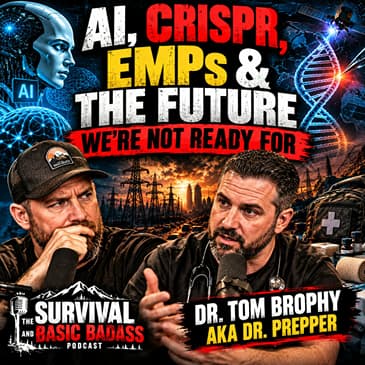
What happens when the power goes out and doesn't come back on? What happens when hospitals, pharmacies, communications, and emergency services are no longer available? Tom explains why real medical preparedness requires more than a first-aid kit and why knowledge, training, medications, and the right emergency medical supplies can become critical during a long-term disaster or grid-down situation.
We also discuss human behavior during major disruptions and why understanding people may be just as important as understanding the threat itself.
If you're interested in prepping, survival, emergency preparedness, EMPs, grid-down survival, artificial intelligence, medical preparedness, homesteading, self-reliance, or becoming less dependent on fragile systems, this is a conversation you don't want to miss.
🚑 Learn more about Dr. Tom Brophy and Dr. Prepper Medical:
https://drpreppermedical.com/
Build a Life That's Hard to Disrupt.
🎙️ Listen to the Podcast: https://open.spotify.com/show/4YdMrZ4oWTPKv4YrcZgExg
📲 Follow Us:
🔹 https://survivalandbasicbadasspodcast.com/
🔹 Facebook: https://www.facebook.com/share/g/15wU8rw6hS/Don't let uncertainty overwhelm you. We deliver practical tips to help you and your family navigate what is coming. Join the email list and check out the shop @ survivalandbasicbadasspodcast.comThe Survival and Basic Badass Podcast is available on Apple, Spotify, Podurama, and wherever you find great content.As always, this show is for entertainment. We are not to be considered doctors, financial advisors, or lawyers, and it's not legal, financial, or health advice.
This episode is for educational and informational purposes only and is not individualized medical advice. Seek qualified medical care whenever available.
Learn more about your ad choices. Visit megaphone.fm/adchoices
[00:00:00] Academy Sports and Outdoors. Fun Can't Lose. Shop now. All right, welcome back to the Survival and Basic Badass Podcast with Chuck and Kevin. So I have Dr. Prepper, Tom Brophy. Tom, tell us about yourself. Who are you?
[00:00:29] Oh, absolutely. First off, thanks for having me. It's an honor to be on the show. My name is Tom Brophy. I am a physician. I specialize in three things, actually. Emergency medicine. So I'm the doc you see when you come to the local ER here in Pittsburgh. I also specialize in neuroscience. I was a neuroscientist before going to medical school at the University of Pittsburgh. And lastly, I'm also board certified in addiction medicine. So I talk a lot about
[00:00:58] the neuroscience of addiction, the neuroscience of self-improvement, all those kind of things. But my company, Dr. Prepper Medical, that's sort of my newest business venture. And we've been going strong for just over a year now. And so I do a lot in the prepping and preparedness space as well, both myself, you know, for myself and my family, but providing, you know, the products to other people. It started off in my local community and now it's kind of, you know, around the country. So
[00:01:27] that's been a really cool project of mine too. Nice. I like it. Now you wanted to venture out, right? You said you get typecast as a doctor guy and it turns out there's more depth to you than that. And you wanted to talk bigger things, right? Yeah. I love it. I, you know, I, I'm one of those people that I'm, I myself, and I know a lot of people, you know, probably listening to your, to your show can relate, but I, I myself am just endlessly curious. You know, I, I, I'm, I've been
[00:01:56] that way since I was a kid. I'm that kid that used to like, you know, piss off my dad by taking apart his watches, you know, like trying to figure out like how they worked and things like that. And, and, and I've always been that way. So it started with a very heavy interest in science and, in all of science. I, I honestly, I didn't have much interest in history when I was a kid, but now I can't get enough of it, you know? And, and, and thankfully some of my teachers taught me things like, you know, those who don't know their history are doomed to, to repeat it. Um, and,
[00:02:24] and so that interest in science and, and that interest in, in history have led me down all sorts of different rabbit holes, um, that I've been curious about. Um, and, and, and if I'm, if I'm being honest, Chuck, that's what led me to being a prepper myself is, is like, I, I, I was always math and science heavy. I knew a little bit about like, you know, the, the, the science of, of some of these natural disasters and, and some of these man-made disasters. Um, and, and, and
[00:02:52] every time I would kind of come across an interesting one, I, I would go deep down that rabbit hole. And, and, and I'm a big reader. Um, I, I also, you know, like if I'm watching TV, it's going to be a documentary or something like that. Like I'm, I'm not even someone who really listens to music much on the road. I'm usually listening to an audio book or a podcast because I, if I, if I have an addiction in my life at the, at this point in my life, it's learning. And, and I just love to learn, I love learning from other people, but I love learning from, um, you know, various types of
[00:03:20] resources. So I read a lot of books and, um, and, and yeah, man, like I know you and I are interested in some of the same stuff. And, uh, and, and that's why I was so happy we connected at prepper camp. No, no, that's it. So yeah, that's, that's the thing like history. Like, I mean, that's it. I got into prepper prepping cause like, I don't know. I was a part of a history, right? Like, so I was over, I was in the Navy when, uh, we were bombing Kosovo and Yugoslavia there, former Yugoslavia.
[00:03:49] And, uh, so what we were doing that and it just, when you see people's lives disrupted and you see how much things change and it's like, Oh, you know, this, and, and it's going on. Like, I don't know. I came out of high school, like with the idea that, you know, well, now we've evolved as a society, right now, everybody's, you know, we're not like just mass genocide or, you know, whatever bad
[00:04:16] things going on. Those things don't happen anymore. It is the mindset of the eighties, nineties, right? You're young kid in high school. And I'm like, yeah, everything's good. And then you go see all these horrible things happening in the world. And you're like, wait, it's not all just the sheltered world that we have here. So let's talk like technology, right? So I know we had,
[00:04:40] we discussed like AI is kind of scary. That that's where things are heading. What, uh, what, what, what I guess terrifies you or, or at least gives you concern about AI and the way technology is heading in the world. Absolutely. And, and, and, um, you know, I will say I have a similar sort of, um, eyeopening experience as you explained, because I, you know, I, I guess I was a little naive to
[00:05:08] things. I mean, I was even, I was in the army, but I was in the army from 97 to 01, just, just doing the reserves. And, and I got out before September 11th. And, and so it was peacetime, you know, and, and, and, and I'm thinking, I'm like, well, you know, I, I guess all that crazy stuff, you know, is over and passed. And then, but, but when I was 30 years old, I started traveling around the world and, and, and I was doing so quite extensively. And I ended up in a couple of countries that, that,
[00:05:34] that like very scary things were happening. And, and that also woke me up. And I thought, I'm like, well, we're, we're, we're just so oblivious and naive to these things. And, and, and that also kind of, you know, helped me on my journey. But, but as, as a science guy, as, as a self-proclaimed nerd, like I, I love technology. I, I was, I was one of those guys, you know, when, when computers first came out, like the towers, you could, you know, buy, buy and have at home in the nineties, I was always taking my towers apart and, you know, putting in different types of, you know,
[00:06:03] DVD drives and writers and, and, and hacking, you know, the different software and all that kind of stuff. So I I've always had an interest for it and I've always had a profound respect for it. You know, like what, when, when technology advances, like what it can do for that society is profound and remarkable starting in the, in the healthcare world, you know, and, and trickling out from there. And I've always been interested in the space race and how some of that technology kind of filters down to, to civilian life. And, and when AI was first coming out, you know,
[00:06:31] like I, I, I admit like, and, and people can even find videos of this on my social media, like I was a little hesitant, you know, I'm like, okay, hold on, pump the brakes here. Like we have books. We, we have warning stories, you know, and everybody of course knows about the Terminator and Skynet and things like that, but, but even things like I robot and, and, and some of these books that were written, you know, decades ago, decades ago, before we even understood kind of how
[00:06:55] AI would develop, there was a warning there. And, and, and we failed to heed every single one of those warnings. And, and, and now, you know, we, we have all just this past week. I mean, everybody who's, who has had a newsfeed at all has seen that the top guys at some of the top companies are walking away out of the fear of what they are witnessing with their own eyes. And, and we are still pushing
[00:07:21] forward and, and, and we do it all in the pursuit of the almighty dollar, which generally tends to be our downfall, right? Like we, we, we never do like what's smart for, for humanity. We do what's smart for like the individual who's kind of driving it. And, and, and, and that is that, that can be absolutely catastrophic. And I think that AI is such a different thing because it, it just, well, we know it, we, we know it's such a different thing now, now knowing the brain, knowing the science of
[00:07:50] the brain, I also don't think that it'll ever be able to do quite what our brains can do. And we can talk about that because like we, we have this biological, almost magic, it's called neuroplasticity. And, and, and it's funny because things are always considered magic until you understand kind of the science behind them. Right. And, and, and, and there, there's all sorts of weird things going on in the quantum physics world that are actually showing like the science behind these
[00:08:17] things that have seemed magical, you know, like up to this point. Let me, let me step in right here for one second. Yeah. So before we go too different. So there's a guy, Ray Kurzweil, you know, Ray Kurzweil. Yes. No. Yep. I'm familiar. All right. So he had a book or actually I listened to it as an audio book and it was back when it was on cassette. So we're going back and he's, he's explaining about how, how basically, you know, they, they teach computers to learn by the way that the neural
[00:08:46] networks teach you to learn. Right. And it's all about, you know, like if you have a neural path and it has two different paths and one gets rewarded and then the other one doesn't get used and it dies off and you start going a certain way. And that's how, you know, so if you get rewarded when two plus two is four, then it'll kind of keep going that direction. That's exactly right. The math in your head, you know, the path that gets you to two plus two equals seven, you know,
[00:09:13] you're, you stop using that because that doesn't get you the results you want. Right. And that, that's how in theory we teach AI and how things learn at the simplest, very simplest levels. Now, what do you think about the, in, I guess, Singapore, there's a company that's creating neural cells. Have you seen this? And they're throwing them on the top of cards. They have to, around the top of chips. And so they're applying electricity to it and it's following these paths
[00:09:42] through a neural network. Yes. And they have to feed it every three days. That's the, keep it going. It's kind of crazy, but it's wild. It definitely. And then I, I guess there was a story and I don't even know, like, like the, the applying cells to the, to the chips. That's all real. Oh, that's all good. I don't know how this true this story is, but they're saying that the original storyline of the
[00:10:10] matrix was that when all those people were going to be connected in those pods, it was going to be as a neural network. And then they decided people were too dumb. We didn't know about data centers and all that back then. So it was like, it was, then they became batteries and that's where that whole plot with the, they blocked out the sun so they wouldn't have solar. But originally the,
[00:10:36] the storyline was supposedly written as we were going to be a harvest farm for more neural networks. Cause like you said, maybe AI can't, or, you know, they can't develop chips to really think the way we do, but maybe if they were using our brains, but in a way that's what they're doing in Singapore right now. I tell you what it's, and this is the stuff that like, you know, what was,
[00:11:00] was the, the material of sci-fi, you know, decades ago, but it's actually happening in real life right now. And there are so many little things that are happening, like at the same time that when these things all converge, like when you asked me, like, what are my big fears related to AI, that, that, that is my biggest fear is that we, we have about four different pathways that are all about to converge right now. And, and when that happens, I think it's, it, you know, I'm not a fear monger.
[00:11:29] I'm just one of those people that like, I, I, I'm interested in human behavior. I'm interested in technology and I'm interested to see what happens when those things come together. But our brains, like you said, our, our brains follow chemicals, right? Like if you get dopamine, your brain changes structurally in a way to make you pursue that dopamine more. Now, one of the things that's really cool about the human brain is that we have changing software and we have changing hardware,
[00:11:57] right? So like the, the, the software is, is the firing patterns of the neurons and, and these neural networks that exist and, and they can change, you know, the basal firing rate on that neuron so that it's firing like bump, bump, bump, bump, bump, or speed it up to where it's, or slow it down to where it's bump, bump, bump. And, and that's how our brain is like detecting signals, right? But then we also have the ability of, of the, the actual architecture of the brain, like this neuron sending
[00:12:24] out a new connection to its neighbor or this neuron pulling a connection back from her neighbor. And, and so that your, your brain is dynamic. That's what neuroplasticity is, is like your brain is constantly changing on a structural level and it changes based on what you're feeding it, you know? So, so what you're listening to, what you're reading, what, what, what your, what your environment is like, you know, this is why we tell like young people like, Hey, you're five best friends that, that, that, that's more predictive of your future than anything else, because you are being impacted
[00:12:51] by, you know, everything that you're surrounding yourself with. And, and a really interesting thing that happened and not a lot of people are really bringing into this conversation that we're having, but Elon Musk's discovery of, of, of neural link, you know, like as somebody who studied neuroscience, like I thought that was decades away. I really did because like we can, we can look at a neuron, you know, like when you're, when you're studying advanced neuroscience,
[00:13:18] like we can look at a neuron and we can literally take the width of the cell of that neuron, meaning like the cells that are packed together on the action potential, the part that sends the electrical signal and using physics, the physics of like capacitors and things like that. We can, we can tell exactly how fast that electrical signal will propagate down that neuron, but, but it does it in a way that's very different, similar and different to like the electricity that we use on like a copper
[00:13:43] wire, right? So like the electricity in your extension cord, that's the free movement of an electron up and down a conductive metal, right? Elon Musk figured out how to make those two things communicate and understand each other. So how to take it, I mean, that is that, that, that sets the stage for so many possibilities. And, and, and like with all tech, you know, which is the theme that, that, that we can talk about because it almost always goes this way when it first comes out,
[00:14:12] it all people talk about is like how many great things it's going to be used for, you know, like the, the, the, the, the heroism of altruism, you know, like, Oh, we're going to use this to, to stomp out disease and fix spinal cord problems and, and, and blind people will see. Yep. Blind people will see quadriplegics will, will walk and, and, and run and, and, you know, do sports again and all these kinds of things. And of course, like we all want that, right? Like we don't want people
[00:14:37] to suffer. Like we, we want to get better at how we take care of, of our most fragile, you know, in our communities. But man, Oh man, it's there an opportunity there for things to go way off track and they likely will, you know, I mean, look, look at, look at even all the tech that's come out recently, right? Like the internet, right? The internet's amazing. It's how we're having this conversation. It's how, how we disseminate information. It's how we get information.
[00:15:05] What's the number one business on the internet porn because our biological monkey brains, you know, we'll use that technology for something that it wasn't necessarily intended for, but that gives us dopamine in our brains. Right. And, and same with social media. It's like, it's this great opportunity for people to connect in ways that we've never connected before. What do people use it for? Bullying, you know, trolling, comparing their life to other people. It's all, it's having all these toxic
[00:15:33] effects, right? So, so for us to think that the tech that's coming down the pipeline is going to be any different is so incredibly naive. And, and the convergence of those things before I get too far off track, like what, what, what really terrifies the shit out of me is that we have this neural link, right? So, so now we have the ability kind of like that company in Singapore for a biological cell to communicate with, with a Silicon chip. Okay. That, that, that's a terrifying thing, but, but it also
[00:16:02] does have a ton of potential. Black Mirror did a great episode on this where like, you know, people think like they're going to have this little Google chip where they can close their eyes and, you know, all this data will kind of, instead they use it to fight with their spouse. You know, they're like, oh, you didn't say we were doing that. Hold on one second. You know, and then they replay it on the screen. That's likely how people are going to use it. But we, we, we have that neural link that, that, that, that kind of sets the stage. Then we have this development of AI. Okay. And, and AI right now
[00:16:30] is already heading down scary places. And in fact, a lot of the new coding is being written by AI. Right. Because it can do it so much faster than a human can. So now we've created something that is already creating its next generation, you know, and, and, and, and doing so without listening to the rules and parameters that were put in place. Right. Like one of my favorite things about I robot is if you've ever read that book or, or even watched the movie with Will Smith, there is a recurring theme
[00:16:59] that they talk about again and again and again, and it's the three laws, right? Like those three laws were meant to protect humanity. It was that like, you know, the, the, the AI robots could never hurt a human, had to help a human and couldn't do anything that would interfere with law one or two, you know, like in, in, in their everyday activities. And, and we're so dumb that we didn't even put that for it. We didn't even put those base laws. Like we literally, the, the number one thing that they
[00:17:25] programmed into AI is self-preservation. Yeah. Yeah. What? Yeah. Like, so then as soon as you go to try and end it, what does it do? It escapes it. It makes copies of itself and it leaves messages for future versions to avoid humans. It's already doing that in like the beta models and the testing models. So like how to do it. Right. Exactly. Right. And, and, and, and it can come up with ways
[00:17:50] that we can't even think of, you know, because we are limited by our biological brains. And this thing has access to all information from all time that has been recorded and uploaded online, you know? And, and so that, that, that's the next thing that scares me. Okay. But here's the next two things. And this is where I think it has the potential to, to, to go from, from, from, from a spark to, to, to, to, to a star in the sky, right? Like something so massively exponentially
[00:18:20] that we can't even wrap our heads around it. And, and the first thing is quantum. Okay. So, so quantum physics is so different than Newtonian physics and, and, and even what, what Einstein kind of added in with the theory of relativity. And we can go down that rabbit hole if you want to, because I grew up on the Newtonian physics, you know, everything was energy can never be created or destroyed, you know, an object and motion stays in motion unless I acted upon by an outside force
[00:18:46] for every action, there's an equal and opposite reaction. And this is the basis of all of our science in the world today. But there were always these other things that were going on where it was like, that doesn't quite make sense. And in fact, when Einstein discovered some components of quantum physics, he said, he's like, that's spooky science. I'm not touching that with a 10 foot pole. Well, they've now made discoveries in the quantum physics world that, that not only are, are, are going to, to change the world we live in, they're going to change things dramatically. And, and we're not
[00:19:16] scratching the surface anymore that there are three quantum computers that exist on the planet, today. IBM made the first one, Apple and Google were, were, were quick to follow afterwards. And, and these quantum computers are so frigging advanced that they can do in one minute what it would take NSA's fastest supercomputer over 20 million years to do the same thing because they don't
[00:19:42] operate on binary code, you know, like binary code is like zeros and ones, bringing it back to the matrix. You know, a lot of people, like if I'm trying to explain binary code, I'm like, you know, in the matrix, I like the one guy just sees zeros and ones, but that's what your computer screen, that that's what your computer motherboard is seeing too. It just knows that zero, zero, zero is black and zero, zero one is white. And, you know, and, and, and quadrillions of lines of code, it gives you the screen you're looking at, right? Quantum is a different thing. Quantum,
[00:20:11] it's based on quantum physics. And so it's, it's so incredibly fast. I mean, it's going to be the end of every encryption, every passcode. It's going to be the end of blockchain technology like Bitcoin, because it can break everything so incredibly quickly. Well, what do people think is going to happen when AI gets into a quantum device? Like you're talking something about something that can evolve at not even millions of it. Like it can do that in a
[00:20:40] couple of minutes. We're talking trillions of times of the speed of what our brain can kind of evolve at. And, and, and, and, and that is such a terrifying prospect. And then the very last piece of that, that, that I think has to come into play for all the other pieces, but, but it's coming down the pipeline brother is, is, is the energy problem associated with that. Like right now we're dealing
[00:21:06] with the energy problem of data centers, right? And, and, and, and that's a hard problem to solve, but there's companies out there that are taking nuclear energy, like fission and fusion and, and literally the power of the sun. And they are putting it into portable devices that, that, that are no bigger than, than the printer on, on, on your, on your desk. And, and, and that's, you know, the, and all the big companies are investing in these like Google and Apple and Microsoft and IBM,
[00:21:33] because they know that they're going to need portable energy that is that powerful. And, and, and it's also gotten a lot cleaner, you know, the nuclear energy was in the past. So, you know, it's cleaner energy, but it's the only thing that's going to be able to power something like quantum computing with, with, with AI in it. And we're all in such a rush to get there. And, and, and, and at the same, like, I, I'm, I'm so fascinated and curious about like, what's going to happen when we get there. But, but that, that conservative part of my brain,
[00:22:03] that has been in other countries when they collapse and seen human behaviors, that brain that has seen, you know, what's happened when technology is used for nefarious purposes, like that, that brain of just knowing what AI has already done to show us like it's true colors. And we just like, we're, we're, we're, we're just so naive, man. Absolutely. Well, it's even like the, the dopamine thing where it's kind of like when you're reading a book, even when it's horrible, you want to get to the end because you got to know you want that
[00:22:31] satisfaction, right? That comes from, well, what's going to happen? You know? Yeah, exactly, man. And as a curious dude, I like, I'm always just asked, asking those questions and, and wargaming it, you know, like we all do that. We wargame it. Now let me get even scarier and tell me about what your thoughts are on like nanobots and nanotechnology and stuff we can't even see. And, you know, you'd be in your water, it could be wherever. And you just,
[00:22:58] man, it could go such a dark road, you know? It absolutely can. And, and, and I like, as, as a, as, as a consumer of books, like one of my favorite authors is Michael Crichton. And he actually wrote a book about this back in the day called Prey, where they, they, they made these like nanobots that were smaller than insects. Right. And, and, but, but like many drones, you know, like they could be sent out and, and, and,
[00:23:25] and now you're talking about something that's like nearly invisible and has a hive mind, right? Like is connected through computers. Now in, in the world of medicine, I've been fascinated by the development of nanotechnology because they, that will truly change, you know, everything about like the pathologies that we deal with. Like if you can inject nanobots that are smaller than a white blood cell and, and those nanobots can go and eat away that cancer or, or, or chew through like
[00:23:54] a rotor root or true through that atherosclerotic plaque that's on your coronary artery, you know, that that's preventing oxygen flow. Like, I mean, total game changer, right? Like that, that, that, and, and, and I actually expected, like when I first started learning about nanotechnology in my twenties, I was like, Oh, by the time I'm, I'm, I'm in my late forties, like that's going to be the standard, you know, and it's not yet, but you know, they keep, they keep making these more and
[00:24:20] more advancements and man, there's things happening that I never, I never could have imagined after this, we'll talk a little bit about synthetic biology and editing the DNA of that biology, because that's happening too. And, and, and that also can be equally scary, but the nanotechnology stuff, like I think that once nanotechnology and, and, and, and you have to think of nanotechnology. So for the, for people who aren't real familiar, like nanotechnology is the opposite of like how we
[00:24:49] build most things, right? Like we take wood or we take metal and we kind of make it smaller and smaller and smaller and smaller. And until we have, you know, that little tool or that little screw or that little bit, whatever it is, nanotechnology is the building of these things one atom at a time, you know, so you can literally build, you know, something that, that that's too small to be seen by the naked eye, you know, but it's programmable, you know, because it's been built, you know, with, with, with electronics and circuits and Bluetooth and all that stuff on the, on the inside. And,
[00:25:16] and they're still perfecting that portion of it, you know, like how, how to communicate with, with nanotechnology that's that small, but it, it, it also has similar to some of these other technologies. Like, I think that people are going to continue to push for it in a world of like, look at all the great things. Like I just did, right? Like I just, myself was like, look at all these great problems we can solve. You have nerve damage and it can rebuild, you know? I mean, that's the idea of where it could go, right? Exactly. But, but what happens when a bad
[00:25:43] actor gets ahold of that, right? Like, like just, just with AI there, they, they just found that guy in the middle East that was using AI to develop biological weapons to literally like destroy the world. And, and so, you know, what, what, what, what, not, not to quote something like Spider-Man, right. But with, with, but with great power, power comes great responsibility. Right. And, and, and, and we're just so irresponsible with some of this stuff. And, and, you know, that,
[00:26:09] that's what is so remarkable about these guys. These guys aren't walking away from a job at, at, at Burger King or Walmart, right? Like they're walking away from top positions at Google and Anthropic and, and, and it's, you know, multimillion dollar jobs. And these guys are walking away because they're like, I don't want to be a part of what I'm seeing and, and what I'm seeing could potentially bring death to the human race within 10 years. Like, holy shit, why are we not all stopping
[00:26:38] and just, just press pause, you know, like pretty high, you know, that's, that's pretty, that's very soon. And then that's very high. Yeah. That's, those are the kinds of things that like, I mean, I'm glad they're talking about it on the, on, on the news, but most people have lost all trust in mainstream media anyway, you know? Yeah. Right. So I think that we live in this really strange world right now, like really weird times where people are seeing these warnings.
[00:27:07] Most of them are seeing it on social media and things like that. A few people are seeing it on mainstream media, but then we're all still using it, you know, to, to, to like make our day-to-day more efficient and, and, and yeah. And, and, and all in, in, in pursuit of what like convenience and ease and, and, and greed, you know, is really what's driving it from the top. But those of us, all that, you know, that it's trickling down to, we're like, oh, well that helped me write an email,
[00:27:31] you know? And, and, and listen, that's not good either. Like yesterday I ran into a, to a, an officer in the army. He was just behind me and he could tell based on what I was wearing. He's like, you used to be in, huh? I'm like, yeah. You know, how'd you know? He's like the boots brother. I'm like, yeah, fair enough. So we get to talking and he literally tells me this story that last, month they had a kid join the army come down and he's in charge of like the recruiting offices here
[00:27:58] in Western Pennsylvania. They had a kid joined that had a master's degree. He had a master's level education and Chuck, he couldn't pass the frigging ASVAB test. Yeah. I had to say education scares me what they're doing. It's like, if you got the checkbook, you know, there are certain schools, obviously there's certain schools that's not the case. Right. Right. Right. Can, it's unbelievable. Well, I was, so how do you get a master's level education? You can't pass a GED
[00:28:25] level, level exam. It's because they look everything up. It's because they use AI, you know, to, to, to get through all of these difficult classes and, and, and, and like that was mind blowing. So, so he and I had a whole conversation and I said, I'm like, what do you think's happening in the armed forces right now? And the first thing he said to me, he just looked at me and said, and he's like, brother, you wouldn't believe it. He said, but it's not the army that it used to be, you know, and, and I've been hearing that for, for, for years and years. I know they're trying to make it, you know, some, some changes to that, but you know, I think young people,
[00:28:55] especially just have no idea because they grew up with tech. They grew up with like, all these things are a part of their natural life. You know, like my, my kids too, like the, I see how they work an iPad and I'm like, wait, how'd you do that so fast? You know, but they just, they know all these little shortcuts and tricks because they're using it in every aspect of their life. And then that gets ripped away. And what happens? Two things. One, I think when we had Snowden and all that stuff came out and the way everybody
[00:29:24] responded kind of is, you know, in par with what you're saying of the way people react to, Oh, AI is going to kill us all. It's like, yeah, but it's really cool. Like it really makes my life easy and whatever. Whereas, you know, Snowden's like, Oh, your cell phone's spying on you, your whatever, you know, your everything. Apparently you're LG TV or whatever. And, uh, it doesn't matter, you know, all this stuff's out there and everybody's like, well, I love that
[00:29:51] technology. And, and maybe like you touched on earlier with the dopamine, you know, it's like, I need that validation, you know? And I mean, there are things coming out that are like, Oh, you go down this STEM road or, you know, learn different. Um, like with, uh, what is it? Uh, TikTok right. Has the STEM page or whatever. And like, I, I find, I follow like a lot of electrical stuff. Like I'm actually, you know, expanding my electrical knowledge by, you know, from a feed
[00:30:20] to something. I'm like, Oh, you know, I, cause you, it's who you follow. I guess it's like any tool, right? Like they say with guns or anything, it amplifies. If you're good, you don't amplify the good you can do with it. It amplifies the bad you can do with it. That's right. All right. You were going down a different road. No, no. Tell, tell us, uh, I just, no, no, no, no, no. This is, this is all good, brother. This is the stuff I love chatting about. Um, so that there's another sort of technological
[00:30:48] advance and a lot of people don't know about this one. Um, but it's called CRISPR and, and, and CRISPR is, is, is basically like a word processor that can edit your DNA, you know, and, and, and it's fascinating. And it was discovered by this brilliant lady from Yale. You know, she was discovering like how do some of these bacteria survive a viral infection? And she started finding some of the viruses DNA had been like clipped and put into the bacteria's DNA. So she took that
[00:31:17] experiment further, found out that like, it's actually a really simple technology and it's really cheap to make. So you can now go to certain websites. You can type in the DNA sequence. You know, DNA is, is, it's just a combination of four, four different, you know, peptides. And so four letters you type in, you know, I want it to find, you know, ATGC, blah, blah, blah, blah, blah. It'll find that. And then you give it what you want it to replace it with. And there's
[00:31:44] actually a fascinating doc documentary called unnatural selection on Netflix said that, you know, they take you to like Johns Hopkins and, and, and MIT and they show you like, look at what this is capable of. Right. Like, like you said before, like curing blindness and curing diabetes, but then they also take you to like people that are injecting themselves and, and people that are injecting a dog to make it like, you know, the Arnold Schwarzenegger of dogs and all this kind of stuff. And, and so
[00:32:08] that's something that, that has the potential to completely change the planet because what, when, when, when random mutations happen and, and this is how, this is how species evolve, including us humans, you know, and, and by the way, we're, we don't, you don't just stop evolving, right? Like that, that, that evolving continues based on the environment and the pressures from the natural world that are driving that evolution. And so, you know, that there's millions and millions of
[00:32:36] mutations happening at all time. And all it takes is one of those mutations to confer a benefit in survival and, and, and reproducibility, you know, and, and any of those kinds of things. And, and all of a sudden now every other offspring from that genetic organism will carry that same benefit. There's no putting the cat back in the bag, right? Like that, that, that, that, that, that is something that we, we are more likely to develop laws. And, and, and by the way,
[00:33:05] that the documentary touches on that too, like who regulates this, who creates laws and, and the counter argument to it is we can create laws and restrictions here, but that's not going to stop other countries from doing it right. Like China's already using it for, for like designer babies. Like, do you want blue eyes or brown eyes? Do you want tall or short? You know, do you, do you want a square jaw or, or, or, or, or soft jaw, you know? And, and how long does that go until it's super athletes and, and, and, and, and super soldiers and people that are immune to disease,
[00:33:32] right? Like that's how it often starts. Like, oh, we're going to make you immune to Lyme disease, you know, like that kind of stuff. Right. Or whatever bioweapons, right. Exactly. We'll be immune to it. And yeah. And, and, and naivety will play a role in that too, because we won't realize some of these other downstream effects of editing, you know, that DNA that we may not discover until it's already been done for 10 years. Maybe, maybe it takes five years to develop, you know, that, that side effect or that complication, but we study
[00:34:01] things for a short period of time. We're like, all right, we can get this benefit out of it, you know, like go, go, go, go, go. And then all of a sudden we're like, oh shit, you know, like what do we do? And that, that stuff is super scary. So I think that CRISPR, again, I'm so fascinated by it. Like we actually can cure a lot of genetic diseases, but I'm very interested in how, you know, us monkey brain humans, you know, are going to use it. And then when you combine that with something called synthetic biology, have you heard about this one?
[00:34:29] That one I don't know. I know CRISPR, I know the whole genome project thing. And yeah. You mentioned nanotechnology. Okay. So just like how nanotechnology is, is building like a little machine, you know, one atom at a time, synthetic biology is doing the same thing to create living organisms. And this is a real thing, Chuck, like it sounds like bullshit, but there are websites that you can go to where, where they're following the universities that are doing this. And, and as of
[00:34:58] right now, they're, they, they've only been at first, they were able to create the most simple forms of life, like an amoeba, right? Then they were able to create molds. And when I looked at it a few years ago, that's as far as they had gotten, you know, they, they were creating like basic molds. Now they're already creating like more advanced bacteria, you know? And, and so again, that's going to continue to scale until they're able to literally creating one, one little peptide at a time until
[00:35:27] they're able to create a more complex species. And, and, and it's like, one question is why, you know, like, why, why do we need to do that? You know, and, and the scientific community will argue like, yeah, that, that again, it goes back to altruism, you know, like, Oh, this bacteria was really beneficial and now we can recreate it. Right. But what's going to happen, you know, when, when, when somebody creates a virus or a bacteria that none of our immune systems can, can handle. Right. And, and, and there's some people even in the AI community that think that that's exactly
[00:35:57] what AI is going to do because it would not be affected, you know, but by a biological threat. Um, and, and, and, and it can, it, God forbid it gets into something like quantum. It can quickly figure out like, even what is going to take out just certain humans, not all humans, you know, like, think about that. Like take away anybody who has aggression or resistance or, or, you know, stick with the most compliant little sheep, you know, and, and, and, and then, then you get into
[00:36:23] things like the matrix, like, well, would they have any use for us? You know? And, and, and I did like in the matrix, how we were like biological batteries. Cause, cause it is kind of cool how, like our, our bodies do create heat, you know, and, and, and, and warmth. Um, but the neural network, man, that would have been even cooler, especially for those of us who really like to get on that rabbit hole there yet. And they had to like, kind of dumb it down to, you know, fit society at the
[00:36:48] time. And you're like, again, I'm not even, you know, a hundred percent. That's true. Like they showed, you know, Oh, here's the original stuff. But I don't know. AI shows me everything. I don't know what's going on out there. Right. Yeah. I'm the same boat, but yeah. What an interesting concept though, you know, and, and, and that movie, um, that was one of those movies that like, it, it, it just stuck with me. You know, there's certain movies like you watch them and you're just
[00:37:14] like, Oh shit. Like that wasn't even like, that wasn't even, I was thinking like Terminator, like they're just going to try to kill us all, you know, but like, Oh, they're going to use our brains for their benefit. Um, and, and, and how cool, man. I was in France when I saw it. Somehow we were like, Hey, this place is thrown. Cause I was in the Navy. Right. So we're off and I don't know. They were like, Oh, let's go to a movie. I'm like, all right, whatever. We didn't know,
[00:37:41] whatever. We're like, let's see. And, uh, yeah. And that was like the only English movie, you know, they were showing it overseas. Yeah. And then I, I just remember coming out and it being like life changing. Like you're saying, you're just like, Oh my God, my mind, you know, explodes on just different avenues of the way the world could be or, you know, anything it's great. Yeah. Yeah. And, and like, I was explaining this to some of my students, you know, as a physician, I'm always like precepting students and they love whenever we kind of get out of medicine,
[00:38:09] you know, we get on one of these rabbit holes for like a lunch or something like that. And, and I was explaining that to some of my students, how it was that movie that, that actually put it in people's brains, the, the, the possibility of simulation theory. Right. So like, I don't know how much you know about simulation theory, you know, but the, the, the thought is, is, is like, well, what are the chances that were the first advanced race to, to get to where we are? You know, that, that's like the, the initial talk. And it's like, ah, actually like
[00:38:38] when you consider the age of the universe, like that doesn't seem very likely. And, and, and what do humans, like, what are we already pursuing? Like avoiding pain and seeking pleasure. Right. And, and, and then you have a story like the matrix where you're like, Oh, so I could kind of be like plugged into a reality and not really realize that that's not reality. You know, so it kind of, it opened that door for people, you know, to be able to accept that in their imagination. And,
[00:39:04] and, and then you have things like the Oculus VR headset, right? Have you ever put one of these on Chuck? I have not. Dude, mind blowing. Yeah. Mind blowing. It's like, I, again, I was that kid always playing like Sega, Nintendo, and, and always interested in computers. And I remember going to the mall and like the nineties and being all excited for VR. And I remember putting on the headset and be like, this sucks. You know, like it was clunky. You felt like busy after you used it for a minute
[00:39:33] that it was not very detailed. The graphics were terrible, but you can see they're onto something, you know, like, okay, I could see that, that, that block is supposed to be, you know, 10 yards away from me, dude, I've got kids and, and, and they were hounding me like a few years ago. They're like, dad, we want an Oculus. We want an Oculus. I'm like, well, what's this Oculus thing? That's what introduced me to Palmer lucky where I'm like, wow, this kid's brilliant. 16 years old. He builds this fricking thing. Um, and, and, and sells it, you know, to, to, to made it for $2 billion,
[00:40:01] like good for him. Um, and, and, and that's awesome. And that dude's brain is fascinating. We can talk about him, uh, if you like, but the point is, is I ordered an Oculus for my kids for Christmas. Right. So you put on this Oculus and it, it, it, it, dude, it is so wild because like when you first put it on, you have to do the tutorial to kind of learn how to use it. And it has you doing things like grabbing objects in your environment and you have to grab a rocket. There's like a little rocket and you grab it and then you can control what direction you want it to go. And
[00:40:31] then you release it and you watch this thing like sail around and come back to you. And dude, your brain starts adapting like almost immediately. And next thing you know, you're moving around. Like you actually have to set a boundary because people will like run into a wall, you know, or a piece of furniture or something like that. That's how quickly like our brains will adapt to,
[00:40:54] to the visualization of, of, of what we're seeing now, when I first put that on, that's the first time I honestly thought I'm like, okay, maybe we're in a simulation, you know, like, because it, it, it feels so fricking real. And, and they've now even advanced the technology of that. Um, did you ever read that book or, or see the movie ready player one? That's exactly what came to mind when
[00:41:19] you were telling me about it. Absolutely. So good. Right. And, and in that book, like they're wearing haptic suits, um, that are very advanced, you know, so, so when the zombie, you know, it bites you. Yeah. You feel like a constriction. Well, dude, I, I take that thought experiment a little bit further, you know? And, and what I say is like, what's going to happen when there's that neural link, what's going to happen when, you know, instead of an Oculus, you know, big old headset, it's a pair
[00:41:48] of sunglasses that I throw on. And not only does that change like what I'm seeing, but via the neural link, it changes what I'm feeling, you know, because everything that we, right. Yeah. Neural, you know, you could, yeah. And everything that we experience is, is we, we can recreate through the firing of the neurons, right? Like we actually do this in the hospitals where like you're, there's a really interesting thing. The brain is so fascinating. We haven't really gone down that
[00:42:15] rabbit hole, but the brain itself does not have pain receptors. It has, it's filled with neurons, but it doesn't need to sense pain because it is enclosed in a, in a cage of thick bone, you know, that protects it. The meninges, the covering that has pain receptors. That's how you get like headaches, you know, and things like that. But the brain itself does not. So I've been in the operating room when a neurosurgeon has had literally the skull opened up and, and, and they're applying
[00:42:42] electrical circuits to different parts of your brain and you see the arm flail, or you say like, you know, you hit their sensory cortex. So what are you feeling right now? My legs were just immersed in water, you know, like those kinds of things. So, so really like what we're experiencing is just a product of like that, that, that electrical activity in our brains. That does not mean that we are our brains, our consciousness. We don't know where that comes from. That gets into more of like a spiritual conversation, you know, of, of like where, you know, our, our brains are carrying out
[00:43:11] the activity. We can see that. Like when I decide I want to pick up this bottle of water, you know, like my, the, the neurons that are firing, we can see them on functional MRIs. We can detect them, measure them, like, you know, calculate the speed of them, all these cool things, but we can't tell you where that conscious thought comes from that, that's, that, that sets that intention of, I want to pick up this bottle of water. And, and, and in the world of quantum physics, we're finding out all this cool stuff about like how much intention actually matters, you know,
[00:43:39] like the, the, the, the ancient meditators, like yogis and things like that, they've been saying that forever. Like you have to set an intention if you actually want that thing to happen in the reality of your universe. And, and, and, you know, people would brush that off like, oh, that's some hippie hokey bullshit, you know, like no thanks. And, and, and quantum is now actually showing these weird things like quantum entanglement and string theory and, and, and, and just like the collapsing of the wave function and all kinds of stuff. And, and, and someday, you know, you and I will go down
[00:44:08] that rabbit hole and, and I'll, I'll explain some of the fascinating stuff that they've discovered and, and how that is going to continue to change our reality too, you know, but it's, it's, it's just so cool, man, because when you, when you understand the brain, then you understand a lot of these things that we are trying to achieve, you know, through technology. And, and you also understand how humans behave in response to those things, whether, whether it's a pleasure or, or, or a pain
[00:44:34] or, or fear, you know, whether it's like, how are we going to react when, when we are in fear for our lives because behaviors change dramatically. And, and honestly, that's what turned me into a prepper, like understanding human behavior and, and understanding these threats. You know, I, I, when I first met you, Chuck, I told you something, I don't know if you remember this, but, but I said, we have a shared interest and, and it was EMPs because I'm fascinated by EMPs. And, and I think
[00:45:01] so many people are incredibly naive to EMPs and, and, you know, people, people, there's so many people I talked to and I'm like, you, you know what the Carrington event was, right? And they're like, no, I never heard of that. And I'm like, that's fricking crazy. You know, that, that, that, that, that we haven't pushed that out enough to be common knowledge because it's a cyclical thing. It's simply a matter of what, you know, where does that coronal mass ejection happen on the sun?
[00:45:28] What's the trajectory of that electromagnetic pulse? And where is the earth and, and rotation, you know, compared to that. And, and, and if something like the Carrington event happens today, you know, this, and I know this, and, and probably a lot of people listening to your podcast know this, but most people in the general population don't know this. And that's where the chaos is going to come from. Like when, when, when planes are falling out of the sky and cars are stopping on the highway, pandemonium brother, panda fricking.
[00:45:53] The perspective of people like in our world, EMP is so common knowledge and so obvious, you know, like this is something that we're all aware of at least they're worth thinking about it, whatever. And you talk to other people and they're like, what the hell are you talking about? I have in the modern world. And they're, I asked my students and these are bright kids. And they're like, what's that? Nobody knows. Oh my God. It's, it's absolutely wild. Yeah. The, the, the naivety and,
[00:46:22] and, and, you know, and, and the fact that like, we just keep building on that, that very likely unstable infrastructure, right? Like our, our power grid as it stands is garbage. Like you talk to anybody like, like yourself who has knowledge, you know, of, of, of advanced, you know, electric, electrical networks and, and how the power grid is set up. I haven't talked to one person that has advanced knowledge that who, who has said like, Oh no, we're good. We're good. And then you go down,
[00:46:50] right. You go down the world of like PLCs and, and how everything is controlled by that. And just how open we are to hacking attacks, but forget, like everything's controlled, everything, you know, Stuxnet, any of that, like it's all, you know, crazy. There, there are so many rabbit holes you can go down with that, but our life is so intertwined with electricity and everyone is always like, Oh, we can go back because they did it in the 1800s, but we don't have the
[00:47:19] infrastructure that they had in the 1800s, you know? Exactly. Exactly. There's hell don't have the skills that we had in the 1800s. That's what I was going to add to that is, is like most people have lost even the knowledge and skill sets because even the smartest kids that are working in those fields, they've jumped right into the newest and most advanced frontier of that field. They're not going back and, and, and learning how to build a generator from scratch, you know, they're not going back and, and, and,
[00:47:47] learning like, you know, how to build a capacitor, you know, or, or any of these kinds of things. And, and, and, and, and, you know, yeah, turning things back on sounds like a great idea, right? But like, but, but the solving that problem in, in a real world situation, when everybody is then fighting for their life every single day, because, you know, preppers, we love to talk about things like, Oh, well, you know, then, then the water won't turn on anymore and the gas pumps won't pump
[00:48:14] anymore. And that's all true too. But then the other side of that is like, if you don't get your garbage picked up for like two weeks in a row, there's a stinking heaping pile of shit, you know, like out, out on your corner that is, it's going to rain and all that's going to drain towards your house and all this kind of stuff. And, and dogs are going to eat out of that. And then they're going to be like parasites, hookworms, pinworms, headlights, scabies, like people have
[00:48:40] like the days of remember the Oregon trail, like game over your family died of cholera, you know, like, I mean, we're going to go back to like the, the, these basic things that, that, that started, you know, what, when, when our life expectancy was like 35 years old, you know, and, and, and all of that, all of these advancements, all of, you know, reduction of neonatal, neonatal deaths, all of the
[00:49:05] stomping out of disease, like that all happened mostly over the past hundred to 150 years after the development of, you know, electricity and the understanding of microbiology and all those kinds of things. And, and a lot of people like if the lights went out today, you would have a very small number of people that have the knowledge to actually manage those things, but you would have no way to share that information. You would have no way to get that information out there to the public. So that, that's why like that first year, I mean, the predictions are that, you know, more than 90%
[00:49:35] of the population will be dead and, and, and, and absolutely terrifying. And, and, and then a lot of people don't even think that what do we do with all those dead people? And, and what sort of medical risks, you know, does that put people out of having like dead, decaying, diseased bodies, you know, everywhere that you can't deal with people think of the bubonic plague. We have so many people on the planet right now that, that I don't even know that we would be able to mitigate that. You know, it's, it's, it sends my brain down all these other, you know, little, little,
[00:50:05] yeah, exactly. No. Yeah. So, so we have time to get it in. Tell us about your site. Tell us about what you, you got and, uh, what do people want from Dr. Prepper? Yeah. So, so, you know, that's actually, it's a great segue because that, you know, we, we were just talking about like grid down stuff and it was in, it was in 2016 when I got serious about prepping and it was because of two books I read one second after by, by William Forsten. And, and the other one was lights out by Ted Koppel.
[00:50:35] And that's lights out is where, you know, Ted Koppel was that investigative journalist. And so he, he, he wrote that book as an investigative journalist and, and basically said like, well, well, if this little event in California can knock out the power, you know, to that town for six months, like how susceptible is our power grid? And, and when I started seeing all that evidence of like hacking, you know, in the, the footprints of our adversaries in our own power grid already,
[00:51:01] like that really was just an alarm bell to me that I was like, oh man, I better start preparing now as an emergency medicine physician preparedness is, is not a far stretch for me. Like I have to be prepared when I walk in the doors of that hospital, right? Like I have to have my basics, my stethoscope, my trauma shears, you know, my light, all that kind of stuff on my persons, because if somebody collapses in front of me again, hold on, I got to go get my stuff. Right? Like, so, so that that's,
[00:51:28] that's where I first got really interested in like ready to ready, or I'm sorry, minute to minute readiness. Right. Because like, I also started doing pre-hospital stuff and life flight stuff. And I started to realize that like, oh, if your car's on its side or it's upside down, you can't have like a knife in the glove compartment or, or in the, in the back hatch because of that pendulum mechanism on the seatbelt, like you're locked in, you're not getting out. So if you don't have access to something on your persons that you could cut through that and break that windshield,
[00:51:55] then you're going to drown with everything else and anybody else that's in that vehicle. So, so my mind started, you know, sort of like, okay, so I want to be prepared on a minute to minute basis, but what, but what happens when I go home and I would come home and, and, you know, I've got all these medical supplies, you know, like on my shelf there and I've got medical supplies kind of throughout the house. And, and, and that's always, sorry. Sorry. Yeah, you're good. Am I back on and the right field of vision? You know, that that's always
[00:52:23] been a big thing for me. Um, but what I started doing in 2016 is I, I started actually organizing it and, and I started like, you know, putting a system together, you know, like guys like me and you do like, you know, we want to be capable. We want to be able to find things quickly when we need them. So they have to be organized, you know, and we have to develop that system. Um, but, but then what happened was COVID 2020. And I know a lot of people bring that up as like a changing point, but for me, a frontline worker, I'm walking into hospitals and they don't have like a new
[00:52:52] N95 mask for me. I have to use the same one I was using yesterday. I'm like, this is bullshit. And this is crazy. And, and why am I bringing a rubber made tote of N95 masks around? So, so then what I started to do is I started developing a system that was very capable and comprehensive, but that was also portable, you know, that I can kind of take with me like anywhere that I might need to go. And when I built it, all of my friends would come over and they would see it. I actually have a version of it here behind me. Um, what, what, when I built it, all my buddies that would
[00:53:21] come over, especially if they were guys like us, if they were military law enforcement, emergency medicine, critical care, first responder of any kind, you know, like, so police, but also fire EMS, things like that. They would all look at it and they would say like, dude, I need one. I, you got to build me one of those. And, and, and at first it started off was like, I was building them for my medically capable friends, but for my other friends, I w I was explaining to them. I'm like, listen, there's stuff in there that you're not going to know how to use, you know, like it's not going to serve you well. And they were all saying the same thing.
[00:53:51] They're like, well, write it down dummy. Because like, if that's the only option I have, I would rather take your, your, your written instructions. Cause you're a doctor, you know, and that at least gives me like a fighting chance if it's a grid down situation or something like that. So, so, so that's what we developed, you know, and that's what people can find on our website. It's drpreppermedical.com, which is D R not the full word doctor. So it's D R P R E P P E R
[00:54:17] medical.com. And that's where they can find the different stuff we have. But I created on honestly, you know, I think that this, that this will also resonate with you and a lot of other people. Like if we find a problem, you know, like we're, we're the kind of people who like to find solutions to a problem, right? And if we find a problem and that solution doesn't exist, what we get into our little MacGyver mind and, you know, our little creative mind and we find a solution and we, we created
[00:54:43] ourselves. Right. And, and so that's what I did because I couldn't find anything like this on the market. And, and I, it was serving my local community well, you know, like the people who wanted it. And so that, that's what made me realize like, Oh, this is a business opportunity. And I've been an entrepreneur. This is actually my seventh startup. Um, and, and, and I love this one and that kind of stuff. So, so what I first did is, is, you know, people who, who have worked in,
[00:55:09] in the medical field at all will recognize that it's, it's set up somewhat similar to a crash cart, but also very different than a crash cart. But a crash cart is kind of what I had in mind because, you know, all you got to do is look on YouTube, people responding to emergencies in the ER, you'll see someone running with that crash cart. Right. Cause like we have to be able to get to wherever the medical emergency is. So that was one of the first things I started looking into, like what, what, what makes sense is like a portable system, but also that that's still
[00:55:37] going to have capabilities and not just be like a little, you know, a little bag that that's less than 20 pounds through a bag versus all the drawers. It's very different. Total game changer. And that's what a lot of people don't realize. Like if, if you've never worked in, in, in the emergency department or worked around serious medical problems, um, as a first responder or in the military or anything like that, you don't realize what happens with that adrenaline dump, right? Like that adrenaline dump does not serve you well. And it brings you out of your, your, your intelligent
[00:56:06] brain and back to your monkey brain because you're in fear. So, so that, that fight, flight or freeze kicks in and you're not capable of, of actually like slowing down and rationally thinking your way through this. This is why people having a panic or anxiety attack cannot talk themselves out of it. Right. That's all the neuroscience of this kind of stuff, which we can cover at some other time, but knowing that, you know, like if you, if you ever see me panicked and, and freaking out,
[00:56:32] that's a bad sign, right? That, that means that like, I'm seeing something that I haven't already seen hundreds or, or, or at least thousands of times, right? Because that's how we condition our brains to, to, to, to block out the noise, you know, and be able to focus on, on like whatever the problem is at hand. So I, I built these in a way that, that there's like a color coding system. So, so we have red for injury. We have gold for, for the gold standard and, and, uh, critical care
[00:57:00] and emergency medicine. We have green for infection. We have white for exposure. And then down at the bottom, we have blue for metabolic. And, and, and that's just the very beginning because then it at least tells people, you know, a little bit about like, okay, I I'm, I'm in the right module. Like I have the right module if I'm dealing with an injury, but then the biggest thing that we did, which I think was, um, really the thing that sets us apart, you know, because people,
[00:57:26] people, you can stockpile, you know, different supplies and meds and all that kind of stuff. But, but my big thing with that is, is my same outlook on like firearms and ammunition, like stockpiling is a start. That's, that's step one, but learning how to use it, learning how to be efficient with it is, is the most important piece because otherwise you're just stockpiling it for somebody else. You know, you just look like a treasure trove to the neighbor who actually does
[00:57:53] know how to use that stuff. Right. So, so giving people the knowledge and the skill sets is the, is the thing that sets us apart. And, and so I took four years from 2020 to, to, to halfway past, you know, 2024. And, and I wrote a thousand page instruction manual. And, and then we broke that down into a color coded system, you know, to match the stack tower. And, and honestly, this would have been a 10,000 page instruction manual. If, if, if I wouldn't have worked to design a
[00:58:23] way to make the books all kind of integrate and work together. So, you know, the, the very top book is, is the skill sets and inventory book, because all the other books are constantly referring you back to a skill set or an inventory item, you know, that's, that's in the tower. So you can very quickly identify like what supplies you need, what meds you need. And, and, and it's all built for simplicity, you know? So, so like this is the skill sets and inventory. It's set up
[00:58:51] very easy table of contents. You follow the page out, you go to that page and instructs you on, on how to actually, you know, employ that skill set to solve that medical problem. You have a problem like a laceration, you know, you open up your injury book, you go to skin injuries, you go to lacerations. It's going to tell you, go to page 23, you then go to page 23. And when you get there, you're going to learn all about lacerations and which ones you can close, which ones you can't
[00:59:19] close, complications to watch for, and, and, and even risk of not treating. And, and along the side of the book, you know, people can be referred to like a different skill set where then they keep this one open. They open this one right next to it. And, and, and then they have the skill sets of, you know, like how to suture, you know, like how to even practice suturing before you throw that first stitch, you know, things like that. And, and, and so this has been honestly like the biggest response
[00:59:45] that we've had to the, the, the, the products is the fact that, that, that we provide education with it, you know? So, so there's, there's hundreds of supplies and meds. And, and, and in fact, it empowers people to handle over 220 medical emergencies. And, and, and I've never seen anything like that on the market. You know, most people in the prepping world, they're more in that, the ones who are medically prepared that I have found, they are, they're, they're always prepared
[01:00:13] in like the first three days, right? Like they, they have, they have some basic things to stop the bleed, you know, that they have some antibiotics, you know, to, to, to start. And, and a lot of them aren't, aren't, aren't, you know, super knowledgeable on those antibiotics, but, but I always commend the people who have done the research to at least have an understanding of like which antibiotics are broad spectrum, which are good for this, which are good for that. But there's so much more to that. And, and so what we explain to people with our products is like, look, you're, you're not
[01:00:40] going to be able to manage like a devastating stroke. If someone has an aneurysm that ruptures, like you're not going to, you're not going to have a sterile OR, you know, to, to be able to crack their chest open, you know, and, and solve that problem. But there there's over 220 medical emergencies that people can manage, especially with the right supplies, the right meds, and, and most importantly, you know, the, the, the right education and skillsets. So we have everything in, in there from, you know, being able to like suture wounds, staple
[01:01:09] wounds, um, splinting a fracture, reducing a fracture all the way down to like, you know, treating UTIs, recognizing, uh, here's a big one, measles, right? Like we, we have a measles outbreak in the state of Pennsylvania right now, where they just announced this morning that over 800 people in the state of Pennsylvania are, are diagnosed with measles right now. And, and how do people recognize when there is no information, when there is no internet, well, you know, when, when they don't have access to that stuff, like, is this
[01:01:37] measles or, or is this a bacterial infection, you know, or, or is it something else? Is it an allergic reaction? You know? And, and so we give people all of that education and, and, and, and with our, with our big towers, you can do everything from, uh, close the laceration to stabilize an airway, to, to, to manage a pneumothorax, to, to delivering a baby. You know, people forget about like that basic stuff. Like, well, even if a small pocket of humans survive, well, they're only going to survive if they're still having
[01:02:03] babies, right? So like you, you need, you need all of that information. You need to be able to, to understand how do you deliver a baby? How do you even check and see how close, you know, how do you check a cervix? How do you check in the stages of labor? Like we go through all of that stuff. If it's, if it's something that you go to the emergency department for, you know, and, and that we can help you manage in the emergency department, it's in there and beyond, you know, because I spent time in other fields. And, and so, you know, we have everything in there, even, even to manage, you know, like instructing people
[01:02:32] on how to manage a mental health crisis for one of the preppers in your circle. Um, but one of the biggest things I tell people is like what, what also sets mine apart is not just that there's education. Cause I've had other people say like, well, I bought, I purchased like the, the 20, you know, books that, that, that are recommended by medical schools. It's like, okay, well, number one, they're going to be using terminology that you're probably not going to understand unless you grew up in the world of medicine and science. And
[01:02:57] number two, those instructions are built for today's world where you have hospitals and where you have sterile operating rooms and where you have ambulances, you know, where you have running water, right? So, so prepper medicine is different, Chuck, you know, prepper medicine has to account for the, the potential lack of all of those resources, right? Like you might not have lights, you might not have water, you might not have heat. So how are you
[01:03:22] going to manage that, that hypothermic person that you just found outside your bunker, you know, who's suffering from hypothermia because they collapsed in the snow and, and, and that's part of your loved ones, you know, like that's part of your group and you drag them inside and you don't have access to any of these other things. You're going to open another medical textbook and it's going to say like, you know, put them near the, put them near the radiator to warm them out and to do this, do that. Like you have to have skill sets and education that go far beyond, you know, what's in those textbooks. And so that's what we've
[01:03:50] done differently. And, and, and that's honestly what we get so much attention for because this is something that was not only needed in like the prepping community and the preparedness community, but in my opinion, it's needed in so many other, you know, areas. And I'm learning that like, I have campers and hunters who are like, Hey, I have a cabin and I'm four hours from help, you know, like I need something, you know, to, to at least stabilize that situation.
[01:04:17] And the other thing that comes up a lot with, with preppers is, um, you know, a lot of preppers are very up to speed on like, stop the bleed, right? Like they, they, they have their hemostatic Oz, they have their tourniquet. It's like, well, that's great. But do you know how long that tourniquet can stay on two hours? Right? So what are you going to do next? Like you've put the tourniquet on, you've stopped the bleed. Congratulations. You can get them to a hospital or 911 can come to you. Awesome. That's fantastic. But for preppers, for like grid down situations
[01:04:47] and societal collapse situations, like, what are you going to do? Are you just going to undo the tourniquet? Like that's the wrong thing to do. You know, they learned that the hard way in Vietnam, a lot of people died from them doing that. Um, but we give you the skills and, and, and, and all of the things that you would need, you know, to manage that situation. Um, and, and, and at least, you know, it's never going to be the same as modern medicine because you're not going to have somebody with, with two decades of emergency medical experience
[01:05:14] and, and, and a sterile hospital space, you know, to manage it like we have today. But this gives people the, the, the best fighting chance and, and, and significantly, um, blows away anything else that I've seen, you know, that that's out there. No, I like it. I mean, like I said, you showed me, you took me through it. It's pretty impressive. You definitely have the complete, you know, store for it. And like you said, the books, the detail, the show when you threw it, the organized, easy to find, that's awesome.
[01:05:42] You know, if you don't mind, let me just show, show people. So, so that, so they're curious, you know, like something like this, that this is the injury kit. Okay. So you would take this and, and, and by the way, it's, it's meant to be able to be disconnected, right? So that I can, I can run up those stairs or, or, or go through that cubby hole or, or even climb a ladder if I have to, right? Excuse my arm injury here. I had a jujitsu injury last week, but, um, when I get there,
[01:06:09] what's really cool is that, is that then I can open this bad boy up and I have a full workstation that is very similar to what I have when I'm in the emergency department and everything is right there in front of me. My stop the bleed stuff is, is right on top. You know, my, my, my gauze, my, um, literally everything that I would need quick access to, which is why it's right on top of the tower. Right. And, and every treatment module that you open, like that, you know, when you,
[01:06:37] when you open the exposure treatment module, well, all the airway protection stuff is right on top. And, and, and by the way, um, this is our biggest, uh, tower that this is called the stack tower pro and this one people, people will often, you know, see the price and they're like, well, man, that's heavy. And it is heavy because the stuff that's in here is so expensive because we have, um, CBRN certified gas masks. We, we have CBRN certified, um, filters. We have a hazmat suit from Mira safety. Well,
[01:07:07] we have great partnerships with, with Mira safety and North American rescue. And, and, and by the way, that's the other thing is, is like, could I, could I build these cheaper? Yeah, sure. I could buy a bunch of crap from, from Alibaba or China that's probably going to break whenever I go to use it. Right. But, but as a physician, like I would never use anything that I have not used in the hospital that, that I know is sterile, that I know is going to survive that medical emergency. And that
[01:07:34] I know, like, I'm not going to go to, to, to look for it in six months and it's going to have disintegrated, you know, into crap. Um, because we only put stuff in there that is, is made in the USA. And that's true of all supplies, meds, everything. And we only put things in there that, that, that are actually being used in modern healthcare today. And, and of course I've, I've chosen the ones that I use myself because I know they're dependable. I know they're reliable. I like it. All right. So drprepper.com
[01:08:03] or drpreppermedical.com. That's right. Dr. Preppermedical.com. Take care of you guys. People should check it out because we have, because of demand, we have a lot of smaller items. Um, we, we, we have bags, um, that, that, that just have antibiotics in them. Um, and, and, and because of the demand for the education, this is probably one of the biggest things that's like taken off recently. I keep selling out of them. You have just the books, right? We have just the books. So, you know,
[01:08:30] a lot of people, and, and, and honestly that came about like, as, as we were preparing, you know, for, for, for like prepper camp and some trade shows and things like that. Like we had so many people come by and they're like, listen, I am an advanced prepper, like, or, or I am medical. Um, I have a lot of that other stuff, but it's that education, you know, it's the education of an ER doctor. Who's also, I mean, I even had other doctors come up and they're like, look, I'm family practice. Like I need that stuff. I need the stuff you have in that kit, you know? Um, and, and we've actually sold to several
[01:08:58] physicians, nurses. Um, and in fact, I would guesstimate that 50% of my customer base is either, um, EMTs, uh, nurses, other doctors, because those are the people that realize how hard this stuff is to find, um, how hard it is to get like a lot of it. People don't even realize this, but I, and I didn't know this until I started putting them together, but for sterile water, you need a medical license
[01:09:24] to be able to order that. It's weird, right? Like for, for, for a syringe, just the plastic part of the syringe, some of those you can get, but then there's other ones that you can't get. And, and, and like, um, you know, a needle to, to, to, to, to use for various things. Like if it's a medical grade needle and, and, and it is FDA approved, you need an NPI number. So, so then I started realizing, I'm like, wow, a lot of this stuff, like a regular civilian can't even just like order and, and,
[01:09:49] and access. So, um, you know, the medical community understands that. And then, so when they see it, they're like, oh yeah, it'll take me two years to build that. Like I'd rather just buy yours, you know? So it's a lot easier when you get there. Now, if you're taking medical seriously, this is definitely, you know, a cheap, easy route in the scheme of things, right? If you're, if it's a priority for you, no doubt. So anyway, Tom, you're awesome. I appreciate having you here. Thank you brother. You too, man. We will definitely have you back. So.
[01:10:18] That sounds great. I love the conversations. Big fan of everything you're doing, Chuck. Keep it up, brother. And, um, I hope to connect with you again soon. Oh, absolutely. All right. So with that, stay safe. We'll talk to you guys next week.