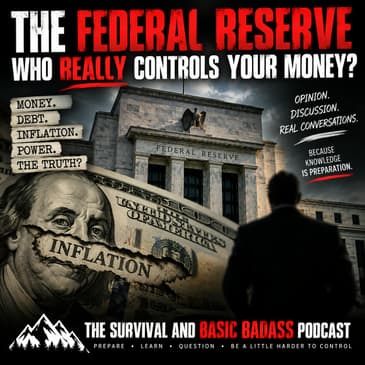
Who controls America’s money, and how much influence does the Federal Reserve have over inflation, interest rates, debt, banking, and the everyday cost of living?
In this episode of The Survival and Basic Badass Podcast, we share our opinions and personal perspectives on the Federal Reserve, the U.S. monetary system, government debt, central banking, inflation, and the declining purchasing power of the dollar.
We discuss how decisions involving interest rates and the money supply can affect mortgages, credit cards, employment, savings, retirement accounts, housing prices, and the cost of basic necessities. We also examine the relationship between government, banks, large financial institutions, and the American taxpayer.
This episode is intended as commentary, education, and entertainment. It represents the opinions of the hosts and should not be considered financial, investment, legal, or professional advice. Some subjects discussed are debated, and listeners are encouraged to research the Federal Reserve and monetary policy independently and reach their own conclusions.
Topics include:
• What the Federal Reserve does
• How money and debt are created
• Inflation and the value of the U.S. dollar
• Interest rates and the banking system
• Government spending and the national debt
• Financial preparedness and self-reliance
• Reducing personal debt and financial dependency
• Why economic resilience belongs in every preparedness plan
Preparing for disruption is not only about food, water, power, and security. Financial knowledge, manageable debt, savings, and multiple layers of resilience can also help you build a life that is harder to disrupt.
The Survival and Basic Badass Podcast covers prepping, survival, self-reliance, homesteading, off-grid living, emergency preparedness, economic uncertainty, government policy, and the uncomfortable conversations other shows avoid.
Learn more about your ad choices. Visit megaphone.fm/adchoices
[00:00:00] Academy Sports and Outdoors. Fun can't lose. Shop now.
[00:00:30] Passform. Altra versteht das einfach. Altra, stay out there.
[00:01:00] To plan your ideal trip. Inshore or offshore. Saltwater or freshwater. Book now at louisianacharterfishing.com. What are you waiting for? These fish aren't going to catch themselves. Hey, it's Chuck with the Survival and Basic Badass Podcast, and I just came from my local Academy Sports and Outdoors store. Rifle season is finally here. And Academy Sports and Outdoors store has everything to gear up for the field for less.
[00:01:28] Don't miss our Savage event, where you can score up to $100 off. Select Savage Rifles for a limited time. Plus, shop a wide selection of rifles, ammo, deer stands, game cameras, optics, and camo hunting apparel from the brands you trust. Swing by your local Academy store today. Or shopacademy.com, where we have thousands of firearms with free ship to store.
[00:01:54] Need a hunting license? Pick it up in store while you're shopping. Well, we'll see you soon at Academy Sports and Outdoors. All right. Welcome back to the Survival and Basic Badass Podcast with Kevin and Chuck.
[00:02:23] Today, we're going to talk about the Federal Reserve. And, you know, I got to say, I was kind of afraid to even approach this topic. The Federal Reserve is like a big mystery. And even the people who are most in the know about it, when you hear them talk and explain it, either it sounds like gibberish because it turns out it actually does make no sense,
[00:02:48] or they're feeding you some line of smoke where, you know, they take you in all kinds of directions. So it's kind of tough to, you know, decipher and get through. But I think we should be able to shed some light on it and open it up a little bit where people, you know, might have a better understanding. And I got to say, after I put all this research into it,
[00:03:13] I feel like voting and politicians have a lot less effect on our lives than maybe the Federal Reserve does. And we'll see. What are your thoughts, Kevin? Well, yeah, the Federal Reserve is pretty complex if you really want to get down to exactly what's going on. I don't know in half hour or 45 minutes, however long we go with the show,
[00:03:38] that we're actually going to get any deeper understanding than what you probably got from grade school. But at least we're not as unbiased as your teachers. Big pillars, right? There's a big, impressive building. Yeah, it's big. Then they're in a bunch of states. There's a bunch of them. They're all over the place. That's right. All right? Now, one of the big questions I always hear people talk about is who owns the Federal Reserve. Who does own the Federal Reserve? Well, it's not the federal government.
[00:04:08] They don't own the Federal Reserve. All right. Who does own the Federal Reserve is private banks. Now, this is from the Federal Reserve website? No. No. On the Federal Reserve website, they say nobody owns the Federal Reserve. Nobody owns the Federal Reserve. Okay. But if you own a private bank, you can own shares of it. Okay. However many shares people own, we don't know. Okay. Good to know. All right. So let's get started with a little bit of the history of the Federal Reserve. All right.
[00:04:37] You have some insight, or is that me? No. Go ahead. Oh, I get to take this on. All right. So basically, I think the whole controlling money and banker thing kind of goes back to really the Rothschilds. There was Mayor, hang on, I'm going to get it.
[00:05:01] Mayor Armshell, and then later Armshell Rothschild, who basically had a bank in Germany, and his symbol was an eagle with a red shield. And so German red shield is Rothschild. Mm-hmm. And that's where that comes from.
[00:05:22] And later, when he had five sons, his symbol has five arrows in the eagle's talon. And that's kind of where their family crest comes from, whatever. And you're saying, well, what does this guy in 1760 have to do with the Federal Reserve? Well, these guys kind of set up banking as we know it.
[00:05:46] And basically, he's really the guy who instituted fractional banking or fractional lending. Mm-hmm. And basically, we're just not smart enough to come up with something like that. This guy, now you think, well, no, I'm not corrupt enough to come up with something like that. But it turns out, the way banks work is, you know, and I know we talked about this in the economic collapse episode a little bit.
[00:06:15] But the way banks work, they end up lending out, they have 10% of the money. You go in, you put in your, you know, $100. I put in my $100. And we all put in $100. You know, you have 100 friends and $100. And then you have a lot of money in the bank. Now, then the bank goes and lends it out to other people in the form of mortgages and loans
[00:06:43] to buy cars, different things like that. Well, the thing is, it's all good because they're making interest on that money. But the problem is, if everybody came back and wanted their $100 back, they don't have the money. So, this is kind of how we get into the Federal Reserve. But basically, so we're going to get back to here in one second. But work with me. Now, I'm going to go back to the Rothschilds.
[00:07:10] So, he came up with that idea of being able to lend out, you know, money to various people and, you know, leveraging the money you have in your account. So, he ended up going around. He started with his sons loaning money to various governments. He would help finance wars, all the things that cost a lot of money.
[00:07:35] He would help put it together and set up financing for them and arrange this kind of stuff. He ended up putting his sons kind of in power in various countries all around. And they were never really politicians, although some ended up becoming politicians. But they were more at the right hand of political leaders. And they were the trusted, you know, right hand.
[00:08:00] And these guys, you know, you hear the story of the war against Napoleon, the Battle of Waterloo. And you've heard stories, I'm sure, about the Rothschilds cashing in and, you know, cleaning out the Bank of England, basically, because of that war, because they reported false news. Yeah, they reported that the Battle of Waterloo was lost. Right.
[00:08:26] And so, stocks and values dropped. And then they bought everything up. Because this is going to come into play as we get into the Federal Reserve. And it's all going to make sense in a minute. Just let me give you a little back story. Work with me. So, right. So, he had his spies on the inside. And this would be, he would be Nathan Rothschild, one of the sons. And he had his son there.
[00:08:54] And he's set up with the English Stock Exchange. And his guy came and reported back, we won the war, everything's great. Now, he got this information at about 8 o'clock the night before. The opening of the stock market where everybody found out. 8 o'clock the night before. So, everybody's watching him because they know these guys are connected and able to, you know, get the information.
[00:09:24] So, whatever he does, they want to watch and find out. So, as soon as the opening bell, this guy sells all his stocks in the Bank of England. Well, the majority of his stocks. The stocks plummet. You know, the bond notes are selling like crazy. Then, he sells even more. Even when they're really low. He's like, I don't care. I'm selling. People are like, that's it. We're sure. We got to dump everything. Then he buys everything.
[00:09:53] And he pretty much bought all of England's debt in that one day. You know, because one, he sold, got all that cash when he sold high. And then he was able to buy everything. And then he was able to buy it back when it's empty. Then the market rebounds, you know, when the information comes in later that day. Now, you might be asking yourself, well, how does he get the information before, you know, the British government does and everybody else?
[00:10:21] Well, the reason was because of the five sons strategically located around the country. They were actually trading information, secrets, you know, contraband, all kinds of stuff from the countries. But as long as the couriers had that red shield on their pouch, the governments were always told their soldiers, just let them go through because they're working with us.
[00:10:48] But the problem is they were working for both governments. They were working for everybody. So they were able to kind of slip through and get information in and out rather easily and not have the headaches of the checkpoints. So that's basically the beginnings of fractional banking. Now we kind of move into the future, into America, the Revolutionary War.
[00:11:15] There was a lot of issues with banking governments and stuff going on there. But again, I don't want to bore you because I listened to some boring crap trying to get all this information. So we could talk about a lot of things. But anyway, so what happens is we come out, our government goes through, you know, civil war. We have all these issues, various things, you know, go on.
[00:11:42] Different banks are issuing their own currency, right? Because of the gold standard, yeah, banks are issuing their own currencies. A lot of, you know, people are getting distrustful and issues. Now, this is where I was going to go earlier is, so the banks were deciding to lend out more. And if everybody came to collect on their money, they were afraid there'd be a run on the bank.
[00:12:06] And every, because once people start hearing, oh, there's no money in the bank, then they panic and they want to go get theirs before it's too late, you know? So the bankers got together and they said, you know what? We're really actually doing pretty prosperous. And the government actually has very little debt. And that was concerning to the bankers. Because when you have debt, you pay interest. Right.
[00:12:34] And that's what bankers are all about, is you paying fees and interest. So they were like, you know, we need to find a way that we can do a lot of lending and get people back in debt. I hate to say it. I know that sounds shady. But the bankers got together and this was their plan. And even if you don't want to look at it as debt, they wanted to be able to make as much money as possible for whatever reason. Whether you believe it's to kind of keep people in debt. But that's why you get into banking.
[00:13:04] So they got together. They said, all right, what happens is we need to be able so that if we lend out 90% of the bank's money, we need to make sure that we're not screwed if everybody comes back. We need some kind of security blanket. So up until this point, if there was a run on the bank or people, you know, came back for their money,
[00:13:32] the bank would be on the hook and those people would go out of business and they'd lose their personal fortune. All right. So what happens is they said, let's create a system where all the banks are tied together and we share that liability. And therefore, if there's a run on the bank, it's because the economy went bad or it's because of what else you're going to blame the system and not the bank.
[00:14:00] And so then the banker is not on the hook for him being crazy and making big fees. So now he has some kind of security blanket because the Federal Reserve. And basically, if you came in and demanded money, then the Federal Reserve can just print some more out and go, oh, there isn't any, but here you go. We got it. Don't worry about it.
[00:14:25] And it basically had a bigger pool so no one bank would end up getting destroyed. So that's the nice logic of it. And it sounds good on paper. You know, it kind of makes the system run smooth. And if it's not corrupt at that point, right. If people are all honest and looking for good things, that's, you know, where you would go. You know, that makes sense. The only thing, you are kind of courting danger.
[00:14:55] I did have a quote from Thomas Jefferson that said, you know, no one has the natural right to the trade of money lender except he who has money to lend. And that's the problem. These people are just kind of giving themselves the power. Right. And how much money does the Federal Reserve store for when they want to, when people need to take it out these banks need it? Well. Do they have like big warehouses full of cash?
[00:15:22] Well, you've seen these signs on your bank when you go the FDIC. Right. Right. Okay. So the FDIC guarantees, hang on, I have it, 70 cents to every hundred dollars of liability is what they really guarantee to the bank. And then the bank's supposed to cover that extra 30 percent. And that's why you're fully insured.
[00:15:44] So the tricky thing is they only keep 3 percent of all that they're guaranteeing. So if every bank went, because they're doing that same thing of leveraging. Right. Like, well, they're not all going to fail on the same day. So that can't happen. So they only keep 3 percent. But here's where it gets even trickier.
[00:16:07] That 3 percent, they have in government bonds, not in actual cash. Okay. So there's no actual cash. There's no actual cash being stored. And they're just holding it there ready to go as bonds. And they're just thinking, well, we'll just fire up the printing presses. And that's what it is. Now, you might ask yourself, well, so is the Federal Reserve backed by gold?
[00:16:37] Is it backed by the U.S. Treasury? No. There's nothing. It's not backed by anything. And that's where some of the magic happens. So the New York Federal Reserve has a pamphlet. And it says the currency is created by monetizing people's debts. Now, if you think about that, that doesn't mean anything. I mean, it just doesn't make sense. How is money created out of debt?
[00:17:05] Now, it's even weirder than that because the debt doesn't exist until they make the money. Mm-hmm. So, all right. Here's how you can imagine it. So you have the federal government. And they're like, you know what? We need a million dollars. I know that's a small number. And the government would never ask for just a million dollars. But hypothetically, we need a million dollars.
[00:17:32] So the Federal Reserve is going to get a million dollars of bonds printed up. They're going to print up government bonds. They're going to try and sell some of those bonds to the public. Any of those that people buy, that'll be part of that million dollars. And that would be a bond that you bought, say, $500 bond, a savings bond. Yes. That's one of those bonds. Right. But people aren't just buying $500 bonds.
[00:18:00] So then, whatever doesn't get purchased by you and me, the Federal Reserve will buy the rest. Now, so they're going to buy those bonds and print up the cash out of nowhere and hand it over to the government. And really, they'll do it digitally. The government will have it in their checkbook that'll then write the checks out to, you know, to anyone.
[00:18:26] Now, so the idea is the government has the debt. So we're going to trade by taking on the debt. The Federal Reserve is going to take on that debt and hand over the cash to the federal government. So they're trading debt for cash. So the debt is creating the cash. The cash isn't there until... It doesn't exist. Nobody's... There's no things.
[00:18:56] There's no... There's no thing. Nobody working. There's nothing. So really, a dollar represents government debt. But now, the government is going to take that and trade it to you for a product. And that then means, all right, we owe you. See, it's the debt. But it goes twice. So the dollar is, you know, backed by debt. And it's twisted and weird. It doesn't sound logical. I watched a bunch of documentaries.
[00:19:26] I bought this book, The Creature from Jekyll Island. It's a 24-hour audio book. It was freaking brutal. I tried. I tried. I was looking at that. Now, let me ask you. We all know that George Washington is on the dollar bill. George Washington is on the dollar bill. You know, what does he have to say about it? I actually have a quote here. You have a quote. Let's hear it. This is from George Washington. It said,
[00:20:10] This is the guy that's on the $1 bill. Yeah, you would think that's a little ironic. It kind of backfires on his dreams. Well, the basic logic is when government or when money comes from the government, it's distributed by the government. And then it expands the government. And it just kind of goes as this endless cycle where it's all government corruption.
[00:20:40] You know, I'd really put it this way. So, the next thing you need to know about the Federal Reserve, now that you understand that it's kind of based on nothing, but in a way it's a system that kind of works. I mean, I was always worried like, oh, you know, we can't just keep printing money because eventually there'll be too much.
[00:21:05] I guess what you have to understand is the government can get you anyway. They can get you with taxes or they can get you through inflation with printing money. I know it sounds simple, but let me break it down for you anyway just because, I don't know, I feel like I'm not giving you the full picture if I don't kind of go through it. So, imagine this. If the United States of America is really you and me and that's it.
[00:21:34] So, if we decide that we have monopoly money here and we're going to take $100 and that'll be the money for our world, the United States of America. So, we have $100, we have 10 $10 bills. Now, in our world, we have two cars, two houses, three pigs and a goat.
[00:22:02] So, a pig, you know, we decide mutually that a house is worth $30, two cars are worth $10, and, you know, the pigs and a goat are worth another $10, whatever. Now, if I'm like, well, you know what? I know where the monopoly box is. I'm going to pull out another $100. Now, you think, oh, I'm going to have the big upper hand and I'll be able to buy everything.
[00:22:31] But, you're going to say, well, wait a minute. You have all that money. I want more money for my house or my car. And, it'll even out. And, basically, you're going to charge higher prices because that paper, you know, you can keep the paper because I already have a house, two cars and a pig and a goat or whatever. When you talk to the old hippies and the grandparents and they say, in my day, milk only costs this much. In my day, you know.
[00:23:03] So, basically, you're not voting and electing the people that run the Federal Reserve. No. But, they can raise and print more money, which raises inflation. Which takes away your money. Which takes money out of your pocket without it even happening. Right. For everything you have to buy, you have to spend more money. When you saw those Pepsi machines back in the day and they said five cents on it, that wasn't to return the bottle. That was for the Pepsi. That was for the Pepsi.
[00:23:31] So, you know, that's how it worked back then. Uh-huh. And, that's the thing. So, you can have, I mean, I hate to say it, you know. I mean, you know, you've heard me talk. I love Ronald Reagan. He's the man. He saved the world. But, they were printing cash like crazy. Mm-hmm. Under Reagan. And, well, that's good because everything was going well. Well, they can balance the budget, right? They just have to print more money.
[00:23:58] So, we can have, and the sad thing is, under Bush, remember we had the big bailouts under Bush. He started it. It wasn't all Obama. Now, if nobody owns the banks, nobody owns the Federal Reserve, and the Federal Reserve doesn't have huge amounts of money in the bank accounts. How did they bail out all the bankers that own the Federal Reserve? All right. Let's talk about it. Because they took the money from you.
[00:24:30] They just printed more money? They just printed more money. So, the bankers that owned the Federal Reserve had the Federal Reserve print more money to pay the bankers that own the Federal Reserve. Now, you've gotten it. Okay. Right. But, it's a not-for-profit, right? You were just telling me that they don't... Right. They were actually interest-free loans, which is interesting because not many people get interest-free loans. Turns out, yeah. Yeah. So, bottom line.
[00:24:56] So, you have Republicans who are just printing the money and lowering taxes, or you have Democrats who are raising the taxes, and then now under Obama printing the money, too. So, they're like, fuck it. You know, we're all in. Mm-hmm. And... But it really doesn't matter which way you go because they're doing the same thing. Right. You now have more money in your pocket. It's just that everything costs more money.
[00:25:18] The way I heard it described, you know, I was listening to these economists, and they were like, well, really, we never have to charge taxes again. Because we can just keep printing money to pay for things. And then, the reply was, yeah, but we can use taxes to control which parts of the population we can take money from and give it to. Well, I have a quote from one of the Rothschilds talking about that specifically.
[00:25:48] It says, give me control of the nation's money supply, and I care not who makes the laws. Because when you vote, it doesn't matter. No. Because your taxes are going to go up, or the value of your property is going to go up, or the value of everybody else's property is going to go up. So, it doesn't matter where the money comes from. They're going to get theirs. Right. Now, here's where it gets even cooler. All right? These guys are so slick, they're always, you know, they don't miss a trick. Mm-hmm.
[00:26:16] So, what they did is, so, basically they monetize debt, right? That's what I told you. And I explained, or they print out bonds and whatever. So, the government takes that liability. So, somehow in the 80s, or late 70s, we were like, oh, these countries are going to go bankrupt. And we have a bunch of American banks that have lent them money. Mm-hmm.
[00:26:42] And if the countries go bankrupt, the American banks are going to have all these people default on their loans. If they default on their loans, even though they're FDIC insured, they're still not going to be able to make those high interest dividend payments to their shareholders. Mm-hmm. And, you know, that just really wouldn't be right. I mean, I feel like I'd be losing out. Yeah. You know? So, that doesn't sound good.
[00:27:09] So, we need to find a way to make sure other countries are backed by the Federal Reserve. Mm-hmm. And that way, we can really make sure American banks never make a bad loan. Mm-hmm. So, guess what? The Monetary Control Act, 1980. You can create funds based on foreign investments and foreign governments.
[00:27:33] So, if a foreign government comes to the Federal Reserve and says, hey, you know what would be cool if you gave us this billion dollar loan so we can build, you know, Mexico City and make it all pretty. Mm-hmm. We're like, hey, are you going to pay interest on that? Yes, I am. Sounds good. Are you going to pay us back in pesos? Sounds good. All right, because we're going to, you know what?
[00:28:01] I don't really trust the peso, but what I'm going to do is I'm going to get the U.S. government, which really means the U.S. taxpayer, to guarantee the loan. Mm-hmm. This will work out perfect. So, the U.S. taxpayer is on the hook for the Mexican government taking a billion dollar loan from you. Mm-hmm. So, if they don't pay back, they don't have to worry about a lot. They don't have to worry about it because the taxpayers are on the hook. Because we're insuring.
[00:28:31] Now, then it expands. So, the Federal Reserve is like, well, we're good, but you know what would be cooler? If we got together in New Hampshire and we put together the World Bank and the IMF. Wouldn't those be great organizations? Then we could lend to everybody. And here's what we do. You know, it wouldn't be right if the American taxpayer was on the hook for all that. Because that's just not right.
[00:29:25] Mm-hmm. They're putting in, you know, the Zimbabwe, you know, trillion dollar bill. They're putting those in. They're like, oh, we'll send this. We'll send you a couple of trillion Zimbabwe dollars and you can buy a loaf of bread with it. So, it turns out it's like 40% American dollars. And then the rest of it, you know, don't even worry. We'll just hold it in the safe. Mm-hmm. And then so we'll use whatever money people will take. Yeah. So, it's not really all America paying for it. Mm-hmm. But it is.
[00:29:56] But it is. But it is. Because nobody wants yet. So, there's a lot of that shit going on. But you know what? The real time when you make money is when you're at war. Mm-hmm. And you kind of need an enemy. You kind of need bad guys to, you know, mess with. And, you know, it doesn't even matter if we actually go to war. We just have to be afraid of war. Right. So, we have to be spending money like crazy. Because, you know, we can loan people shit all over the place. Well, we've got drones.
[00:30:26] But now Russia has drones. So, we have to have better drones. Better drones. So, you know, that's the kind of thing we get with the Federal Reserve. Let me see. I have some other good notes for you. Well, here's a quote from Henry Ford. You know, he's the Model T guy. Yeah. Hey. Dude starting Ford Company. He said, It's well enough that people of the nation do not understand our banking and monetary system. For if they did, I believe there would be a revolution before tomorrow morning.
[00:30:56] But as long as we're all confused about how the Federal Reserve works. Yeah. Then it doesn't matter. That's it. And you know what? That's the thing. So, I listen to a 24-hour audio book. Mm-hmm. And you're like, I don't know. This guy quoted. Everybody went through everything. And man, it's just overwhelming and tough to really wrap around. So, then last night, I'm looking through Netflix. There's some movie on the Federal Reserve. And it's a documentary. An hour and a half.
[00:31:25] And I kid you not, all they have is like former governor of the Federal Reserve, former chairman of the Federal Reserve, or economist, or banker. But they're all guys in the tank for the Federal Reserve. Uh-huh. And they're all like, I don't even know why you're worried about anything. Everything's great. Mm-hmm. You know, people made stupid mistakes, but we've worked that shit out since then. So, don't even worry about it. And that was it. That was for an hour and a half. Mm-hmm. And they were like, yeah, but what about this?
[00:31:55] Yeah, that was bad. Whoa. Did you see that? Yeah. We didn't do that anymore. Now, was the Federal Reserve created before or after the Great Depression? 1913. Yeah, so it was a little bit before. And they didn't get that one. No, they didn't catch that one. The, um... They said they were just trying to figure it out. No, they didn't figure it out. No, they were trying to figure it out. Still in 2008, they're still figuring it out. Well, then, there was the one guy, uh, Volker. Is that... Am I saying that right? Under... The guy appointed by, uh, Jimmy Carter. Okay.
[00:32:24] And he was awesome. Mm-hmm. And he actually reined it in. And I think we just heard, uh, me and Kevin here were checking out a Thomas Sowell video. And, uh, he was, you know, like, yeah, the reason he was great was because he undid a lot of the stuff that the Federal Reserve had done up to that point. Mm-hmm. Um, after that, you know, people always think, you know, when they think about the stock market and like that, they're like, oh, the Clinton years. Clinton years, I was killing it. You know, making 12% or something on my stocks.
[00:32:53] And everything was going great. Well, that was Alan Greenspan. Mm-hmm. Greenspan used to be like an Ayn Rand student kind of thing. Very, very conservative. And, I mean, everything I read by him, I'm like, this guy's a genius. Mm-hmm. I love him. He's great. And then now you listen to him talk and he is night and day from what he was before. Mm-hmm. And he'll say the exact same thing and be like, that's the worst thing you could do. Don't ever do it. And I'm like, what are you talking about? So, I don't know.
[00:33:22] He, so he led us through that huge prosperity under Clinton. Ah. And then he led us into that big disaster that started coming at the end of Bush. Mm-hmm. Whatever. So, and then Ben Bernanke, don't get me started. And now Pamela Yellen, not even any better. So, right now, I have you all beat up and discouraged. And you're like, is there even a way? Can there even be a money system that works? Well, there was one once.
[00:33:52] There was a money system. There was a money system that works. And I have to point out, Rome, same thing. Fractional banking, whole thing. Yeah. They did that. Okay. And guess what? That was the end. Mm-hmm. As soon as they started counterfeiting the money and shaving the money. Remember, they had the gold coins and everybody shaved off of the board. Then the government's shaving a little off. And then they're freaking, you know. Yeah, I think that was a big problem. They're doing gold plated. That was the beginning. I was listening to the history of Rome.
[00:34:20] And that was one of the big things was that he was putting in so much money, so much gold to be printed in coins. Yeah. But the guys that ran the bank got a little bit of that. Everybody got a taste. And the guys that worked, the presses got a little bit of that. So, after a while, the gold was mostly bronze and copper. Wait a minute. Yeah, exactly. Yeah. So, you know, things were getting a little shady. So, anyway, I think it was like around 760, somewhere in there, the Byzantine Empire.
[00:34:48] So, they saw what was happening in Rome, I believe. I think that's how they put it together. Mm-hmm. And they said, look, we're not going for that shit. So, if you want to handle money, you want to be a banker, you want to do any kind of business, you need to sign a pledge. And their money is called the Besset. Mm-hmm. And it was never devalued the whole time they had it, because what happened is, it was actual gold.
[00:35:18] And they said, if you shave any off, you deface it, you counterfeit it, we're cutting off your hand. Mm-hmm. Turns out, people were good with that. They were like, hey. They didn't want their hand cut off. And all of a sudden, they're taking it outside the empire, and their money really worked. Mm-hmm. And so, we just need to go back to that. You mess with the money. Based on a... And they actually did that with the U.S. federal government way back, where they said,
[00:35:43] anybody who devalues this currency will be punishable by death. Mm-hmm. And that was a good way. That held strong for a little bit. So, one of the other things, like, you know, I mentioned the IMF and the World Bank. So, the idea is, they're like, well, we don't mind lending out all this money. One, they were said, one of the guys, I don't remember the name, and it really doesn't matter.
[00:36:11] The point is, you know, this is the mindset. But, basically, as long as it's backed by the U.S. federal government, they love loaning to governments, because they never pay the debt back. They just pay interest forever. Mm-hmm. And as bankrupts throughout history, it happens over and over and over and over again. But, as they get to the point where it's too overwhelming and they can't pay it back,
[00:36:36] the Federal Reserve or the IMF or the World Bank or whoever are like, whoa, don't worry about this. This is okay. Then they go put the American taxpayer on the hook. They get the federal government to guarantee it. They charge the government a higher tax rate, a higher interest rate. Mm-hmm. And they'll refinance them with another loan that's way bigger. So, they're going to have money for a while to pay it back. Mm-hmm.
[00:37:04] So, everything will be good for a couple of years. And it doesn't matter, because now, even though it wasn't guaranteed by the U.S. taxpayer before, they got your back, so, you know what, maybe I'm going to lower that interest rate a little bit, and it's all good. Now, there's other craziness that got us in trouble early on, and I guess they said this was a big thing that led to the real estate market crash in 2008,
[00:37:31] was that they could loan, if everything is FDIC insured, or it's not really FDIC. See, there's another one. They have one for mortgages. Mm-hmm. And it has a different name, whatever, but it's insured by the federal government, your mortgages. So, bottom line, if a banker gives you a good loan, it's insured. And if they give somebody a shitty loan, it's insured.
[00:38:00] So, if, like, you don't really make that much money, I'm worried you can't pay it, you know, you kind of did some shitty things in the past, you didn't usually pay your loans. But, the cool thing here, I can charge you, with your shady past, 9% interest, whereas the nice guy with the good credit, I can charge him 3%. Mm-hmm. Well, both are guaranteed by the federal government. Can you guess which one I want to make? Mm-hmm.
[00:38:29] Because I'm going to freaking get 8.5% or 9% from you. But, bad loans are good business. Mm-hmm. Because I can make a ton more money, and I'm not going to lose. Mm-hmm. And, the bottom line, I hate to be the negative Nelly, but the government doesn't want to lose. Mm-hmm. And, that's pretty much the trick, is you've got to look out for yourself.
[00:38:55] Now, I don't want you to go get all discouraged, get all New World Order, although if you look into the World Bank and the IMF and the way they can control countries, manipulate things, they're happy to give money to dictators, because dictators just want to live fat on the hog, and then, now all of a sudden, when they have these huge loans to the World Bank, they kind of, you know, start to fall into line, and they're able to be controlled a little bit more. Mm-hmm.
[00:39:23] Um, you're thinking, oh, well, they'll just say, fuck you to the World Bank, and I'm not going to pay you back, I'm a dictator. Well, that sounds cool, except when they have 20 other countries who owe them a ton of money, and they're like, you know, if you take out that dictator over here, then, you know, then I'll help you out. So, bottom line, he who controls the money wins, you know, something like that. Mm-hmm. That's how it works out.
[00:39:50] So, you've got to look out for yourself, you've got to live the life you want to live, and you've got to just be prepared to feed your family, to take care of yourself, because if you prepare and you're not desperate, that's how the government gets you to do what they want, is when you're hungry, when you need to take care of your family, when you need to provide, so don't get caught in that desperate position, you know? Make sure you're ready, that you can take care of yourself, and you don't need things
[00:40:20] from other people. And that's what survival prepping, being a badass really is. Mm-hmm. And that's how I wanted to tie that together. I think that's really where we're coming from. That said, check us out on Facebook, preppingbadass.com. Check out our YouTube channel, and you know, if you like what you guys are hearing, either
[00:40:44] shoot us an email, give us some encouragement, maybe head over to the iTunes, leave a review, or maybe you want to go on Patreon and give us some of those worthless dollars, because you don't need them anyway. They're not even backed by anything, come on. Anyway, that said, stay safe, and we'll talk to you guys next week.
[00:41:28] Hey, it's Chuck with the Survival and Basic Badass Podcast, and I just came from my local Academy Sports and Outdoor store. Rifle season is finally here, and Academy Sports and Outdoor store has everything to gear up for the field for less. Don't miss our Savage event, where you can score up to $100 off select Savage rifles for a limited time.
[00:41:51] Plus, shop a wide selection of rifles, ammo, deer stands, game cameras, optics, and camo hunting apparel from the brands you trust. Swing by your local Academy store today, or shopacademy.com, where we have thousands of firearms with free ship to store. Need a hunting license? Pick it up in store while you're shopping. Well, we'll see you soon at Academy Sports and Outdoors.