
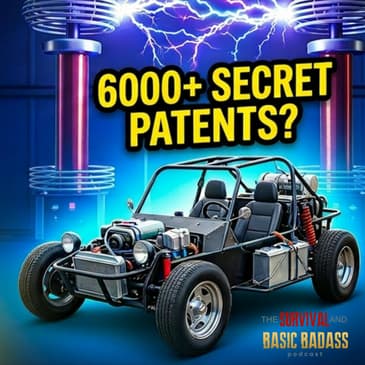
Is the government hiding free energy technology from the public?
In this episode of the Survival and Basic Badass Podcast, we investigate one of the most controversial questions in alternative energy and conspiracy history. From the 1951 Invention Secrecy Act to mysterious inventors who claimed breakthroughs in fuel efficiency, water-powered engines, and over-unity energy devices, we explore the line between national security, corporate interests, and scientific reality.
The U.S. government absolutely has the legal authority to classify inventions and suppress patents under the Invention Secrecy Act. Thousands of secrecy orders have reportedly been issued over the years — but could some involve revolutionary energy technology?
We break down the stories surrounding inventors like:
- Stanley Meyer and the Water Fuel Cell
- Tom Ogle’s vapor fuel system
- Charles Pogue’s 200 MPG carburetor
- Floyd “Sparky” Sweet and the Vacuum Triode Amplifier
- Nikola Tesla and confiscated research papers
We also examine:
- How patent secrecy orders work
- Why governments classify technology
- The Cold War origins of the Invention Secrecy Act
- Claims of suppressed “free energy” inventions
- The mysterious deaths of several inventors
- Skeptical scientific arguments against perpetual energy devices
- Whether disruptive technologies are being hidden today
Are these inventors proof that revolutionary technology is being buried… or are these stories fueled by myth, bad science, and conspiracy culture?
Decide for yourself.
🎙️ Listen to the Podcast: https://open.spotify.com/show/4YdMrZ4oWTPKv4YrcZgExg
📲 Follow Us:
🔹 https://survivalandbasicbadasspodcast.com/
🔹 Facebook: https://www.facebook.com/share/g/15wU8rw6hS/
Don't let uncertainty overwhelm you. We deliver practical tips to help you and your family navigate what is coming.
Join the email list and check out the shop @ survivalandbasicbadasspodcast.com
The Survival and Basic Badass Podcast is available on Apple, Spotify, Podurama, and wherever you find great content.
As always, this show is for entertainment. We are not to be considered doctors, financial advisors, or lawyers, and it's not legal, financial, or health advice.
#FreeEnergy #Conspiracy #StanleyMeyer #NikolaTesla #InventionSecrecyAct #SuppressedTechnology #AlternativeEnergy #GovernmentSecrets #PrepperPodcast #SurvivalPodcast #TomOgle #CharlesPogue #Tesla #HiddenHistory #EnergyCrisis
Learn more about your ad choices. Visit megaphone.fm/adchoices
[00:00:00] Planning a fishing trip shouldn't feel like a full-time job. With FishingBooker.com, you can find and book the perfect fishing trip within minutes. FishingBooker.com connects you with trusted fishing captains around the world. Booking is fast, easy, and secure, with access to verified customer reviews, loyalty rewards, and around-the-clock customer support. Everything you need to book with confidence is in one place.
[00:00:24] So head to FishingBooker.com and start planning your next fishing adventure today. Planning a fishing trip shouldn't feel like a full-time job. With FishingBooker.com, you can find and book the perfect fishing trip within minutes. FishingBooker.com connects you with trusted fishing captains around the world. Booking is fast, easy, and secure, with access to verified customer reviews, loyalty rewards, and around-the-clock customer support. Everything you need to book with confidence is in one place.
[00:00:54] So head to FishingBooker.com and start planning your next fishing adventure today.
[00:01:11] Well, let's talk about free energy. So free energy, is it possible? I mean, that's always the big thing, right? You know, you think of Tesla. We all have seen that picture of them with the big, you know, the Tesla coil.
[00:01:27] So it's like the sparks and everything, you know, flying around them, just coming out of the atmosphere. You always wonder, like, is that even possible? But, you know, Tesla was pretty, pretty credible guy, but our government, you know, we seem to pay for oil and our government's like, yeah, go with that. You just got to keep buying more oil. You know, that, that's where it all comes down to.
[00:01:51] So we're going to dig into like a lot of people's theories. I don't think this is the episode where you're going to learn how to make free energy. I'm definitely going to expose you to a lot of people who are doing it and, and could, you know, could create it. And I also think that we're going to talk about why it's not happening, right?
[00:02:14] Why it's not a public thing that we all just have free energy, or we can't just whip something up in the backyard and why that's not happening. Cause it's kind of weird. It's kind of feels, it feels very much like a conspiracy. And anytime the government is trying to oppress us or slow us down, that's what I want to dig into. You know, I feel like that's something that needs to be a wound that has to be picked at.
[00:02:42] So if that's your kind of thing, make sure you guys like subscribe, do that kind of thing. You know, it always helps out. So we appreciate it, but let's get, let's get into it. So the first thing, let's just talk about why we don't see any of these things happening, like why it always seems to not come to fruition.
[00:03:03] Well, the first answer is the 1951 government secrecy act or invention and secrecy act, right? That that's the big, right? The big thing. Um, yeah. And a lot of that involves, uh, government and military specifically military, uh, things that are used by the military that, that they don't want regular people to have yet.
[00:03:32] Some of those things were GPS. That was one of the, that was around a long time before it was available to you and me. Um, jet powered drones is another one that was invented and then just disappeared. So we even have jet powered drones now, I guess we do. And yeah, it's a thing. Oh yeah. Oh, the Reapers. Yeah. Reaper drones. I guess I was thinking like residential, like our little things, but you're right. I mean, they're yeah. Yeah.
[00:04:01] Uh, night vision was another one. It was around for a long time before it was available to people. And even before people knew about it. And that was all classified, that was all invented by regular people classified by the government and basically, you know, basically seized by the government. And it's like ours, ours. Well, and I think, right. And part of it, it was seized because of the cold war, because of those damn commies, you know, we were just so afraid of the commies. They were going to get everything.
[00:04:29] Commies, right. Um, so yeah. Invention secrecy act in 1951, uh, it was done under, uh, president Harry Truman. Uh, now basically what it entailed was they basically had covered weapons, just like you're saying, communications, nuclear technology, radar, aerospace, crypto, and basically anything with energy.
[00:04:55] Um, and again, it doesn't mean the government had to seize these patents. It meant they had the authority to, if they felt that it was relevant to national security. And Kevin, do you feel like if there's big donors to your campaign, could what's important to them be relevant to national security? Is that possible? Yeah. I mean, ask Jeffrey Epstein, bro. Like, Oh, national security. We can't let that out.
[00:05:25] Gonna get all my friends in trouble. Come on guys. Now, which one would that fall under in there? I, I'm not sure. I'm looking at the list. Um, maybe communications, maybe, maybe weapons is Epstein because what, once you expose the Epstein files, then people could weaponize and blackmail. You see, see how I tied it in there. Yeah. Yeah. I mean, if everybody knows about it, it's not blackmail anymore, right? It's only blackmail.
[00:05:55] If a couple of people know about it and I'm going to tell, I'm going to tell you better do what I want. Right. Right. That's a good point. All right. Well, let's stay on track. Okay. Um, so we had some hardcore guys like Tesla and everybody, but the government just kept snatching up things. You know, they always say like the government, the FBI went and raided, uh, the hotel room and then the offices of, uh, Tesla when he died and they snatched up all his documents.
[00:06:25] They snatched up all texts, Tesla stuff and it disappeared. And the family's like, we still haven't gotten that stuff back. Um, right. Why would the government do that or why, or who else is doing it? Like it doesn't even make sense, Kevin. Well, there's a lot of, uh, a lot of, you know, and you just mentioned that a lot of corporations that are involved in, in this sort of stuff. Um, one of the main things, one of the, one of the big ones that, that we know about now was the phobias cartel. Right.
[00:06:54] And basically an international alliance in the 1920s, uh, that conspired to artificially limit the lifespan of incandescent light bulbs to a thousand hours. Um, so that way you have to keep buying light bulbs, right? I hate my two, these new ones, they say like nine to 15 years or something. I've only lived in this house for four years and I'm telling you, I'm changing light bulbs all the freaking time.
[00:07:18] And I put in all new cause they were all like incandescent. And I moved in and I put in all led and I'm dude, I'm buying a like 12 pack of light bulbs. Like every other month. Yeah. And they used to be, it used to be the light, the incandescent bulbs were like a dollar 50. Yeah. And now you got to spend like nine, $10 for the new ones. But it's going to last forever. So it's going to last forever, but then it doesn't.
[00:07:43] Yeah. That was what, and they were advertising it way more than nine to 15 years when they first came out, they were kind of like, they're forever. They're just good. But it turns out Kevin, they're crap. I'm just saying it's just bullshit. I don't know that like, I'll probably get sued if I mentioned a specific company name, but I used to work in the appliance business.
[00:08:06] And I, uh, I had a friend who was a former, uh, you know, worker for one of these major manufacturing companies, just like you're talking about. And they would, they could tell you to the month that a motor would stop by how thin or thick the wire they would use to wrap the coils. Uh, they could actually chart out when that motor was going to die and based on what they put on there.
[00:08:34] And it's pretty crazy. Like they actually do research that kind of thing. I'm sure that everybody's morals and stuff are improving nowadays. Right. Right. They're not doing it now, but that was definitely happening in the seventies and eighties. Yeah. People aren't, I, I haven't heard of anybody acting in a greedy manner. Right. Really? That's not happening anymore. So that's cool.
[00:08:56] I wonder if our, our sarcasm falls short or if it's, I don't know. I might hit it a little bit too hard. The New Yorker in both of us is just a little too much maybe, but yeah, you know, I gotta be me. One of the, one of the big things that, uh, one of the big ways that, that corporations use to kind of suppress these things is they they'll buy the patents from the inventors. Right. I mean, I would sell.
[00:09:24] Yeah. I mean, at least the dude gets to make money and doesn't have a random heart attack, you know, that's it. You know, it's like sell it or commit suicide by shooting myself in the head twice. You always see exactly with the wrong hand, but that that's one of the, have you seen, they have like what in the movie shooter where they had the whole like device they put on them that like holds their arm there.
[00:09:46] If you want to get really elaborate, but I don't think they really investigate things that much that, you know, you could just kind of shoot them and put the gun in their hand and it's good. It's good. It's fine. Um, especially if you like leave them in their underwear or some kind of embarrassing position. Everyone's right. Can't. Nope. Don't look. Nope. He killed himself. It's obvious. Look, he's in his underwear. You think somebody would come in and, and shoot you if you weren't in your, you know, no. Yeah. So anyway, that, that kind of thing happens.
[00:10:16] One of the, there's a documentary called the lost century. If you guys are like really want to dig deep into the inventors. Uh, there's a guy, I think his name is Dr. Greer who did this and it's on free energy devices and his whole premise for the show is like, and you can see like the people doing the tests and stuff is whatever you do, just get, make it open source and make it free right away.
[00:10:42] Or somebody is going to kill you. And he's like, that's how you need to do it. And it's, there's a lot of conspiracy in all this stuff. Um, but it basically seems like, I mean, obviously big oil, right. Has an incentive to come in and stop you from, you know, dramatically reducing it. Right. If you could sell the Ford, a carburetor, that's going to get cars 200 miles to the gallon.
[00:11:13] Then obviously that's going to affect oil, right. And oil prices. It really is. I mean, there's no way around it. Right. Cause obviously things aren't motors, aren't just in cars. You could then use motors for everything else. And then, you know, that reduce the prices. So it does have a big effect. And I understand why big oil would want to buy these things up and control it.
[00:11:36] And maybe release it on their timeline. That would be okay. I get that. And them offering you money, but they're always like, Oh, they always, every single person like releases some of their stuff, but they changed the data. So nobody will say it. And like, you'll hear that over and over again in these conspiracy theories. Oh, that guy changed the data so that it wouldn't. And I hate to say it any good conspiracy theory.
[00:12:05] I feel like if I'm the government and I want to stop you, I'm going to mix a couple of crackpots in there that I can immediately disprove. And you don't have to, like, I think these guys are all real. Like they existed, but you kind of put them in the same theory as like Tesla.
[00:12:24] I don't think Tesla was faking his inventions. Right. I don't think that he was like, Hey, we could do this. And then he really couldn't. Uh, one of the big thing, uh, what is it? The, the word cliff tower. I think it was called that he was going to create right on long Island, create the big free energy.
[00:12:43] And basically JP Morgan was, you know, financing it. And when he realized that Tesla's plan was to just give it away for free. He's like, and, and, you know, there's the famous quote from JP Morgan of, well, where do you put the meter? How do you charge people for this? And he's like, no, you, it just is there. It's everywhere. The energy. And they were like, Oh, Whoa, we're not paid for that. But why would you pay for that? Right?
[00:13:12] If you're a rich big energy guy, like I understand if you're Tesla and you're like, I can create something amazing. Cool. But on the flip side, if you're the money guy and you're already making money by selling energy, why would you be like, Hey, let me shoot myself in the foot and make, so I can't make money in perpetuity forever. Why should I spend money to make no, that doesn't even make sense. Right? So I get that right now you could say,
[00:13:42] Hey, well, we could do the common good because Kevin, then we're going to have a better planet. If we're not burning oil and fossil fuels, we're going to have a cleaner environment. Everything is going to be better for everybody. And everything is going to get cheaper for everybody. If the cost of manufacturing goes way down and the pollution goes way down.
[00:14:02] Um, but Kevin, I could have a billion dollars. If I don't tell people, you know, if I stop, don't stop people from buying oil, I feel like the billion dollars is a pretty big incentive, you know, to keep you in there. Right. Uh, am I, am I wrong on this one or?
[00:14:20] Yeah. Well, I mean, just think about how many wars are fought over energy. You know what I mean? Free energy, free energy could like really end, you know, end a lot of wars, but I mean, it's not you that's dying. It's not the billionaires that are dying. Right. So anyway, the deal was that tower. It basically what he did was I I've looked into the whole
[00:14:46] stack of static electricity from air thing that Tesla had going. And basically what he did is he ended up putting like a ground rod under the tower that went like 300 feet down. So, I mean, really significant ground rod. And then, you know, you had the big tower up top. So basically you're taking the difference of potential, right? You have the static air, you know, static electricity in the air up high, and then you have
[00:15:16] the ground that's even and removed from the static down low. And you're basically combining the two. It's all way bigger than me and my brain, but you see that there is a difference in potential. I know anytime I've looked into, you know, building some of these machines, I'm a bit of a electrician myself. And, uh, you know, I know about things. And so I buy books and read and what if you
[00:15:40] do it? I was able to create an antenna and ground it and static, but we were taking such little energy out of the air. Like it was so insignificant, but you know what? It turns out my brain and Tesla's brain. I like to think we're like neck and neck, but maybe it's possible. We're not. I mean, he might have a slight edge on me. I mean, I am pretty cool, but you know, who knows?
[00:16:08] Yeah. Nikola Tesla. Uh, you know, I mean, there's a lot of inventions that he, he said that he had had the concept for, right. But never actually built. And one of those was, uh, the death ray. That was a fun one, right? Um, basically, um, it was an energy, right? Well, he had drawn out like the laser and supposedly invented, he invented like lasers, which would be the same as your death
[00:16:37] ray. Um, right. You know? Yeah. Like what else? Like what else has he got going? The earthquake machine was a big one. Yes. Now he claimed that he could build a machine that, uh, that could create earthquakes on basically on the opposite side of the earth from wherever they set it up. Okay. You know, that's so, I mean, that's yeah. Yeah. And it was basically building in oscillation, uh,
[00:17:06] oscillating energy back and forth and increasing with each, each pulse and then, you know, disrupting things so much that it actually cracked something on the other side. But, you know, these things were all, all just disappeared, right? He died and some dude showed up and just took all his papers and they were never seen again. So one of the things that I had heard about him that, that kind of like,
[00:17:32] you always hear about like the war between Tesla and Edison, right. And AC and DC and, and the whole thing. Right. Um, it all makes sense, right? Like I get it, but you want to hate one guy and, and like the other, you know, everybody chooses sides with that. And obviously a lot of people go with Tesla. He had fun, cool things that I, you know, I like Tesla. Right. But on the flip side
[00:17:59] of like Edison, if you actually know how to bring things to market, that's kind of cool. Like people argue that Edison didn't invent everything that, you know, he gets credit for, but he brought it to market and made it happen. Right. Like he got these things done. Like he paid for it or utilized, he recognized talent, he funded, you know, things to happen and he invented things on his own. Don't get me wrong. Right. I'm just saying he wasn't like nonstop. Well, he was, but he may, he was by
[00:18:29] years in my standard nonstop in better, but he produced even more than his mind produced is what I'm saying. And that's in a good way and a positive, you know, compliment. Um, the weird going around and electrocuting animals to show you that, um, Edison or Tesla was dumb. That's kind of weird. And you do get a bad taste from that one. Um, yeah. Electrocuting elephants. You can see how that
[00:18:58] could be tainted in a bad light, but basically painted in a bad light, whatever Edison, um, brought, got things done and brought things actually to the public where they said, you know, talking, I've heard people's, uh, friends and stuff say, uh, with Tesla, he would invent something.
[00:19:22] But as soon as it worked in his mind, he wouldn't bother finishing it. Cause he was too busy. He was like, Oh, I figured that out and just kept going. And he would have like lab assistants that maybe could go and finish it. And sometimes they didn't. So there were a lot of things that he could see in his mind and he's like, all right, but I'm moving on to something else. Cause that I already see how that works. It's not important. And you understand how you could get that way. If you're nonstop in
[00:19:49] better guy, you know, I'm just saying, um, yeah. And I mean, he was, he was so brilliant though. You see that a lot of the time, a lot of times where somebody's incredibly smart and brilliant and it just kind of makes them go insane, you know? And he was right on the edge of that, that insanity for a long time. I always think that's my problem. Like that's why I'm like right there, you know, I'm just so smart that it's just, yeah,
[00:20:16] it could go a little bit. But there's, I mean, there's also a lot of people that, that invested a lot of time and effort discrediting Tesla, um, because of those things like, like Edison, you know? So that's the thing. So I think one of the thing is there are a lot of guys and I'm not saying which guys are crackpots and which guys are not. I don't think Tesla was a crackpot. I think that guy was freaking genius who changed our world. All right. Like,
[00:20:44] I mean, he absolutely came out with so many things that affected us in a positive way. And I think there is so much that the government took and I would love to get that information and find out, you know, what's going on with, you know, what secrets did they steal and, and stop. And I, it disgusts me that our government would do that kind of thing. And I understand military
[00:21:08] secrets, but also the development of the world. We could be so much further ahead. That was, if you watch, I had mentioned this documentary, the lost century, they started out. I almost wanted to turn it off because it was nonstop, like global warming for like 10 minutes, right? They're talking about the planet and I have no problem, whatever. I mean, I'm, you know, you can affect the planet and do bad things, but that wasn't the documentary I wanted to watch, right? I wanted to watch a documentary
[00:21:37] about, about a free energy. And they're just telling me about global warming. And the argument is why would a government be so against global warming, but then do everything to stop us from using fossil fuels? Right. Yeah. Everything to keep us using fossil fuels, stop us from eliminating fossil fuels. Right.
[00:22:02] So it doesn't make any sense. And that's, that's the big argument is why would the government do this? And I hate to say, I really feel like it does all come down and agreed, but let's, uh, let's kind of go through. I know a lot of people, when they think free energy, they want to learn about, you know, Stanley Meyer and the car that ran on water and things like that. Let's kind of go through some of these guys. I feel like at least half of them are true. And I mean, I believe these guys, like I said,
[00:22:31] are out there, but I don't know that these things really make sense to me. But again, turns out I'm not the smartest guy in the world and it's possible there are things out there that I don't understand or, or know completely. Right. So the first thing, the first guy who always comes up is, well, Tesla always is the first guy who comes up. I think when you think free energy,
[00:22:57] I think that picture of him with the Tesla coil just, you know, is amazing. Um, but Charles Pogue in the 1930s created a, uh, carburetor that basically he said it vaporized gas before combustion. And they argued that he could get 200 to 220 miles per gallon out of a vehicle.
[00:23:23] And he published a study. And then of course somebody broke in and stole everything. So he wasn't able now, couldn't he rebuild it? You know, couldn't he, I don't want, right. If you built it once, like, Oh, you came in and you stole all my notes. It only worked with my notes, you know, like that, that I don't really buy, you know? Um, but I mean, it doesn't seem that somebody did
[00:23:47] break in and Oh, absolutely. Yeah. But was it him like what, like, and, and these, these questions and concerns can come up with like anybody, anybody we're talking about. Right. Um, that that's my whole point is, is, you know, well, what's the real truth? We don't know. And that's kind of the beauty of a conspiracy is people can, you know, can mess with you like that. You don't know, you know,
[00:24:17] I'm trying to find the right guy here. All right. So he was a Canadian too. So right there, that makes me question everything. Um, he took a V eight Ford and, you know, supposedly got 200 miles to the gallon. Um, but so here's where it falls apart in my head. I understand carburetors. I
[00:24:41] understand combustion engines and, you know, to just say, well, it's cause it vaporized it before combustion. Think of fuel injectors. I mean, they really are turning it into a mist. You know what I'm saying? Like it's not right. What do you do? I mean, I think even more, the big difference, right. Is that, is that it's actually atomized, right? Yes. You say atomized when we say, you know,
[00:25:09] or vaporized, but it's really a mist, you know, and it's not, it's not actual gas that you're, that you're running, you know? Right. And, and that's still, yeah. So it just, I don't know. It's funny. Cause I have this, uh, there's a new Edelbrock carburetor that I have in the Ford in the F 100 I got, and it does, it gets like 16 miles to the gallon, which is pretty good for an F
[00:25:34] F 100. I got to say, you know, for a 1970, you know, beat it too. People are like, Oh, it's better than my Ram. You know, that, so just say, you know, there's, I think my Ram, sometimes I'm getting like 16 now, but a lot of times I'm getting 14 too, you know? So anyway, that said it, and I drive the F 100, like a bat out of hell, you know, cause it's like Duke's a hazard,
[00:25:59] you know, you get in there and it just, it's exciting. Right. In my mind. And so anyway, so it's supposedly this Edelbrock carburetor, they, they advertise it. It atomizes the, the stuff instead of the old. And again, it's turning it into a mist. It's not really atomizing it, but I don't know. So maybe he had some secret that I don't understand. Right. So that's definitely
[00:26:23] possible. And, you know, basically it just, it doesn't add up. Why aren't people recreating it? And then the argument is, well, people are recreating it, you know, now he supposedly died in 1985 of natural causes and old age, no evidence of assassination with him. Okay. However, does that,
[00:26:49] I don't know. Why didn't he recreate it after his lab got broken into? It just scared him and intimidated him. You know, I don't really know what the truth is. So the next one that comes to mind is Tom Ogle. Right. Right. And Tom Ogle, this is 1970s Texas guy. So a lot more believable. Right. Right. So I'm going to give him some credit. Um, he, and again, he toned it back. Hey,
[00:27:19] my engine only gets me a hundred miles per gallon. Right. But a hundred miles per gallon out of a Ford galaxy, Ford galaxy. And I don't know if you know, but a Ford galaxy is a freaking boat. Yeah. It's a 5,000 pound car is, is what I, I looked it up. It's serious. Yeah. Yeah. My buddy had one and we used to race and he'd be like, you get the galaxy. And I'm like, yeah, thanks. I think it had a Chevy
[00:27:46] 350 in it at the time, but you know, cause you know, why wouldn't you put a Chevy engine? Then you get the most of both best of both worlds, right? It looks good and it runs. So, you know, you know, how Fords were racist. Everybody, everybody knows that the Ford bodies are the ones that hold up. And every Ford I see on the street around me is, is half rust, but yeah, but you live in the rust belt.
[00:28:10] So, you know, it's, it's, that's how it is. Um, but anyway, he basically, and, and here's the thing, the same, the same argument though. He basically, there was something about, he had a lawnmower and it got a hole in the fuel tank and he put a vacuum line from the fuel tank over to the carburetor just to like, so when it evaporated, it didn't waste the emissions. And all of a sudden it
[00:28:35] dramatically started getting better fuel economy. Well, all right. For you to notice that, that it's better. I feel like I got to go twice as far easily. Right. Like there has to be a hundred percent. Something that notice. Right. Right. Cause I wouldn't notice if I got, if my, my lawnmower started going, you know, I could cut two thirds of the lawn instead of half the lawn. Right. I don't think I'd even notice that. Like I wouldn't go home. Right. I see what I did there. Right.
[00:29:05] I feel like there's gotta be dramatic improvement and I gotta say reintroducing the gas is not really gonna do that in my mind. It's not gonna, but again, I don't know everything and I don't know his secrets. Right. So I understand why people would be skeptical. That's all I'm saying. I'm not saying it's a lie. I'm not saying he's wrong. I'm saying, I understand why people would be skeptical.
[00:29:34] Um, but he had that vapor fuel system where it, again, it's basically you're loading it in instead of liquid. So it's ready to burn. Right. And that's really where the hydrogen, you know, going in an engine it's, it's going in as a vapor and, and just ready to burn, you know, that's nice. But anyway, uh, major oil interests were ready to buy them out, offering them tons of money. He did demonstrations
[00:30:00] and showed journalists and, you know, and he ran that car. I, I believe people saw him run that galaxy for their extra gas tanks and they, you know, went over everything. So it wasn't, so it wasn't. If it was, if it was a con, it was a really good one. Right. Now I will say that NASCAR would always inspect, uh, Oh, what the heck is the guy's name? Anyway, uh, Smokey Unic there's,
[00:30:29] there's this guy, he was a legend in NASCAR and he was always doing the modifications to whatever. And his trick was he expanded the fuel line to like a half inch instead of three eights. And he added like another 10 feet of fuel line. It was in the line and the tank looked good. They were like, well, we can't find anything. So the big joke was that NASCAR did their inspection
[00:30:58] and they're like, we can't find it. They had emptied the gas tank. And so they fill it, you know, to check for displacement. Right. And they're like, yeah, we can't find anything wrong with it. It looks right. And he's like, and they were like, but we're still going to disqualify you for this other stuff. And then he's like, you know what? Fuck you guys. And he gets in and he drives the car away with the empty gas tank and drives home. And they're like, but you,
[00:31:25] and they were like, that's a problem. So I'm just saying you should look at, he's a funny guy, but I'm just saying there are ways to be secret and sneaky. You just, you know, who knows? Right. I feel like I could fool a reporter if you can fool NASCAR techs. Right. Right. That's again, I'm not knocking the guy. This, this ogle guy probably, you know, had something awesome and I just don't understand it, but I'm just saying it's possible to see why somebody would say, well,
[00:31:54] yeah, but until it was, you know, really documented, we don't know. Now the weird thing though, Tom Ogle, 1981 dies at 24 years old, a suicide overdose involving Darvon and alcohol, but he wasn't known to be a drinker or known to do drugs just mysteriously that day. One day just loaded up.
[00:32:21] So again, that adds to that. There's gotta be something fishy going on. Um, Stanley Meyer, that's the one you guys have seen the water fuel car where he had that big, like dune buggy thing that he took to all the car shows or whatever and, and ran his car on water. Um, he was a big one. Uh, the dune buggy could run primarily, primarily on water that was separated into hydrogen and oxygen
[00:32:49] using resonance. His demonstrations were legendary and everybody, you know, seemed to go for it. Now they did say that in, in Ohio court, he was found guilty of gross and egregious fraud related to investors. Now to investors, I don't know if what that means exactly. I mean, I know what those words
[00:33:17] mean. I just don't know what they're getting at. Did he defraud them? Like, Hey, if you guys each give me a hundred thousand, I'll give you a share of this car that I'm going to bring to, you know, to the market. And he just kept the money. That doesn't mean he lied about the water vapor. Right. Right. But it does sound suspicious. So, um, they said a system violated energy conservation laws.
[00:33:44] I don't even know what that means. Um, so that's something to look into. Uh, he died in 1998 after collapsing at a restaurant. He went to have a meeting with investors. Is that right? And he was, and he's the one that came in and was like, they poisoned me. Right. Right. Outside the restaurant, ran it, you know, talk to his, told his brother, he poisoned, he was poisoned. Ambulance came,
[00:34:12] they took him to the hospital. It was like, yeah, he had a heart attack. Yeah. You know? So, you know, Hey, and then the, uh, the coroner was like, uh, well, no, that was a brain aneurysm. And, but you know, that's kind of a, but you know, it turns out there's no other evidence other than people seeing him say that they poisoned them, but they're like, we don't know that he said that for
[00:34:37] real. Cause only a couple of people saw it and, you know, so, and, and that's how you decide if something's, you know, all right. Now there's this other guy, Floyd sweet. Uh, they call them a sparky Floyd sweet who made a vacuum triode amplifier. Now this is crazy. He had this little box that was like five inches. Like, I don't know. I'm looking at my road microphone box, something
[00:35:07] like that. Like it's like five inches by like three inches by an inch. And he could just plug everything into it. Now the video that you see, I was going to show it. I was like, yeah, I could grab that video and put it on there. But basically he's got the box with some wires going to a bigger box sitting on a work bench. And honestly, you could run a power cord up to the work bench.
[00:35:33] Like it doesn't even like, there's nothing. You don't see everything. It's not like, you know, on a table in the middle of the room where you can see everything. This is like really could be easily faked. And he like plugs in like 10 light bulbs and he's like, look, they all come on. And I'm like, I could rig that up because he's even got it plugged into a box with receptacles and he plugs in all the lights. And I'm like, yeah, but you could just have an extension cord out of that box
[00:36:02] going down the back that we can't see, you know, but whatever. Anyway, he was supposedly the man. Um, if his stuff worked, he's a freaking rock star, but I don't know. Right. Um, he also had some weird like anti-gravity stuff going on, but he, again, he had no independently verified stuff. Uh, basically, you know, people are like, yeah, yeah, he kind of made it up. So you just
[00:36:30] don't know that was in like 1995 or he died in 95 natural causes, um, declining health. You know, they were like slipping them some arsenic in his two. Yeah. A little bit of arsenic every day. And yep. Yeah. Um, if you want to get into more things, there was like a Joseph Papp, uh, made a, a gas
[00:36:53] engine that, you know, could, uh, do pretty good. However, when he was showing it to people, it ended up exploding and killing people. So that one is a little, uh, if you want to look into a Eugene Malov had a cold fusion, uh, there, there was a cool movie with, uh, Keanu Reeves, I think I wanted to go back and watch that for the episode about cold fusion and they were going to, you know, save
[00:37:20] the world and it was going to be great, but let's kind of circle back. Like why would anybody freaking try and stop this stuff? Right. I mean, that's really what it comes down to. Uh, you know, the government has done a lot of shady things in the past. So you guys might remember, uh, Edward Snowden, uh, that wasn't in America's best interest, all the stuff they're doing. Why do they do it? I don't
[00:37:47] know. They do it for greed, right? They do it for money. 2008 financial crisis, right? They bailed out all those banks. Was that really in the best interest of the American people? I mean, it was the, in the best interest of the banks, right? Like the, Oh, the banks would have gone under and right. That's how the free market's supposed to work. You know, you know, if you're shitting at your job, yeah. Then you go out of business and somebody else that's better takes over.
[00:38:15] You know, if you want to sell my mortgage for pennies on the dollar, I might buy it back. I would be that guy, you know, cause they're, they're having a big bankruptcy sale. You know, I don't know. I'm just saying, putting that out there, Kevin, I don't know. So the bottom line is I absolutely think there are patents out there that can do amazing things. Uh,
[00:38:38] this stuff is given to like DARPA and stuff. And you know, that's the defense stuff going on there. But why are we not seeing cooler things unless right? Why has my iPhone not gotten better for the past 10 years? Like it's the same guy. That was dude. Everybody at work was like, Chuck, you're still rocking an iPhone five. And they were like, you gotta get a new one,
[00:39:04] whatever. So no joke. Right. I go and I get an iPhone 13. Obviously this is like two years back or maybe three years back whenever iPhone 13 was the new one. Right. And I go and I get it. And I'm like, it's the exact same dude. It like surfs the same. And there's not like the camera's the same. Yeah. Everything. I didn't notice the camera to be any better. I didn't. And, and I'm sure it was right. Like whatever. Right. But the camera, but as far as
[00:39:34] surfing the internet and your service didn't do a thing for me. And I'm like, it's the exact same. And the answer I got from everybody was, well, what did you think? Well, well, I think I just spent $1,200 on a new goddamn phone. It is the same as the old one. It's the exact same. And it's funny. One of my kids, uh, they were like, I think iPhone six was
[00:39:58] like the cutoff where it wouldn't take the new, the new upgrade, which I have to point out is kind of bullshit because that was the whole thing with switching to Apple over windows. They were like, Oh, we make it so that things don't become outdated because the software just keeps going. Now, obviously it's going to be, they're going to have things that go faster, but we're still going to support your old. That was the argument, right? Turns out that was total bullshit. And they were like,
[00:40:28] Oh, the iPhone six, we're going to, you know, make that so that you don't get updates. But again, I don't get updates. So like, do I, it's been working with the version that it has, for no problem. Why do I need it? Yeah. Kevin, just try and stress me out. That's what I'm telling you. All I'm saying is that the Ford model T got 22 miles to the gallon and the average Ford vehicle
[00:40:55] now gets 21 miles to the gallon. Kevin, do you think there's a slight difference in weight and comfort and accessories and things? I'm just saying, it seems like we're spending a lot of time and a lot of innovation is happening and shit. Isn't really fucking changing. Kevin, the model T was like half wood. I think it did not have an air conditioner or a CD player. I'll tell you that.
[00:41:21] There you go. It did not come with serious, serious XM radio anyway. So don't forget to like and subscribe. We really appreciate you guys. And I think we have some new exciting things coming up. So make sure you're looking out for it. So with that, I say, stay safe and we will talk to you guys next week.
[00:42:52] I feel like a lot of time. Plötzlich fühle ich mich so entspannt. Hol dir dein Geld zurück. Tiefenentspannt mit Visu Steuer.